The Newton Project, created under Rob Iliffe and Scott Mandelbrot, is a site that collects, as well as publishes, the conglomeration of all of Sir Isaac Newton’s work since 2008. From the very writings that led him to his scientific fame to the religious and philosophical papers that were left unpublished, it is The Newton Project’s goal to uncover the incredible mind of Isaac Newton for all to see through translations and transcriptions.
The Newton Project Welcome Page
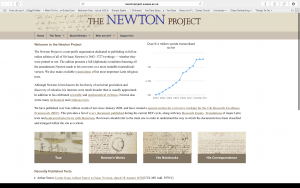
Alongside the publishing of all of Newton’s written works, The Newton Project accomplishes in providing biographical information in regards to Newton’s lifetime, significant moments of his history,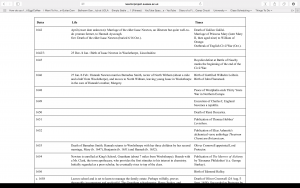 and even his perceived personality to the controversies that he instigated. Through this, the audience who peruse the site can not only just see t
he translated writings of Newton, but also gain a context in how these ideas were formulated.
Sources
The sources of the site were manuscript sources of all of Sir Isaac Newton’s written work, which have been gathered from private donors to a variety of libraries to the Cambridge University Press, all in which help the non-profit site. Many of these written pieces were Newton’s notebooks, correspondences, and even his religious interpretations of the bible.
Processes
In order to create the massive collection, all the sources were transcripted onto a web format from a hand-written entry, then cataloged with tags for a search engine, and putting them into a chronological table as well as an alphabetical list. Furthermore, each work is categorized into the four main subjects that Newton covered (Alchemical, Mathematical, Religious and Scientific). The texts are sorted by date to give a chronological timeline as to when the works were created and published by Newton, and documenting the metadata and source for each text. Lastly, Newton’s Latin religious writings have also been translated into modern English.
Presentations
The viewing of Newton’s works is provided in three different “settings,” such as “normalized text,” “diplomatic text” to “manuscript images.” All these viewings give the audience the opportunity to have a transcripted writings that can be highlighted or copy and pasted on a web-device that a JPEG image could not provide, yet still give the audience the option to see the original copy of Newton’s work prior to transcription. The search engine gives the audience the chance to also utilize tagging devices to improve their search more effectively and efficiently. The audience can be seen on a variety of levels from intermediate browsers to researchers of the historical field as well as those interested in the principles that Newton provide in the most original form.