When examining one of the projects posted on Brain Pickings, “Mapping the Republic of Letters” (http://republicofletters.stanford.edu/index.html ), the visualization of a social network of an influential people became more clear. This philosophical and historical project uses the database of the Republic of Letters and creates a visualization of the social network. Its structure resembles the Kindred Britain project, because both are social network analysis, however the layout varies. The Stanford University Humanities center created this project; through the interpretation and visualization of individual case studies, the overall network is not revealed. But rather, a clearer image of different parts of the whole Republic of Letters intellectual community is revealed. The sources used to create the project are not clearly stated. The Brain Pickings article mentions that data is pulled from the Electronic Enlightenment database. It is important to note that the project does not display or contain the actual letters, but only the connections between the intellectuals that the letters reveal. Clusters of social networks are revealed through the letters.
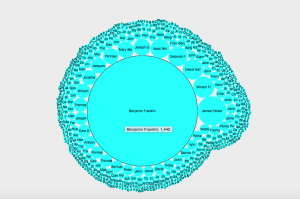
The processes of the project take individual case studies and give a brief description of that intellectual’s correspondence. When clicking on a visualization button, the network of letters of that person appears. Various other charts are shown to represent the timeframe and location of origin of the letters. The visualizations help a viewer imagine the social network of the individuals in a clearer manner. Each case study has different visualizations to represent the location and time of the letters and correspondence. Nothing content related is mentioned.
The Humanities and Design Research Lab at Stanford created the project. Their presentation is somewhat confusing. Not all the connections can be seen at once; each is organized within a case study and can only be viewed when looking at one case study. A detailed narrative panorama is the home page. A video introduction gives some background information, while the contributors are not mentioned directly on the page. Linked through a “related” section, the lab’s website can be accessed to find more information about the contributors.
Overall, the projects website was relatively difficult to navigate and inconsistent within what information was available. The visualizations were not clear and since they were different for each individual, the comparison was difficult to make. The fact that the researchers were not immediately credited and that there was no about page or tab made the information of the social analysis much more difficult to understand as a student looking for information.