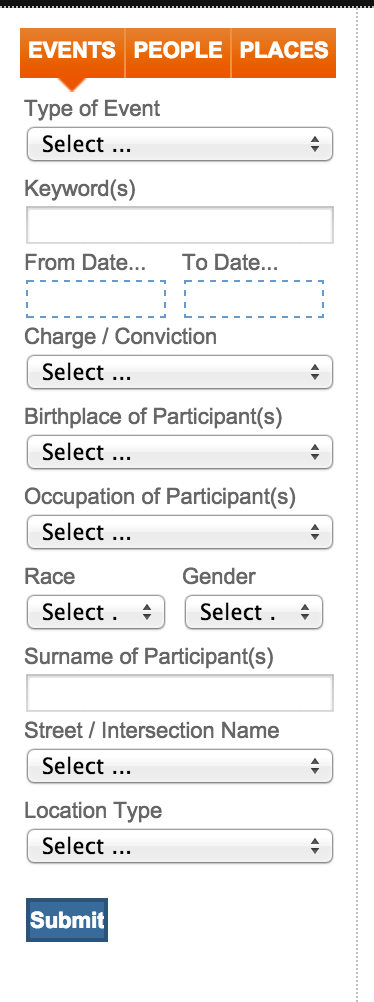
For this week’s assignment, I chose to look at the Digital Harlem site which presents information about the everyday life in New York City’s Harlem neighborhood in 1915-1930 using information from archival and published sources. The interactive map allows the user to search for events, people or places, and then allows the user to click on items found on the map and learn more information about that item specifically.
What kinds of assumptions, and whose point of view, does the map reflect?
The map assumes, or at least makes the user assume, that the site is focused on the black community in Harlem and that the black community plays a significant role in this area. This is assumed because at the top of the map, there’s the option to see the border of black settlement in the years 1920, 1925, and 1930. I think the map is most useful for those who are familiar with the area or know people who lived, or live, in Harlem because the map allows the user to search for specific names, even convictions.

What does the map reveal and what does it obscure?
The map focuses on ordinary African New Yorkers and reveals information about the crimes committed by these ordinary citizens through legal records. The map attempts to reveal “reveal all manner of things that would not ordinarily be labelled ‘criminal’– streetlife, black language, music, family life – as well as evidence of the role of gambling, violence and confidence men in the black community”. However, the About section also says that the project does not focus on black artists and the black middle class, which are large, important portions of the community. Thus the map obscures the idea of the area and what it attempts to reveal because it focuses on a smaller portion of the community. The map also doesn’t explain the context of the crimes committed.
Imagine and describe an alternate map.
An alternate map could include newspaper articles and pictures of the people, places, and events being searched. It would also be interesting to see a map of Harlem today to be able to compare.