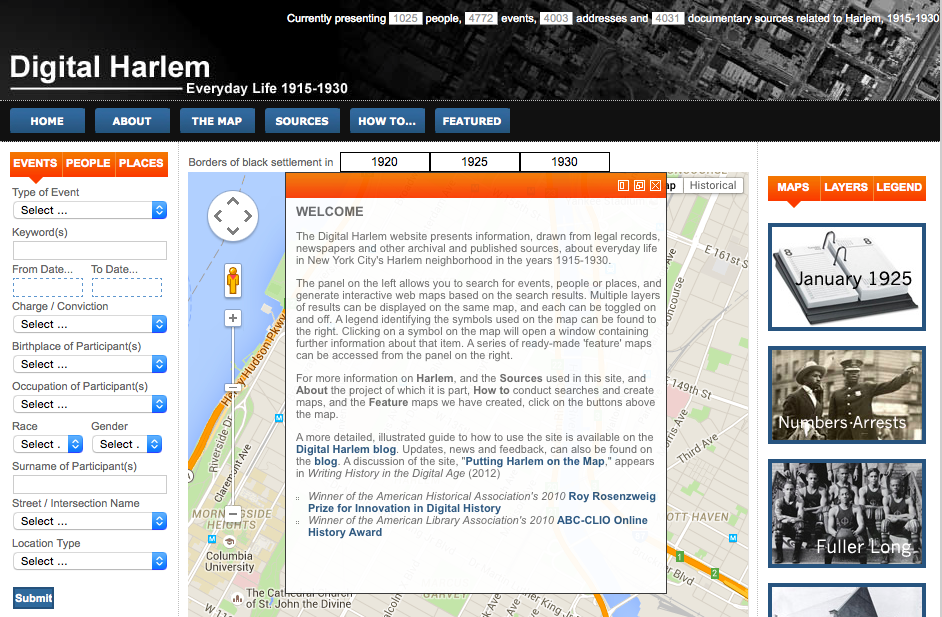
The purpose of the Digital Harlem project is to essentially provide a record of New York Harlem region’s everyday life between 1915 and 1930. The data is compiled and organized so that it can be searched by Events, Places, and People. It looks like all of the data comes from the DA’s office, which certainly gives the data a focus on criminal activities.Using a map as a visualization for this project is an excellent choice because it successfully incorporates all important aspects of the project and presents them in a most comprehensible and appealing fashion. Despite that there is a drop-search for types of events, types of locations, and occupations, the emphasis on keyword search filters suggest that the site is meant to be used by someone who knows exactly what they’re looking for. Once you input a search item, the site allows you to create a layer to which you can assign a name. This is very useful as it color codes the various types of data you’re searching for, and allows you to see interactions, which would not be visible if you had to reload the map for every new search. Once you click on an icon on the map, an information window pops up above, detailing the metadata that has to do with that particular item. That metadata is especially useful because it provides information not only about that particular item, but also about other items related, and that’s what helps the viewer connect the dots and make a story.
Because the project utilizes a current version of Google maps, it proves to be not only useful to a modern scholar or the general public, but it also opens another opportunity for interpreting the data. Considering that the primary sources from which data were drawn, it is apparent that the project supports the well-established perspective of Harlem by focusing on the African-American population and on crimes. As we argued in class, it seems that this project is another example of confirmation of the history we already “know” as reported by popularly accepted sources. If I were to do this project differently, I could use the advantage of laying out my information on a current Google maps in order to explore how the urban culture of 1920s harlem compares to the culture of today. For example, we could see a certain block used to be largely occupied by barber shops, today that area might be largely occupied by fashion stores. This information would reveal interesting insights about the commercial culture of Harlem then and now.