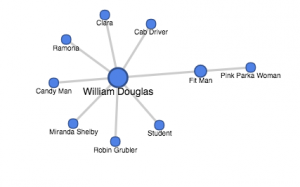
I chose to create a network graph of “Her Lousy Shoes” by Tracy O’Neill. The narrator, William Douglas, describes his unhappy marriage to his wife, Miranda Shelby. William, a professor, recounts his experiences around the holidays and his general discontentment with his life. The entire short story is told from William’s perspective. The reader understands all of William’s inner thoughts and the nature of his relationships, through his interpretation.
Since the perspective is third person limited, the reader contextualizes all of the relationships around William. We do not get any insight into the interactions or relationships between the other characters. In this short story, there is mention of William’s sister and Miranda having a close relationship. However, since William narrates the story, the reader is not made aware of the nature of this relationship.
In my network graph, the edges represent conversations between characters. The narrator, William Douglas, speaks with a handful of characters throughout the story. However, he does not recount any conversations that other characters had that he was not included in. Therefore, William is the most connected character in this network graph. He has a high degree of centrality as well as a high betweenness centrality. He connects the most number of people to each other. William also has a high closeness centrality, since he’s connected with the most number of people, he can communicate quickly to all of them.
The edges represent any two characters that have spoken to each other. They are non-directional. This is a large reason why the network graph is so small and centered around William. Since the narrative is told in third person limited, it is mostly William who converses with all of the other characters. This factor not only skews the network graph, but also the reader’s perception of the other characters. It appears that William is the link between everyone, when in fact, it only seems this way because his conversations are the only ones documented in the story.
The perspective is a large limitation on the network graph. It radically changes the reader’s interpretation of William as a character. If a person were to view only this network graph and not read the story, they would assume that William is a highly social character who interacts with lots of people. However, this is not necessarily true. From the characterization of William in the short story, he is relatively introverted and does not interact with many people, unless he is forced to. In this way, the network graph provides an inaccurate representation of the short story.
It is interesting to see how different one can perceive a character when viewing a network graph versus reading a short story about the same character. The network graph is often very reductive and does not provide an accurate representation of the characters and their relationships.