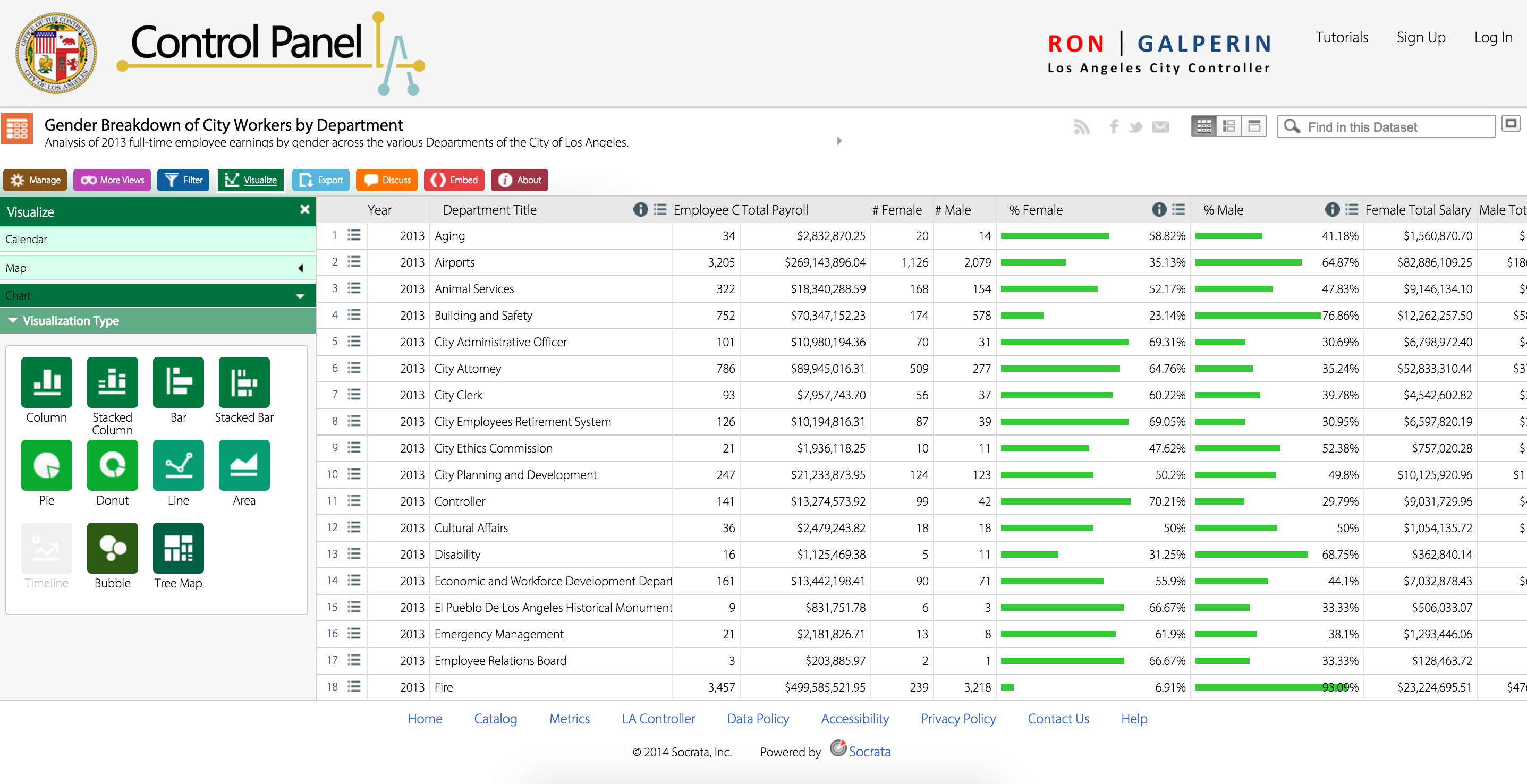
For this week, I chose to look at The Gender Breakdown of City Workers by Department , a dataset provided by the LA Controller’s Office which analyzes the full-time employee earnings of 2013. The dataset looks specifically at earnings by gender across different departments of the City of Los Angeles. The data is presented as a table, breaking down categories such as the department, number of employees, total payroll, and number of female and male worker, but also provided the view other visualizations options (different types of graphs) to allow for comparing different variables with one another.
The content type of this dataset includes the year, department, number of employees, total payroll, number of female/male workers, percentage of female/male workers, female/male total salary, female/male average salary, and percentage of payroll to females/males. The dataset contains 41 rows—41 records constituted by a particular City of Los Angeles department’s individual values for each data type.
Ontologies, as defined by Wallack and Srinivasan, are “systems of categories and their interrelations by which groups order and manage information about the people, places, things, and events around them.” Therefore, in this particular dataset, there are multiple (distinct?) ontological categories such as economic i.e. anything pertaining to payroll figures, as well as social i.e. anything pertaining to gender demographics. The dataset also contains categories labeled by the LA Controller’s Office themselves, such as “women,” “wage gap,” “employees,” etc. This ontology seems to make the most sense to activists in women’s rights and equality, gender studies students and scholars, and policymakers whose platforms advocate for gender equality. This ontology could serve as quantifiable, statistical evidence of gender inequality in the work place in terms of wage gaps and “the glass ceiling.”
The dataset shows that for the payroll year of 2013, female employees for the City of Los Angeles tended to earn lower salaries than that of their male counterparts across multiple departments. For example, within the City Attorney’s department, the average female salary was $103,798, which is significantly lower when compared to the average male salary of $133,977. Additionally, the wage gaps inciting higher male earners are larger than the wage gaps that incite higher female earners. Overall, the dataset supports the notion of gender inequality in the workplace in terms of wage gaps, suggesting the presence of institutionalized discrimination. Furthermore, although the dataset does an amazing job in providing numbers and information across the board, what could have been included in the dataset are the seniority levels of the workers e.g. the number of females and males in managerial positions or entry-level positions. This would have allowed the dataset to make the notion of “the glass ceiling” more quantifiable. That being said, if I were to redo this dataset, I would probably have included ontologies such as education level, seniority level, and salaries in order to further investigate the notion that higher degrees earn more money.