Course blog

Week 6: Text Analysis

I did not realize how text analysis could help discover more about the actual subject and perhaps help form an argument or additional conclusion about the text. Reading about Andrew Smith’s commentary on the Criminal Intent Project and the text analysis of all the Old Bailey court cases from 1674 to 1913. They analyzed 198,000 trials. Researchers found that beginning in 1825 there was an unusual peak in the number of guilty pleas and short trials, whereas before 1825 most of the trials were full trials in which people did not plea guilty. Researchers also found that the number of men defendants started to outweigh the number of women defendants. These findings helped to advance the understandings of the Old Bailey court cases and helped to gain more insight on the changes in the history of court cases in London.

Until I was exposed to text analysis in Digital Humanities and did a little more research on the background of text analysis tools like Voyant I did not realize how helpful of a tool it is. Reading about some background information, I learned that Voyant credits some of its textual analysis skills towards Google because like many other search engines Google focuses on search and retrieval of text content. It also references how Google sets a “standard for simplicity in interface” when browsing the default search page. Now compare the default search page of Voyant to Google and how the Voyant search page includes one box to begin text analysis. I recognized that Voyant and Google are similar in the aspect of simplicity because of the inclusion of a single search box. I did not think of Google, something I use everyday, as a type of text analysis. Learning more about the process of analyzing text and how it can lead to retrieving new texts or formulating new arguments has been useful for my DH project research. Text analysis is something I hope to use more of throughout my research projects.

http://docs.voyant-tools.org/context/background/
Food Web

In “Demystifying Networks”, Scott Weingart explains the basics of networks along with the conceptual issues that go along with them. First he begins with a couple of warnings that one may encounter when network analysis is used in various projects. His first warning is that networks shouldn’t be used on all projects even though networks have the potential to used on all projects. We might be eager to try using networks in our digital humanities projects as we learn more about them but we should give our projects more thought and think about other tools we can use to better suit our needs. Weingart’s second warning is that “methodology appropriation is dangerous”. Here, he explains that theoretical and philosophical caveats get lost once methodologies get translated. Borrowing methodologies can be even more dangerous because we will lack the full understanding to use and apply them properly.

Next, Weingart goes into the basics of networks. He explains that a network is a “complex, interlocking system. Stuff and relationships”. The “stuff” is basically anything that exists — a subject — for example, books. He calls an assortment of stuff as “nodes” and relationships in a network as “edges”. When Weingart explains what networks are I began to think about a food web. I did a quick search and found an interesting image of a network of different foods.

flavour-network


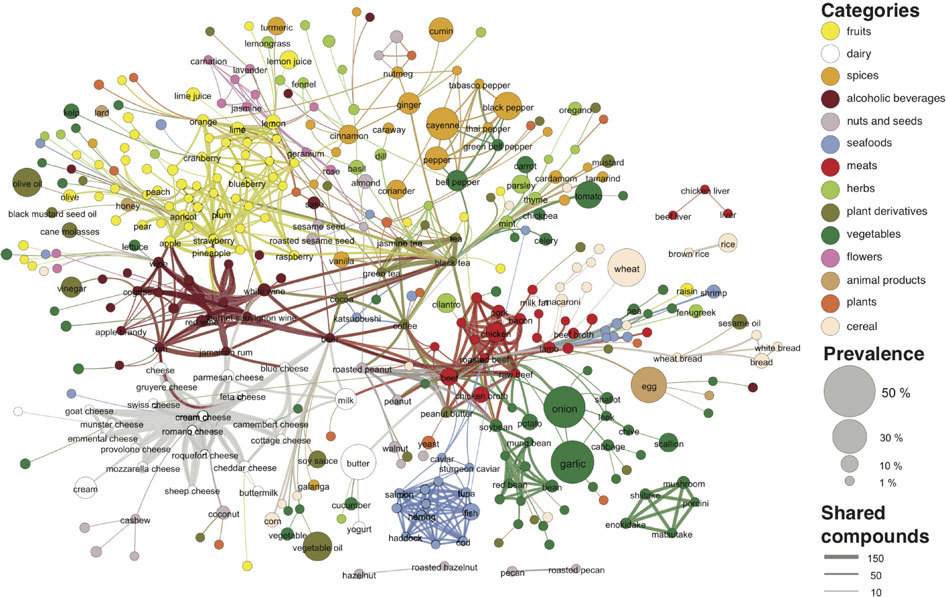
In this example, the author takes the food-paring hypothesis, which states that ingredients work together in a dish if they share similar molecular compounds, and endeavors to create a flavor network. So in this specific example, the relationship in the network or “edges” are the shared flavor compounds. For example, shrimp and parmesan are connected because they contain the same flavor compound 1-penten-3-ol. The “nodes” here are obviously the different kinds of foods or ingredients. The size of each node reflects how often that specific ingredient is used in recipes. Moreover, the thickness of the line shows the relative number of shared flavor compounds. The different colors in the image represent the different food categories such as fruits, dairies, meats, herbs, etc. I thought this was such a great example of a network and the complexities that go along with it. The data visualization that the creator used to portray all the information is particularly interesting because it lets us view data in multiple ways without actually reading it. A network like this would be especially useful for chefs or anyone who is interested in cooking and would like to know the relationships between ingredients and if they would mix well with one another.

Week 6- Networks and Transportation

In the Scott Weingart article “Demystifying Networks,” he breaks down the the origins and uses of Networks, specifically illuminating them in a digital humanities setting.  In the introduction, he starts basic stating that networks are things which show connections between “stuff.”  This stuff is given the more formal term of “node” to denote that it is a spot between relationships.  These nodes can be “bi-modal” or “mulit-modal” meaning that there are more than one type of node in a system.  The relationships which connect the nodes are referred to in this article as “edges.”  These edges can be “directed edges” or “un-directed edges.” Directed edges mean that the relationship can only go in one direction, the order of the nodes is causal and cannot be reversed.

With this basic understanding of network relationships, I started thinking about examples of networks in daily life.  Initially, I got stuck on the idea of the internet, perhaps the ultimate network.  At work last week, I heard two of my colleges go over an analogy for the inner workings of internet that I had not heard before, or perhaps it just didn’t stick with me.  They were discussing the analogy of the internet as a highway: the cars moving being the data communicated and the physical infrastructure being the “metaphorical highway.” This concept really stuck with me: why is it easier to understand a network through an analogy rather than its actually process? Why transportation networks?

LondonUndergroundMap

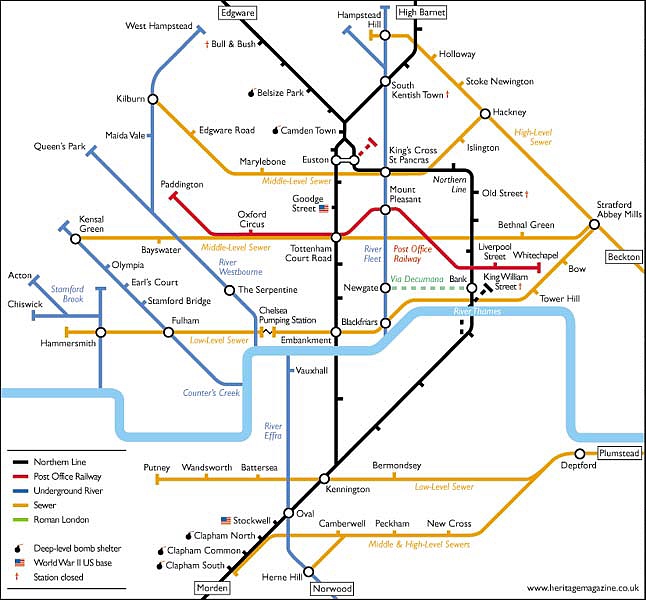
A quick google brought me to an image of the London subway which with its stops and lines, looked very much like the network examples given in the Weingart article.  The circles represent nodes and the lines each represent an “undirected edge.” This example made me realize that networks are things which are encountered constantly in modern daily life: much of infrastructure (invisible or invisible) is organized through the system of  network.  This familiarity is perhaps what makes it such a good model for understanding more complex or conceptual networks.

In thinking about digital networks, I am still stuck on the idea of visualization.  As made clear in the Weingart article, networks are held, in common conception, as complicated entities especially in the context of large data sets. Weingart explains the need to often cut down on the data visualization, to make a graph “sparse” instead of “dense.”  This perhaps answers my earlier question, maybe we need to simplify our understanding of networks such as the internet, in order to actually conceive the basics of the network.  Maybe the purpose of the network is to not understand it in “full” so to speak, but to understand the system to the point where it can be used? What is the purpose of a network visualization? To what point “should” one trim data to make a point?


Finding Paul Revere

Kieran Healy’s article on finding Paul Revere with metadata was very interesting. Aside from the clever point of view of a Royal Security Administration analyst, Healy had some very interesting points to make about metadata. Basically, using only information tracing individual membership to multiple “terrorist” groups, Healy could make some really interesting and useful insights deeper into the data. Initially, the author is able to convert the table from People vs. Groups to a People vs. People table – Healy does this by multiplying the matrix (table 1) by its flipped self (transpose of table 1). This simple equation allows the author to quickly manipulate the data and to start drawing relations between different people that it might otherwise have taken quite a bit of time to discover manually. Regardless, Healy is left with links between people as they are members of the same rebel group. This works in the same way but with the multiplying matrices equation flipped. In this particular case, the author was left with a table of Groups vs. Groups, elucidating how many members each set of groups shared in common. In either case, some quick and easy data visualizations make it obvious quite quickly which groups and/or people were at the heart of the rebel colonial cause.

I believe this case study has some interesting applications in situations where your metadata collection is limited for some reason. In this case, Healy had only the information on group membership to work with, and was able to tease out some very useful relationships (which were there all along but one would probably not have picked up on without the manipulation and data visualizations). For instance, in archaeology our data sets are often limited to information like what types of objects we find and where we find them. Since we study the distant past, it is very unusual to have more information, for instance the name of the artisan who made the item, or who it belonged to. However, Healy’s methods seem to have good applicability in these cases. If for instance we could put together a spreadsheet of pottery types vs. their find locations across a large region, nation -state, or even area like the Eastern Mediterranean, then perhaps we could begin to tease out some central nodes in the data. These nodes may then correspond with production centers, and could help us to understand trade or redistribution patterns in pottery.

Week 5: Networks + Linkedin

I really enjoyed learning about networks from Scott Weingart’s post, “Demystifying Networks”. It made me realize how common networks are in today’s digital world, and also how often they are utilized by websites we commonly visit. One of the social sites I thought about while reading was Linkedin.

Linkedin is very much a literal representation of how networks work. It’s a site that lets you connect with other professionals who are in the same career field as you or career fields that interest you. Based on the people you know, Linkedin will also provide recommendations for you to connect with individuals it thinks belong in your “social circle”, as you might say. One of my fellow classmates discussed the idea of “six degrees of separation”, which means that it means you are connected to someone in some way through 6 other people. Linkedin is a somewhat good example of that. If you don’t know someone, you’ll often see that you know someone that does.

Linkedin used to have a data visualization feature that allowed you to see how you connect with those around you. Unfortunately, it no longer supports it. Personally, I wish they still kept it because it’s a very visual representation of your professional network, and it’s represented in an interesting way.

The photo above is an example of what the feature used to be able to show you when you wanted to see what your network looked like. It would use “edges” to connect you from your name to the person you were connected with. The color of the edges determined how you knew that person. Whether it be through the “social media” field or others. This person, obviously, has a huge number of connections, which can be seen here in their networks. And though this particular individual’s networks are extremely complex, it just shows how interconnected we are.

I believe the reason Linkedin stopped this feature is because it really wasn’t a central point to their site. Weingart touches upon this subject in his article, that “networks” should not necessarily be used for everything. To him, they’re used far too often and for the wrong reasons. That’s true, and I understand this feature wasn’t ultimately Linkedin’s priority. They may have thought of it as something that looks pretty, but serves no purpose. Personally, I think it’s just a nice additional feature to have on the site, but I understand why they wouldn’t want to waste their money or time maintaining that feature for their users.

Source: Scott Weingart, “Demystifying Networks

Linkedin.com


Week 6: Twitter Network Analysis

In his blog post, Scott Weingart offers his explanation of how a network works. He gets down to the fundamental basics of what makes a network and simplifies them into terms even people with little-to-no background in math can understand. He acknowledges the flexibility of the network as a tool, which can be applicable to any data studied within network analysis. However he warns that the network tool should not be abused and should be selectively used. He also warns that the appropriation of data, especially when it comes to that of humanities scholars who are, “often dealing with the interactions of many types of things, and so the algorithms developed for traditional network studies are insufficient for the networks we often have.”

Weingart breaks down the components of any network to ultimately be simply “stuff and relationships.” These components are interdependent and their connection cannot exist without each other. He then performs a run-through of a very simple network formation starting with books as nodes before connecting their variety of attributes to form relationships, or edges.

After reading Weingart’s post, I came across an impressive, preliminary study on Twitter’s billion-scale network conducted by Masaru Watanabe and Toyotaro Suzumura of Tokyo Institute of Technology. While reading through their process and concluding results, I was delightfully surprised at how I was at least able to identify key terms in their comprehensive study after reading Weingart’s explanation. This made it a lot easier to approach Watanabe and Suzumura’s study which I found to also be fairly straightforward in general. The process of their study however is far from straightforward and seems highly complex considering the amount of data they collected among 469 million users between the months of July to October 2012. They categorized the data, which included follower-friend information, into two formats, XML and CSV and also utilized the analysis tool, Apache Hadoop and later HyperANF to compute the degree of separation.

Inspired by a Facebook network analysis study conducted by Lars Backstrom who managed to compute a degree of separation using graph analysis tool, HyperANF and resulted in a surprisingly low number of 4.74. The network structure of Facebook is more friend-based that resembles the way human relationships work in the real world, while a social graph like Twitter is based more on interests and differs from Facebook due to its directed graph. Directed graphs allow everyone to follow someone freely while an undirected graph like Facebook requires approval. Considering that Facebook and Twitter have a different network structure, Watanabe and Suzumura analyzed Twitter’s network in an attempt to compute a degree of separation and diameter. Interestingly, both degree of separation  and diameter are used to measure networks in terms of scale and graph. Degree of separation is found by the average value of the shortest-path length of all pairs of users while the diameter is given through the maximum value. For the data collected within July to October 2012, the analysts concluded in a degree of separation of 4.59 in the Twitter network. After reading a simplified explanation of what makes a network and its analysis, it was interesting to see this applied to a large-scale network like Twitter.

http://www2013.wwwconference.org/companion/p531.pdf

Week 6: Simplifying Networks

While reading “Demystifying Networks,” I kept wondering how spreadsheets for my final project would fit into the structures that the author was talking about. My data has nodes, but instead of one article of “stuff” per node, I had multiple. For example, in my category of “ingredients,” I have many different foods, and I was afraid that my situation is what the author is describing as difficult to translate into a network. “Once you get to three of more varieties of nodes, most algorithms used in network analysis simply do not work; most algorithms were only created to deal with networks with one variety of node.” If I understood correctly, my spreadsheets contain more than one variety of stuff per node. I scrolled down to the comments, and I found someone with a similar problem to mine – figuring out how to translate my complex data into a network visualization, that is. The author’s response was that although this type of data was possible to visualize through some kind of algorithm, it wasn’t the best way to go about solving this problem. Instead, the author suggested multiple ways of visualizing the data, because one method would not be enough. This is kind of what I was already doing to solve my problem – I had created a word cloud, and the data that the word cloud had narrowed down for me could be something that I plug into a new spreadsheet and visualization. “An option might be to represent each node type individually in a separate representation,” the author suggested, in order to easily translate spreadsheet into something visually readable. Then, these individual representations could be combined to see a bigger picture. Although I wish I could visualize something like the image I attached below of the Flavor Network, the process is too complicated for me to translate into a spreadsheet that visualization programs can read. It also might result in too much data in the visualization, because although the Flavor Network looks interesting and connected and color coordinated, there are a lot of connections that are too small to be interpreted, and therefore that data is lost.

srep00196-f2

Arranged Marriages Using Networks

As Stephen Ross describes in his essay “Demystifying Networks” networks are a “net-like arrangement of threads and wires” later to stand for an interlocking system aka stuff and relationships. Something that I can speak on behalf of is the concept of arranged marriages. Now my reader is seeing the word arranged marriages from an individualistic societal perspective. I beg that they don’t. Arranged marriages are a reflection of a collectivistic culture and to say that it is backwards or “not right” is insulting and dehumanizing an indentity. Moving forward, the way that arranged marriages operate is essentially through a network. For example, you feel like you’re at the right age to get married. Your mother and father will spread the word through their friends that you want to settle down. They will spread the news through a network. Each friend of your parents’ also has a network which the news will spread through. And so on.

Now you could be satisfied to marry someone so far along networks that you can’t really see how you found each other, but that isn’t the point. What you really strive for in this process is someone from a network you relate to, can vouch for the family. So you would want to marry into a family preferably from your aunt’s network, because presumably your aunt is a trusted source. Your parents would be the centrality as they decided that your aunt is an important part of the network to give responsibility to. So the concept of arranged marriages is entirely based off of networks.

I came to this idea of arranged marriages as a network after watching this commercial someone had sent to me over Facebook.

Just as a post note, there are different types of ways to approach arranged marriages. It’s not an oppressive way to trap women. (Though we are in modern times, I would be an idiot to not recognize that forced marriages do occur still.) The arranged marriage that I am describing in my post is a typical Pakistani manner of an arranged marriage in which both prospects have the freedom to say no, yes, etc.

Week 6: Networks and Social Networks

For week 6, I particularly enjoyed the reading about Demystifying Networks. In this blog entry, Scott Weingart laid the groundwork for understanding networks.  Although I had an idea of networks before reading this article, there were definitely some elements of networks that I didn’t really understand, so just ignored.  The detailed post explained each level of the network.

Scott explains that a network is made up of stuff and really any stuff.  Each item of stuff is referred to as a node. These nodes are then divided into different types of nodes. For example titles of books and authors of books would be two different types of nodes.  The relationships between these nodes are referred to as edges.  He explains that a key to these edges functioning properly is that edges can only connect two different types of nodes and not nodes of the same type.  There are also two different types of edges that can connect the nodes.  A directed edge describes the kind of edge, with which you cannot swap out Node 1 and Node 2. The other kind, unsurprisingly, is an undirected edge.  With an undirected edge, Node 1 and Node 2 can be interchanged and are connected with a simple line.

When I think of networks, I immediately think of social networks. As a “millennial” our lives are completely intertwined with social networks.  Most of our interactions are even through social networks like Facebook or twitter.  After reading this article, I tried to relate it to what I believe is the most notable social network: Facebook.  It was easy for me to identify that people were the nodes, so in Facebook terms, each profile would be considered a node.

I determined that although Facebook is a vast and complicated network.  In the terms that I had just learned, I could only make sense of Facebook as a unimodal network. If Facebook mainly just contains simple connections between one type of node, each friendship would be considered an edge.  Because there is so much more that goes into Facebook, I was confused that there were not more types of edges, and that I couldn’t see it as a multimodal network. I thought of the different groups that were made on Facebook and how that could be displayed visually without being confused for friendships.

I can see how people on Facebook, if not connected by friendships, could each be connected to the groups they belong to, in a multimodal network. This would form a very interesting web, but only be illustrating the group aspect of Facebook, and disregarding the friendship aspect.  Overall, I am excited to have made progress understanding networks, and although I believe I could make interesting specific networks relating to real life, there are still many things I don’t understand about the networks I interact with in daily life.

Facebook

Week 6: Networks and Friendship Paradox

I started this week’s readings off with Kieran Healy’s post, “Using Metadata to find Paul Revere”. His research into the analysis of personal metadata got me thinking of what constitutes a breach of privacy and when does a governing entity go too far in looking through our personal lives in the name of security. However, I won’t dedicate my post to any alarmist ideas or writings on the need to respect privacy any more than I already have, instead I will write about an interesting aspect of social networks that I heard about a while ago, the friendship paradox.

I originally heard about this as a short story that made it onto the daily news; it does not really have much to do with cutting edge news, but nevertheless it caught my attention. The idea behind the friendship paradox is that, on average, a person has fewer friends than their friends have. This tallying of friends is most easily done on social networking sites where there are friend lists available to immediately quantify the number of social network friends in one’s life. It is fairly easy to log onto social media sites and take a quick look to see if this is true; some of my Facebook friends have over one thousand friends each, easily outstripping me, my Instagram follows are much lower than those of the people who follow me, and a general look over Twitter shows that most people follow at least one celebrity or relatively famous account that can have thousands or even millions more followers than their own. There is actually an article available on JSTOR from the American Journal of Sociology that is dedicated to this phenomenon if you’re interested in reading more about it! If you don’t want to spend quite as much time there is a helpful Wikipedia article that presents the paradox more succinctly and seems reliable (as far as I can tell).

The friendship paradox is loosely related to our foray into network analysis, and could provide interesting data if analyzed in the same way Healy conducted his research or in other ways of analyzing networks. For example, with a sampling of one’s friends from a social media site it is possible to see if there are any other correlational elements that connect the friends with more friends to each other. Perhaps there is a relation between “popularity” on social media sites with frequent posting of statues or photos, or maybe serial posting has the opposite effect and reduces the number of friends. There may even be a specific personality type that attracts more friends that could become apparent when examining their “likes” on Facebook or hashtag patterns on other social medias.