In the Scott Weingart article “Demystifying Networks,” he breaks down the the origins and uses of Networks, specifically illuminating them in a digital humanities setting. In the introduction, he starts basic stating that networks are things which show connections between “stuff.” This stuff is given the more formal term of “node” to denote that it is a spot between relationships. These nodes can be “bi-modal” or “mulit-modal” meaning that there are more than one type of node in a system. The relationships which connect the nodes are referred to in this article as “edges.” These edges can be “directed edges” or “un-directed edges.” Directed edges mean that the relationship can only go in one direction, the order of the nodes is causal and cannot be reversed.
With this basic understanding of network relationships, I started thinking about examples of networks in daily life. Initially, I got stuck on the idea of the internet, perhaps the ultimate network. At work last week, I heard two of my colleges go over an analogy for the inner workings of internet that I had not heard before, or perhaps it just didn’t stick with me. They were discussing the analogy of the internet as a highway: the cars moving being the data communicated and the physical infrastructure being the “metaphorical highway.” This concept really stuck with me: why is it easier to understand a network through an analogy rather than its actually process? Why transportation networks?
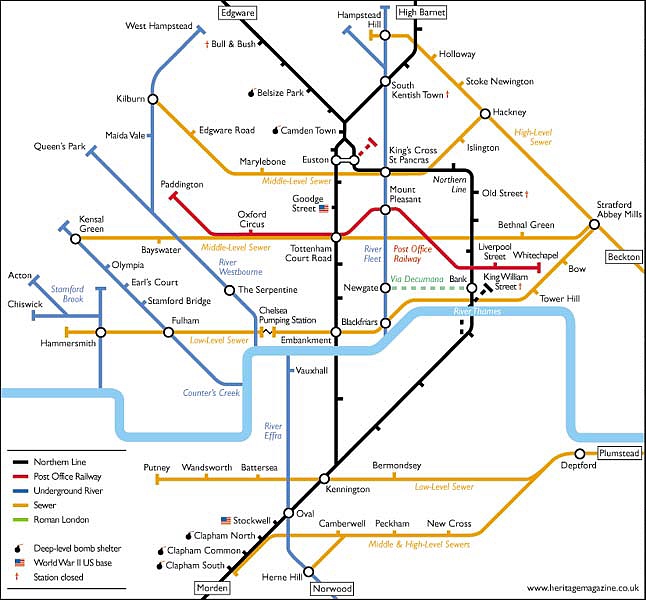
A quick google brought me to an image of the London subway which with its stops and lines, looked very much like the network examples given in the Weingart article. The circles represent nodes and the lines each represent an “undirected edge.” This example made me realize that networks are things which are encountered constantly in modern daily life: much of infrastructure (invisible or invisible) is organized through the system of network. This familiarity is perhaps what makes it such a good model for understanding more complex or conceptual networks.
In thinking about digital networks, I am still stuck on the idea of visualization. As made clear in the Weingart article, networks are held, in common conception, as complicated entities especially in the context of large data sets. Weingart explains the need to often cut down on the data visualization, to make a graph “sparse” instead of “dense.” This perhaps answers my earlier question, maybe we need to simplify our understanding of networks such as the internet, in order to actually conceive the basics of the network. Maybe the purpose of the network is to not understand it in “full” so to speak, but to understand the system to the point where it can be used? What is the purpose of a network visualization? To what point “should” one trim data to make a point?