In “Demystifying Networks”, Scott Weingart explains the basics of networks along with the conceptual issues that go along with them. First he begins with a couple of warnings that one may encounter when network analysis is used in various projects. His first warning is that networks shouldn’t be used on all projects even though networks have the potential to used on all projects. We might be eager to try using networks in our digital humanities projects as we learn more about them but we should give our projects more thought and think about other tools we can use to better suit our needs. Weingart’s second warning is that “methodology appropriation is dangerous”. Here, he explains that theoretical and philosophical caveats get lost once methodologies get translated. Borrowing methodologies can be even more dangerous because we will lack the full understanding to use and apply them properly.
Next, Weingart goes into the basics of networks. He explains that a network is a “complex, interlocking system. Stuff and relationships”. The “stuff” is basically anything that exists — a subject — for example, books. He calls an assortment of stuff as “nodes” and relationships in a network as “edges”. When Weingart explains what networks are I began to think about a food web. I did a quick search and found an interesting image of a network of different foods.
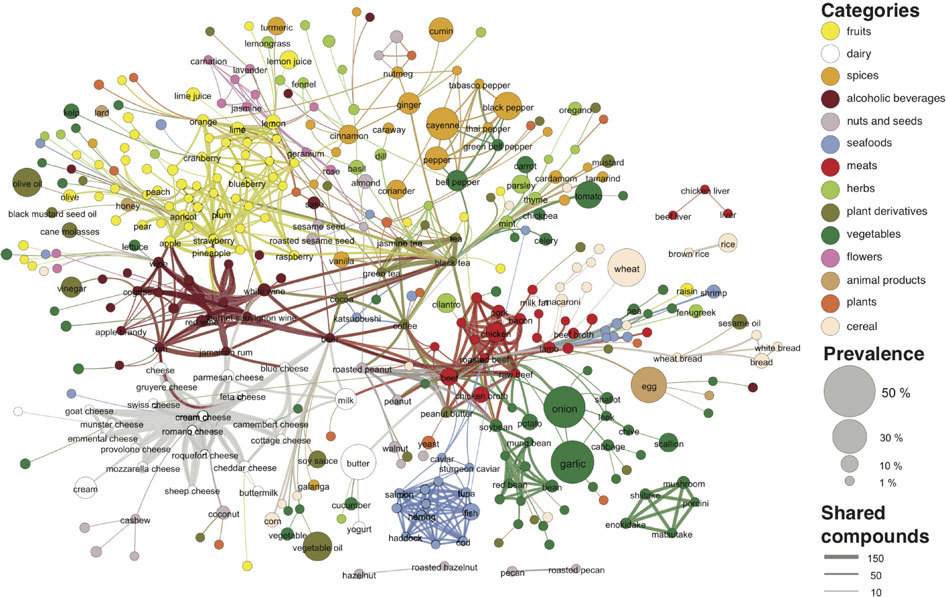
In this example, the author takes the food-paring hypothesis, which states that ingredients work together in a dish if they share similar molecular compounds, and endeavors to create a flavor network. So in this specific example, the relationship in the network or “edges” are the shared flavor compounds. For example, shrimp and parmesan are connected because they contain the same flavor compound 1-penten-3-ol. The “nodes” here are obviously the different kinds of foods or ingredients. The size of each node reflects how often that specific ingredient is used in recipes. Moreover, the thickness of the line shows the relative number of shared flavor compounds. The different colors in the image represent the different food categories such as fruits, dairies, meats, herbs, etc. I thought this was such a great example of a network and the complexities that go along with it. The data visualization that the creator used to portray all the information is particularly interesting because it lets us view data in multiple ways without actually reading it. A network like this would be especially useful for chefs or anyone who is interested in cooking and would like to know the relationships between ingredients and if they would mix well with one another.