Learning By Building

Whenever I get into a conversation with someone about classes, and I mention that I’m taking an introductory course on digital humanities, he or she always asks, “What is digital humanities?” It seems like most students have never heard of digital humanities as a field, and it’s understandable because it is a rather new discipline, especially in a university setting where dominant majors and minors have been set in place for a long time. I only heard of digital humanities through a friend who minored in it and recommended that I take the introductory class to see if it was something I’d be interested in. Seeing that digital humanities is a growing field, I can see why there are a lot of discussions about  whether it can be a solid and teachable field like chemistry, psychology, or history.

In “Introduction: Theory and the Virtues of Digital Humanities”, Natalia Cecire writes about the controversy that the field has to face as many people still have doubts and negative opinions about digital humanities being a new discipline. Cecire provides a quote from Geoffrey Rockwell that states that digital humanities “is undertheorized [in] the way any craft field that developed to share knowledge that can’t be adequately captured in discourse is. It is undertheorized the way carpentry or computer science are.” Ramsay elaborated that digital humanities is characterized by a “move from reading to making”, which makes the field “nondiscursive”. Digital humanities is not a normal field when compared to other disciplines that have gone through the test of time and the production of knowledge. Basically, almost all other disciplines have some sort of structure and universal way that they can be taught in a school setting through textbooks and other collections of knowledge. However, digital humanities is different because there is no step-by-step way it can be taught and there is no basis or foundation of collection of knowledge like the other disciplines.  Much of the learning is experiential; there is shift from reading to making. Cecire compares digital humanities to “hacking”, and I thought it was an interesting comparison because Cecire describes a hacker as someone who looks at data and “learns about them from making or doing”. This changed the way I viewed digital humanities as a field, and I understood why this DH 101 class revolves around a final project — it is about learning by doing.

http://www.adelinekoh.org/blog/2012/05/21/more-hack-less-yack-modularity-theory-and-habitus-in-the-digital-humanities/


I stumbled on an article titled “More Hack, Less Yack?” In it, the author declares that practitioners of digital humanities should be more concerned about building and getting things done than to get into problematic discussions about the discipline of digital humanities. I think this is exactly what we should do, and I’m glad that we are focusing on our projects to really experience the new and exciting field of digital humanities.


Digital Fetishism?


In “So the Colors Cover the Wires: Interface, Aesthetics, and Usability”, Matthew Kirschenbaum mentions how our desktop views  in laptop and/or computer systems are “oddly unlovely, dull and listless”. I find this interesting because technology seems to be advancing at a rapid rate, so we can see the many changes that go into interface design, especially with computer systems and also cellular “smart-phone” devices. One personal example would be my experience with Windows XP. With this interface design, all you had was a desktop with a background and various icons, a start button, and some utility icons on the bottom right. Compared to contemporary interface designs, Windows XP seems too flat and boring. There were ways to customize your home interface screen by downloading different interfaces online, but for the most part, the theme remained the same. You can also change your background wallpaper, but that was pretty much it for customization. The look for this interface remained for a long, long time until Windows 8 came out. With Windows 8, we can definitely see a drastic shift in design. Your homepage is no longer the desktop screen but a colorful arrangement of tiles and icons that display the top files or the most useful applications. Here, we can tell that Windows focused much more on the artistic design of the interface, perhaps to appeal to the touchpad or tablet device market.

Windows-7-vs-Windows-8-slim_thumb

I bring this up because, in his essay Kirschenbaum quotes a passage from Nathaniel Hawthorne’s “The Artist of the Beautiful”. In this passage, we read about how a tiny, mechanical butterfly flutters forth from a jewel box. Hawthorne describes this butterfly in such a life-like, real, and beautiful way that it seems like the butterfly was not man-made. This butterfly seemed more than real; it had some sort of character that was spiritual, perfect, and captivating: “‘Wherefore ask who created it, so it be beautiful?’ … ‘it may well be said to possess life, for it has absorbed my own being into itself; and in the secret of that butterfly, and in its beauty … is represented the intellect, the imagination, the sensibility, the soul of an Artist of the Beautiful!” The artist’s creation is a reflection of his soul, an energy or an aura that pulls the interactor into the artist’s sense of being in way where our being emerges with the creation. I thought that this was fascinating because I can see a pattern these days especially where people become attached to their phones  (ex. Iphones) in peculiar ways. Without their cell phones, they feel naked and lost. It’s as if their phones are an extension of themselves or at least carry a part of them. Whatever it is, there is definitely some sort of technological or digital fetishism that is occurring these days.

Google Maps Mashups

In “The Introduction to Web Mapping”, Jim Detwiler provides a history of web mapping,  how it evolved throughout the years, and  also provides details of each category of web maps. By doing so, Detwiler’s ultimate goal is to teach others how to build mapping mashups which initiated once Google took advantage of the new technology Ajax in order to launch Google Maps. It was really interesting to read about how Google Maps came about because it is such a popular and useful tool that is integrated into the most widely used search engine. Through Google Maps, hackers were then able to figure out how to layer other useful information on top of the maps. This practice, which Detwiler calls “mashup”, caused an explosion of custom mapping applications. This knowledge sparked my curiosity as I wondered about all the different possibilities and ideas that can go into using maps to serve various services and not just to use them to figure out where to go.

If you visit http://taxiwiz.com/?lang=en, you can figure out how much a taxi ride is going to cost by plotting your route from “A” to “B”. I thought that this was really cool because transportation is a big issue these days especially in big cities like Los Angeles, New York, and San Francisco. Moreover, there are many smartphone apps that you can use to call cabs over to pick you up such as Uber so TaxiWiz can potentially be of great use because we can figure out if our trip to our destination is worth the price.

taxiwiz

After doing a search of google map mashups, I was able to see so many different ideas that people came up that utilized maps to serve many different functions. One example was HousingMaps, which popularized the idea that apartment or house finding was best done through online maps. HousingingMaps, layered open apartments and houses on a map of U.S. cities for searchers to browse easily. Craigslist took this idea and implemented their own version and popularized it as a result. Another mashup that I found to be interesting was Pothole Season. This map shows you where all the potholes are for certain cities or areas and also provides driving directions so that you can avoid them. Users can report the location of unmapped potholes. Pothole Season is also available as a smartphone app. This app would be especially useful for motorcyclists and people who ride scooters because potholes can be devastating to their vehicles.


Food Web

In “Demystifying Networks”, Scott Weingart explains the basics of networks along with the conceptual issues that go along with them. First he begins with a couple of warnings that one may encounter when network analysis is used in various projects. His first warning is that networks shouldn’t be used on all projects even though networks have the potential to used on all projects. We might be eager to try using networks in our digital humanities projects as we learn more about them but we should give our projects more thought and think about other tools we can use to better suit our needs. Weingart’s second warning is that “methodology appropriation is dangerous”. Here, he explains that theoretical and philosophical caveats get lost once methodologies get translated. Borrowing methodologies can be even more dangerous because we will lack the full understanding to use and apply them properly.

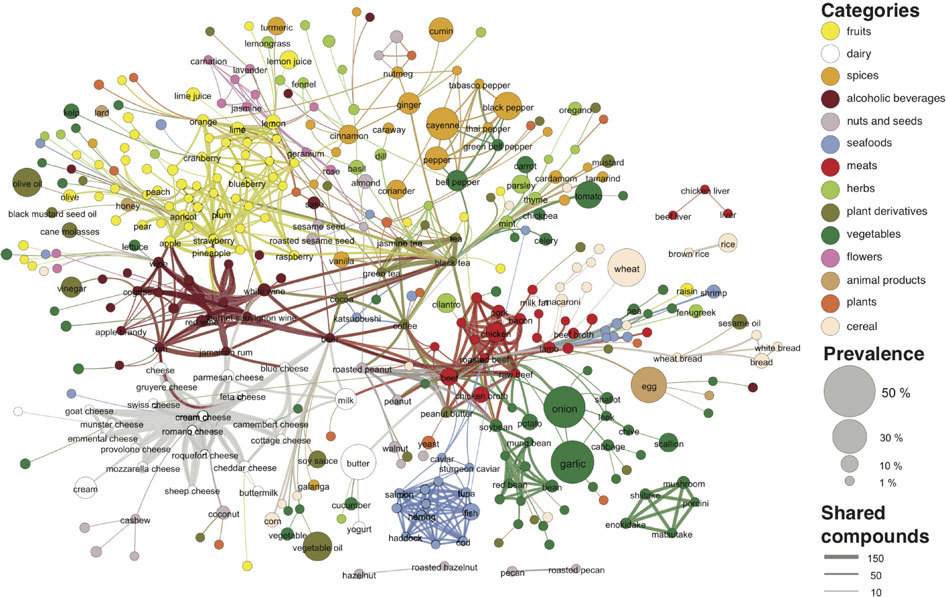
Next, Weingart goes into the basics of networks. He explains that a network is a “complex, interlocking system. Stuff and relationships”. The “stuff” is basically anything that exists — a subject — for example, books. He calls an assortment of stuff as “nodes” and relationships in a network as “edges”. When Weingart explains what networks are I began to think about a food web. I did a quick search and found an interesting image of a network of different foods.

flavour-network


In this example, the author takes the food-paring hypothesis, which states that ingredients work together in a dish if they share similar molecular compounds, and endeavors to create a flavor network. So in this specific example, the relationship in the network or “edges” are the shared flavor compounds. For example, shrimp and parmesan are connected because they contain the same flavor compound 1-penten-3-ol. The “nodes” here are obviously the different kinds of foods or ingredients. The size of each node reflects how often that specific ingredient is used in recipes. Moreover, the thickness of the line shows the relative number of shared flavor compounds. The different colors in the image represent the different food categories such as fruits, dairies, meats, herbs, etc. I thought this was such a great example of a network and the complexities that go along with it. The data visualization that the creator used to portray all the information is particularly interesting because it lets us view data in multiple ways without actually reading it. A network like this would be especially useful for chefs or anyone who is interested in cooking and would like to know the relationships between ingredients and if they would mix well with one another.

Data Mining Pros and Cons

In “The Promise of Digital Humanities”, Andrew Smith writes about the rise of digital humanities as a field due to the increasing popularity of the topic of machine analysis of text. With data mining in the picture, we can potentially and rapidly assess and cycle through hundreds of thousands and even millions of words or texts in order to arrive at an unprecedented conclusion. However, Smith does point out that all these investments in digital humanities technology have not really produced much enlightening or eye-opening results. Instead, many endeavors of data mining result in conclusions that state the obvious. I thought that this was valid point to consider because we are so ready to believe that we can achieve so many new things with the rise of technological prowess. Even though, with technological advancements, we are able to do things faster and more efficiently, we might not arrive at new, profound information all the time. It might just be that sometimes we can arrive at previously known information or analysis at a faster rate. I thought that this was important to remember, especially as students in digital humanities attempting research projects, because we might be tempted to make conclusions about our projects that are obvious. As we are learning to use new digital humanities technologies, we might be quick to render our findings as new and exciting when in fact it is possible that these new technologies make us ignorant or blind to the past conclusions that were based on years of thorough research and analysis.

http://cacm.acm.org/magazines/2014/6/175163-the-power-of-social-media-analytics/abstract

With that warning aside, data mining is potentially a very powerful tool not only for historians to gain new understandings of the past but for businesses to gain new understandings of the market and services as well. Synthesio is a social-media monitoring and research company that tracks customer opinions and posts on travel websites. Synthesio created a data mining tool to analyze the online reputations of thousands of hotels. By pin-pointing key words that attributed to negative reviews and feedback, Synthesio was able to help companies realize what they needed to improve on. For example, many customers for a specific hotel were unsatisfied because their room keys were being demagnetized by their smartphones. Synthesio was able to capture this information and relay it to the company. Then, the hotel was able to address the problem by dealing with the room-key supplier. After fixing the problem, the hotel saw a growth in positive feedback from online posts by customers. I thought that this was such an ingenious example of data mining being used to improve services for businesses. This shows us that data mining and digital humanities technologies can indeed advance our understanding of the past and improve the way businesses are run in the real world.

Databases in Hospitals

This week, I learned about databases by reading about that chapter in Stephen Ramsay’s A Companion to Digital Humanities. In short, a database is like a computerized filing system. As mentioned in the reading, the purpose of a database is to store information about a particular domain or subject. The reading gave us an example of a database that contains information about American novels. A table was given as an example of a database design that included a list of the author’s name, year of birth, year of death, title of the book, publication year, publisher, etc. This example reminded me of databases that hospitals have to use in order to speculate patients and their past medical history.

MediTech

In my previous part-time job, I worked as a blood donor recruiter for the UCLA Blood & Platelet Center. The UCLA Ronald Reagan Hospital would contact us daily letting us know which blood type they were in need of, and it was my job to make sure we meet that demand by calling, emailing, or going out on blood drives to recruit new donors. I was trained to use the MediTech system which was the hospital’s database of all the patients’ information. One of my responsibilities were to make sure that the donors were indeed eligible to donate. First, I would search the donor’s name in the database. When I do this, I’m able to see the donor’s basic information such as birth date, gender, contact number, address, etc. In addition, I can view the donor’s blood type, the last time the donor donated blood or platelets, if he or she traveled to a foreign country that is a high risk area for malaria, if he or she has tattoos or piercings that would make the donor ineligible to donate for a year, or if the donor is taking any medication. Moreover, there were various tags or acronyms that we would have to decipher because some of them meant that the donor could never donate or that he or she would have to talk to a charge nurse first before being approved to donate blood. By navigating and investigating the hospitals database of patients and donors, I’m able to determine if a donor is eligible to donate blood on a certain day.

If it wasn’t for this donor database, it would be next to impossible to recruit a high volume of blood donors because it would be difficult to keep track of all of the donors’ information, especially the aspects that would make them ineligible to donate blood or platelets. Therefore, databases are extremely crucial in the digital era where quick retrieval of information is ideal.

Netflix and Society

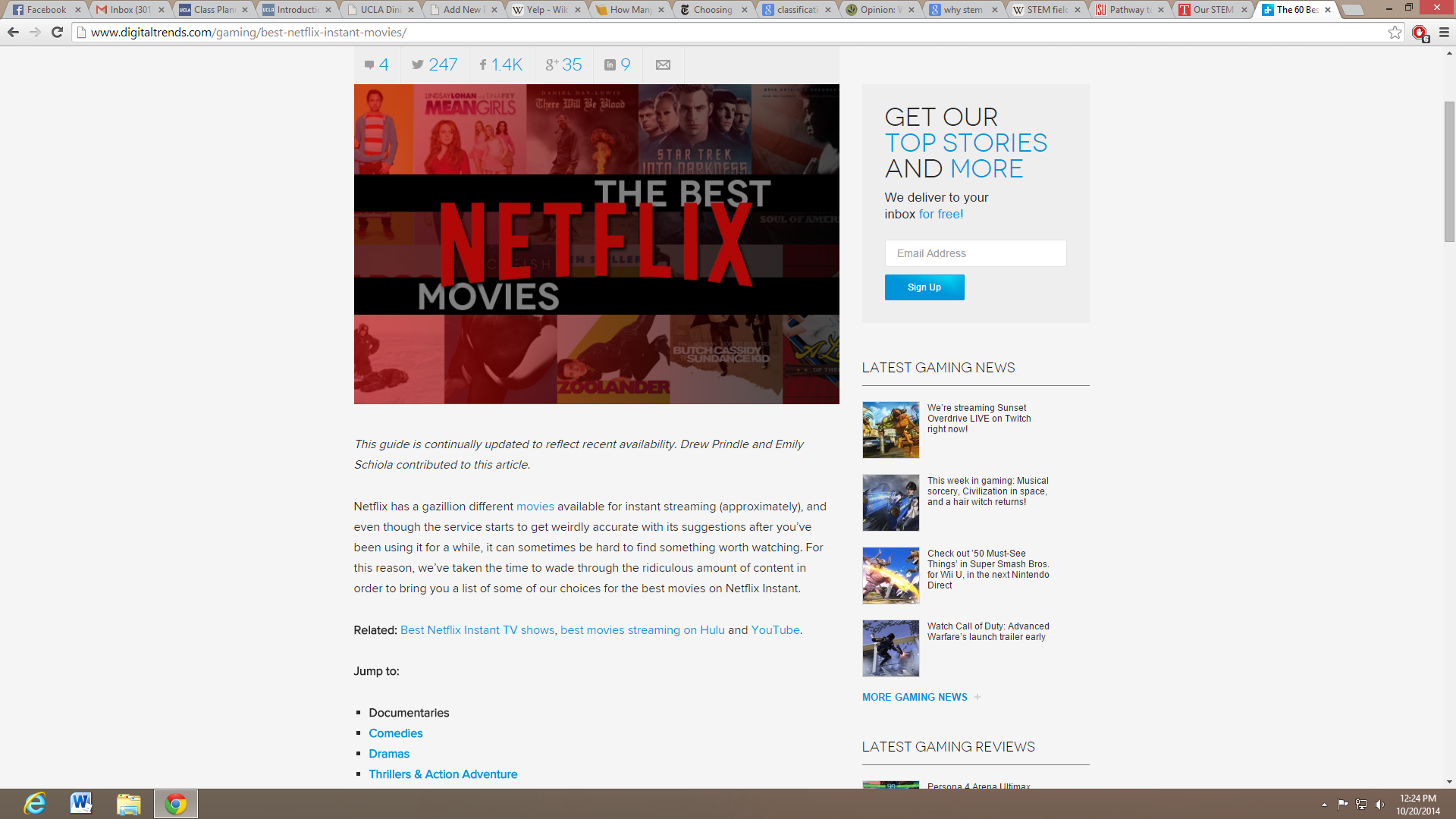
Before reading Alexis Madrigal’s article “How Netflix Reverse Engineered Hollywood”, I wasn’t aware that tens of thousands of microgenres even existed. Moreover, I was skeptical of the fact that Netflix recommended movies based on all the different films and TV shows that we previously watched. I just thought that Netflix recommended the same movies to almost everybody and only claimed to tailor recommendations as some sort of marketing scheme. I didn’t think there would be a group of people who sat down, analyzed, and tagged all the different films to put such a vast project together. Therefore, after reading Madrigal’s article, my appreciation and respect for Netflix grew tenfold. It reminded me about the years and years of hard work that Pandora employees had to invest in order to create the music genome project, which is similar to Netflix in that it endeavored to analyze and tag every song, artist, and album in order to recommend music to individuals. Another example would be Yelp. Yelp endeavors to compile a list of all the restaurants and different arenas of the service sector and tags each establishment in order to recommend places to eat and where one should take his car for maintenance or repair as an example. In this post, however, I wanted to focus on the system of classification and how recommendations and reviews in Netflix lead the masses in society to watch similar movies and shows.

Screenshot (8)

Although Netflix has 76,897 ways to describe a movie through genre tagging, only a very small fraction of those genres are seen in one’s personalized Netflix home-page. The genres that you see are most likely the most popular genres. Moreover, one huge determining factor that goes into the selection of movies that are shown in the front page is the review or star process. The movies and shows that we see in the front page are usually ones with great reviews or the most number of stars. This is one reason why I see a vast majority of similar recommended movies and films. For example, my Netflix home-page and my friend’s home-page share many of the same movies. In fact, sometimes our home-pages look almost identical. Although, of course, personalization comes into play and we do see some differences in the recommendation of movies, for the most part, it seems as if Netflix showcases movies that are highly rated and popular. Since, people only want to watch the best and top-quality movies, as a society, we end up watching movies from a pool that is essentially not that vast at all. This makes me think about the future and how maybe if this trend of classifying and recommending continue as it has for the movie industry such as Netflix and the music industry such as Pandora, Spotify, etc, then we as individuals in one nation might prove to be strikingly similar to one another.

Metadata in Advertising

When I came across the term “metadata”, my initial thought was, “That sounds like something complicated.” However, after learning about metadata for this weak’s reading, I realized how important metadata is in today’s society and digital age. To put it simply, metadata is information about other data. Whatever that information is, its function is to describe, explain, locate, and facilitate the retrieval, use or management of resources. Therefore, without metadata, surfing the web and leisurely tasks such as looking up an artist or song title become almost impossible. For today’s post, I wanted to discuss how I encountered metadata when I was looking to buy a used motorcycle on craigslist.

Metatags in Metadata

Craigslist.org is a classified advertisement website where people post goods and services for something in return. Over this past weekend, I was looking to buy a used motorcycle so that I can commute from home to school and back without spending too much money on gas, parking, etc. I thought that a motorcycle, although more dangerous, would fit my needs better than a car. I didn’t have that much money to spend so I went on craigslist to find a good deal on a motorcycle. Of course, like any other search engine, one would have to type in the item that he wants into the search engine. Here, metadata is at work for the purposes of discovering new information. In this case, it facilitates the identification of all the different possible sellers of that specific item.  In the reading, this was called “descriptive metadata” which is one of three types of metadata. Descriptive metadata can include elements such as title, abstract, author, and keywords.

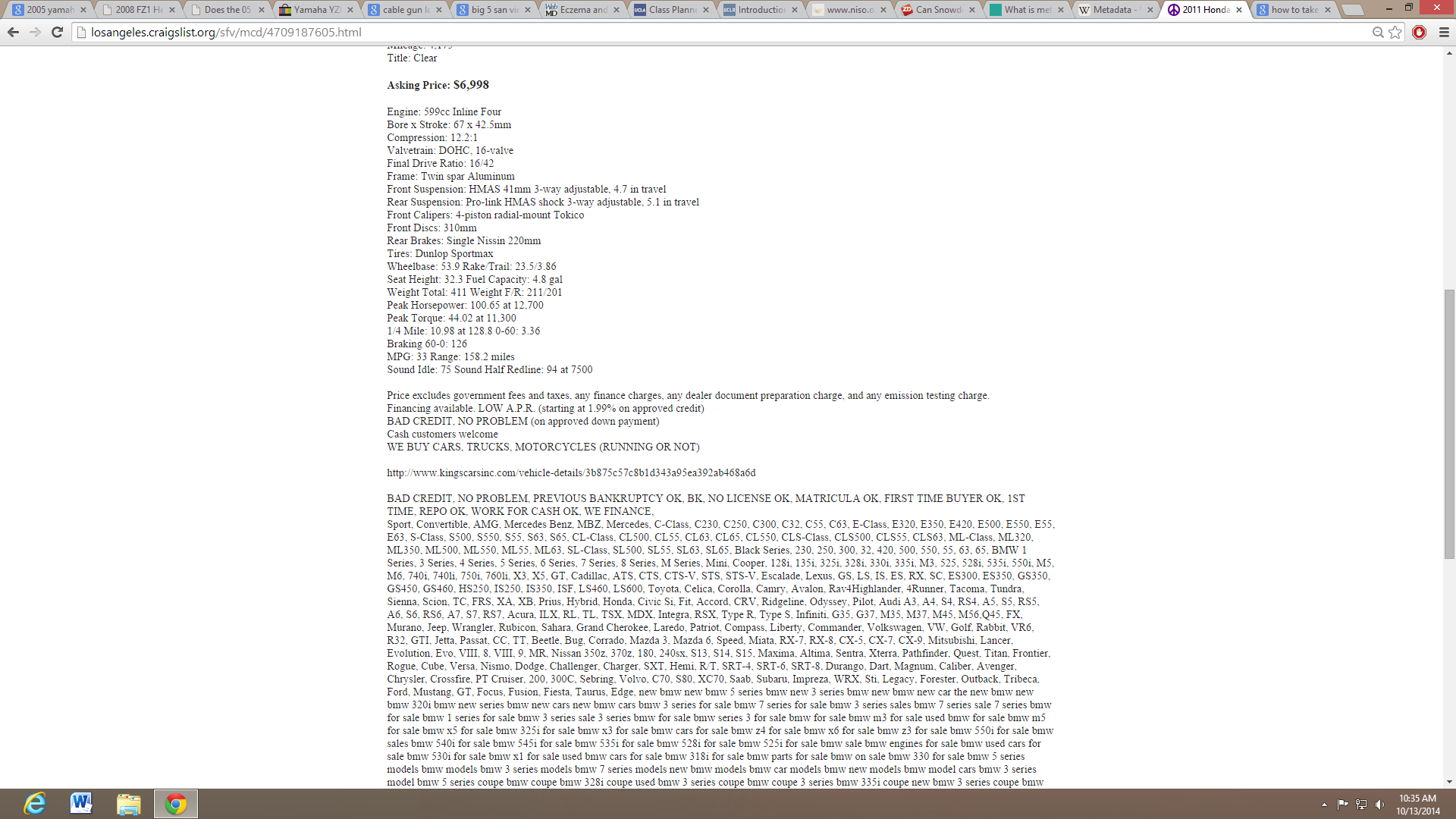
Through my endeavors to find a motorcycle on craigslist, I was able to see how metadata made my search experience a lot easier.  Not only was I able to type in the different models of the motorcycle that I wanted but I also was able to narrow down my searches and filter certain descriptions in order to find the perfect item for my individual need. For example, I was able to set a minimum and maximum price rage, click a checkbox for certain parts, and even filter out the posts without pictures. Since the search can get very specific, most sellers implement “metatags” so that their item will appear on various search specific results. I included a picture of what I mean on this post. In the bottom of the seller’s post, the seller would add keywords of popular motorcycle companies, the model, the year, and type even though it wasn’t the motorcycle that they were selling. They did this so that their ad will show up in different searches which results in a larger target audience.