Category Archives: Uncategorized

Seconds a Day and Social Media Activism

It was interesting how Jill Walker Rettberg’s book laid out a sort of genealogy or family tree of today’s “selfie” phenomenon. One thing in particular that struck me was the “picture-a-day” video phenomenon that launched around the time that YouTube became popular. If this was a point on the family tree of the selfie, then I think it is safe to say that this picture-a-day trend was a point where the tree branched off in separate directions to eventually develop into different things. One branch continued to develop the idea of a public sharing of digital self-portraits, while the other branch developed the picture-a-day concept. Soon many people were starting these types of projects, and like Rettberg said, even apps were developed to help anyone achieve their desired product. Soon, the picture-a-day moved to “second-a-day” video compilations, showing snapshots of action in a person’s daily life over the span of time.

Then, last year in 2014, an organization in England called Save the Children U.K. launched a campaign called If London Were Syria to raise awareness for children living under war conditions. A part of this campaign was the viral video Most Shocking Second a Day Video, which portrays a second a day in a young girl’s life under the circumstances of a hypothetical civil war that unfolds in London. The events portrayed in the video are said to be based on factual accounts of children in Syria. This campaign capitalized on the past viral successes of videos in the photo/second a day format, and developed a way to format it to the equally popular trend of raising social awareness through online and social media platforms. This combination worked: the video reached 23 million views on YouTube in just one week.

It is interesting to discover the different evolutions of online trends and digital technologies through this class. Having grown up during this Internet boom, I probably would have never made the connection that these digital developments branch off of each other, often going farther back than before the creation of the Internet itself.

Week 4

It’s really interesting that this week’s reading, “Seeing Ourselves Through Technology” resonated with my community topic. On page seven, Rettberg talks about blogs, and the different forms of blogs. Blogging stems from diary-writing that many of us have done before. But now it is more likely that we write about it online than on pages of a small book–which is interesting considering that online writing is so public that it is nothing like the original concept of diary writing. My community relates to the topic-driven blogging talked about. I am focusing my project on a community of fashion bloggers that talk about styling and exchange articles of clothing in order to create a diary of individualized styles. It is interesting to see a task that used to be so individualized and personal become such a great community. Now we are able to exchange ideas with others on common interests. In some way, the fashion community I am to explore has all of three modes of self-representation Rettberg addresses: written, visual, and quantitative. The written and visual go hand in hand as fashion bloggers showcase different outfits and write about where they got their clothing, why they chose it, and maybe a tidbit about their lives the day they were the outfit. It is a collection of memories. Fashion bloggers nowadays do not only have a blog, but they usually have accompanying social media sites like instagram, twitter, and facebook. This is where the quantitative mode comes in. Many fashion bloggers also showcase outfits on instagram, as a “sneak peek” to their post and sometimes they geotag it. I’ve seen numerous blogs where they talk about restaurant x they went to while wearing this outfit. If you were a stalker you could basically find people easily through twitter and instagram since everything has tracking, even when you don’t mean to add it. The bad thing about diaries turning into blogging is the lack of privacy. But blogging overall is a new form of communication, expression, and record-keeping.

Week 4: Regulating Self-Representation

In the first chapter of “Seeing Ourselves Through Technology,” Jill Walker Rettberg discusses the creation of self-representations online: blogs, activity trackers, and perhaps the most literal interpretation, the selfie.

Rettberg spends most of the chapter chronicling the history of self-representation, beginning with the first diary and leading up to habit tracking, to explain more modern and widespread phenomenon. But the first chapter also contains a brief discussion of the disciplining of self-representations that is an interesting look into how we mediate the act of creating online content.

Rettberg mentions depictions of selfie-taking in pop culture being especially disdainful, with much of that hatred directed toward “the stereotypical selfie-takers: young women.” Because teenage girls are often derided for being superficial or vapid, selfie-taking becomes a gendered activity, and one deserving of the kind of scorn directed towards other stereotypically feminine interests (like makeup and boy bands). Rettberg hypothesizes that the negative reaction to young women online is part of a larger attitude regarding “who has the right to speak in public or to share images in public,” which is why established figures are allowed/expected to create content while the average teenage girl is mocked—often by adults—for doing so.

There are not exactly official rules for navigating the world of selfies and status updates, but one can find a lot of potentially well-meaning articles that try to propose commandments for online self-representation. Many rules, like the 5 “Rules for Taking #Selfies on Instagram” seem arbitrary, reflecting our expectations about activity online rather than genuine safety and privacy concerns. For example, the first rule is a hypothetical age restriction, and another is a simple “don’t look stupid.” It’s interesting that social media, a relatively new phenomenon with few (if any) established “authorities” is so conducive to the creation of “new ways to regulate who will be heard and who will be taken seriously.”

Instajournalism

Tonight I’d like to talk a little about filters as described by Jill Walker in Seeing Ourselves Through Technology. According to the author there are three types of filters: visual, technological and cultural.   The first is a filter you can add to a photo like a vignette-ing or vintage faded color effect. The second is how not just pictures, but text and information are distributed and shared with you on social media sites. Each one is different, and facebook’s program has algorithms that keep what’s been receiving the most attention at the top of your feed. What’s interesting, is depending on the overall mood of what our peers and family post effects the what we say. So what’s trending really does stay a trend. Lastly, cultural filters are what people find acceptable and in what circumstances.
The outside images I would like to look at combine all three filters. It is the story of a military man named Damon Winter who took photos of his journey through combat and called his work journalism. This person ended up submitting his work to a major photography contest and won Pictures of the Year International. (Woah, what a cool thing! What an honor. Well… some people were not so enthused.) Some people got very upset because the cultural norm is that photojournalism entails the use of incredibly high quality cameras by professionals. Some upset people even called it the death of photojournalism as you can see by the title: “Hipstamatic and the Death of Photojournalism” which also refers to visual filters and apps. Damon Winter used Hipstamatic while underfire in the war in Afghanistan alongside the 2nd Platoon. His use of filters make the job look kind of dreamy and beautiful even though they are images of war. As the chapters we read mention, the overuse of filters can sometimes water down the impact of photos because they become somewhat glamorized. It is a weird sort of juxtaposition when you see his photos which a lot like movies, even though the overall message seems to be that war is not the answer.

there are a few articles but here’s the one I found first

hipstamatic and the war in Afghanistan

hipstamatic and the war in Afghanistan

http://gizmodo.com/5756703/is-hipstamatic-killing-photojournalism

How Much is Too Much?

The second chapter of the reading , entitled “Filtered Reality”, focused on how filters are commonly offered for almost all pictures these days. Although these filters first became popular on Instagram, they are now readily offered to enhance our pictures on iPhones, iPhoto, Flickr, Snapchat, and almost all picture-taking applications. The article suggest that the popularity of these filters, especially in terms of selfless, is due to wanting to take control of our own image. By taking a selfie and then being able to filter it, a person can represent their image without having to rely on someone else.
In the reading they use the terms style and substance to represent this balance. The substance is the actual photograph and the style is the filter on the photo. I have no problem with filters and often use them on my own photos, but I have recently found myself wondering how much is too much? When there is more emphasis on style, than substance, I wonder if we lose the genuineness of the photograph.
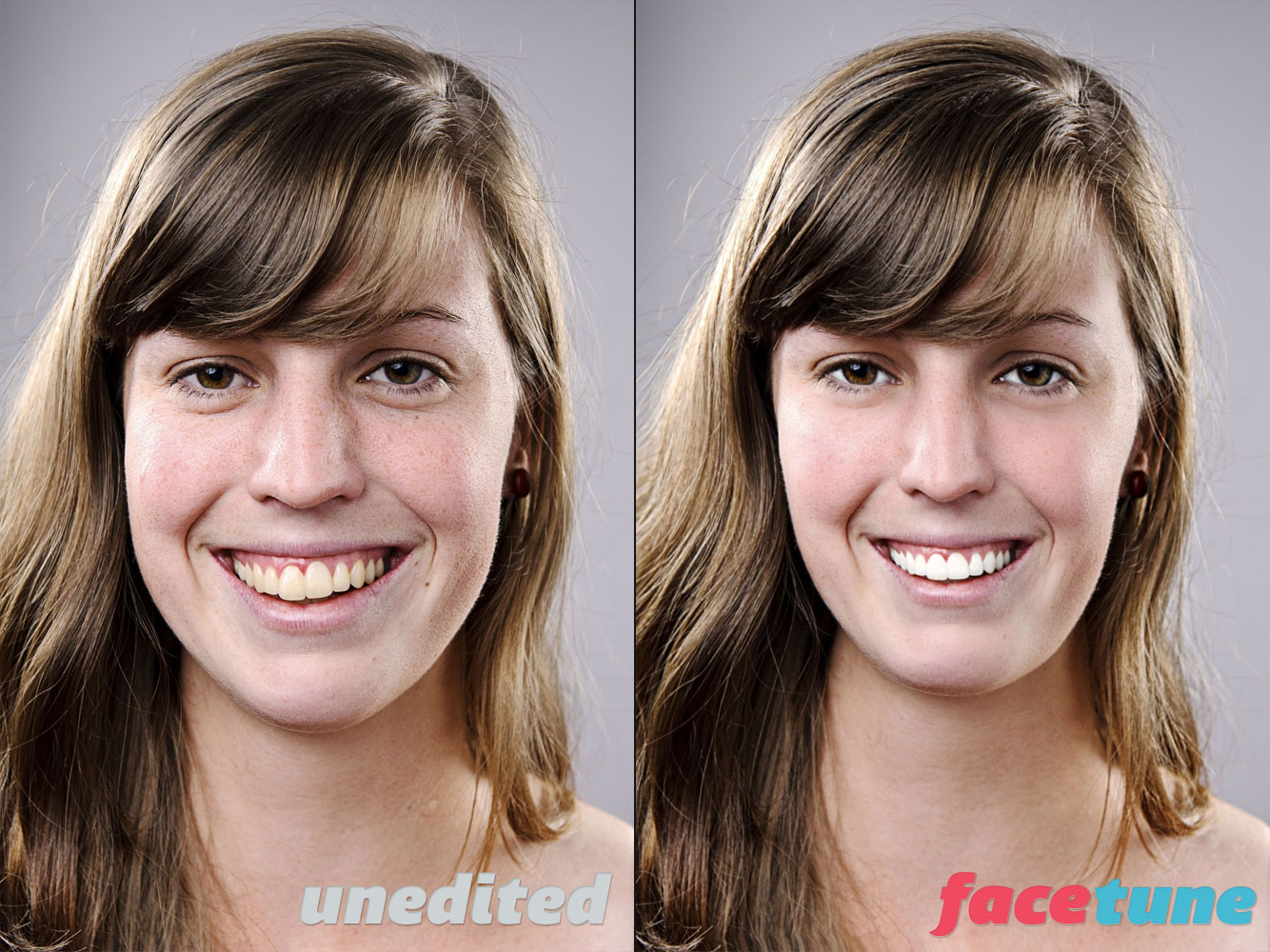
There is an iPhone app called Facetune that many people use, and I wonder if it takes the idea of filters a little too far. On Facetune, not only can people put flattering filters on their pictures, but they can also airbrush their skin, whiten their teeth, and even distort the picture to make themselves look skinnier. On this app people can make themselves look like completely different people. Although I understand the idea of wanting to add style and make yourself look better in a picture, at a certain point the substance doesn’t even matter if it has been editted so much that it is unrecognizable. At that point I believe the photo becomes almost dishonest, unless the person were to explain that the photo was edited. Balancing style and substance is an important element of using digital media correctly without abusing its potential.

Week 4: How To Be Cool On Instagram, According To A Teen

Screen Shot 2015-01-26 at 8.45.47 PM

How To Be Cool On Instagram According To A Teen

In Jill Walker Rettberg’s Seeing Ourselves Through Technology, we are presented with a dilemma. The dilemma begins by Rettberg arguing that selfies are a form of self-reflection and self-creation (12). While I do agree with the statement and the ideas behind her argument, the application of filters to selfies is a trend that teens now see as faux pas.

I had always used filters on Instagram because I always assumed it was expected. Not only that, but to my understanding, filters are what made Instagram what it is today. The app itself started as a means of simple photo editing on ones phone and has now become a social media cornucopia in of itself. Filters are what set the app apart from beginning, even amongst all of the competition and imitators, Instagram always had the best filters. However, everything has changed, and after reading the above-posted article on Buzzfeed, I knew I had to do some further investigation.

In the article we learn that according to teens (the core subject of our class), there are rules for using Instagram.

  • Timing is EVERYTHING.
  • Also, don’t post too much.
  • BUT if it is a big week in your life, feel free to post more than usual.
  • Selfies have STRICT rules.
    • Be “spontaneous and fun.”
    • “Not all the time” aka DO THEM SPARINGLY. “If you think you look good in a selfie fine Instagram it but wait a while before you do it again.”
    • Selfies are “not to be taken seriously.”
    • “Selfies should only be when you have a GOOD one.”
  • Filters are for Brita pitchers, not Instagram.

I must point out that this is only the beginning of the list of Instagram rules. Of these rules, what stood out to me the most and had me reflecting on the reading was the fact that teenagers were adamantly against using filters. This was so hard for me to believe that I messaged my boyfriends niece (an 18 year old UCLA freshman) seeking the truth. Upon mentioning the list of Instagram rules to her she knew exactly what I was talking about. She mentioned that using filters is uncool and that any young person knows better. My mind is still recovering from this to be honest with you guys. What is shocking to me the most is that Instagram came out in 2010 and back then I was still a teenager at nineteen.

While I will continue to use filters on my Instagram, it was very interesting having read the Buzzfeed post after having read Rettberg’s work. As someone who posts mostly scenic photos on Instagram (filters included), I will stick to Rettberg’s idea that people subconsciously apply filters that they believe will meet the cultural expectations and norms. That being said, it was my expectation before having read any of this that Instagram was a means of creative expression, not of self reflexion, or even self idolization for that matter.

– Felipe Carbonell


But First…

There were so many things that resonated with me in Jill Walker Rettberg’s Seeing Ourselves Through Technology. Her main point that she states at the beginning argues that the three modes of digital media – visual, written, and quantitative- are inextricable. I kept thinking back to our discussion of technology determinism and the social construction of technology through this reading. I feel that Rettberg would sit in the social construction camp…I decided this when I read “…technology is a means to see part of ourselves. Whether we use a wearable, networked step=counter or a convex mirror and oil paints, technology can reflect back to us a version of who we are” (2). Rettberg determines that through our constant engagement with technology – whether it be oil paint in Parmigianino’s case, or a FitBit in a 21st century person’s case, technology reflects our need to represent ourselves. Though Rettberg does not quite get down to the core of this human desire, I think that it exists no matter the state of technology.

I was pretty fascinated by what Rettberg theorized about selfies. Upon reading the first chapter which compared Parmigianino’s self-portrait paintings to selfies I was like “Oh, brother…” but then Rettberg discusses “selfie hate” by the media. I immediately knew the type of media coverage she was bringing up – images of news reporters arguing the validity of selfies popped into my head. I roll my eyes at those types of news stories (there’s more/better things to cover besides selfies) but at the same time, I can’t say I don’t roll my eyes when I see someone post a selfie. Rettberg posits selfies as “self-representation” which “involves the creation of texts which will be read and interpreted…just as importantly, creating and sharing a selfie or a steam of selifes is a form of self-reflection and self-creation” (12). I guess I never though beyond the obnoxious factor of selfies, but this makes a lot of sense to me. I often hear people talking about how to “brand” yourself on social media and I think the creation of self through selfies has a lot to do with this.

An extremely magnified example of this phenomenon that Rettberg discusses is Kim Kardashian’s “selfie book” entitled “Selfish”. Kanye obviously inspired the idea, and this example has a lot to do with the cult of fame, etc. but it does speak to self-creation in a very heightened, ridiculous sense. Kim Kardashian certainly has a brand that she built – I sometimes hear people refer to the “Kardashian look”. Admittedly, I follow her on Instagram and observe her selfies. She certainly creates this image of herself, “filtering” and “curating” along the way. This selfie self-representation goes so far in this case as to solidify into a published book. This just proves how prevalent selfies are in the creation of self-brand today.B7zsr8mCIAAAIJV

Creating versions of yourself FT. Lena Dunham

Reitman says that selfies are so prominent online because “we analyse the other writer primarily as a text rather than as a living, breathing human being.” That comment came across a little strange to me. It seems Reitman is arguing against accepting content without thinking of the author. But when we read books, do we constantly think about the author? Does each page contain a picture of the writer’s face, lest we forget who brought the story into existence? Unless it’s an autobiography, isn’t it better for the story to speak independantly of the person who wrote it? Maybe a selfie is a way to prove corporeal existence in the digital world, but other than on FaceBook and dating apps, why is there this obsession with “yes, I’m real.” Words and thoughts are much more important than the person who generated them.

There was a conversation in this week’s episode of Girls, where Chandra expresses disdain of  “cross pollination”, where blogs are turned into books are turned into TV shows. This is metaphysical in the context of the show, which is a semi-autobiography of director/ star Lena Dunham’s life. Dunham recently released a real autobiography of her life after the success of her TV show. Dunham has also directed a movie, Tiny Furniture, which was yet another semi-autobiography with minor changes. All of her productions and publications feature the same core cast. Dunham stars as versions of herself, ditto her friends, but with slightly different tweaks each time, as if she is moving infront of fun house mirror after fun house mirror. Here is a case where a woman has proved her existence, creating and starring in projects, but the observer still doesn’t know who she is.

Indescrepencies between versions of people exist on social media as well. I would argue that people are probably closest to themselves on Tumblr, because it is a platform that users don’t normally share with their IRL friends. It is also a platform where SELFIES ARE COMPLETELY OPTIONAL. Of course, it’s fun when bloggers have tagged/me pages, but it’s not like FaceBook or Instagram, where a meme-filled page generates that icky feeling that you’re being trolled. On Tumblr, you’re actually free to post whatever you want, and that is because no one will nessacerily see your face or your name. Forgoing selfies generates freedom.

Filtering Our Reality Through Instagram

I enjoyed Jill Rettberg’s chapter on “Filtered Reality” where she examines the word “filter” and relates it to our algorithmic culture, studying technological and cultural filters and what it depicts about modern society’s culture today. She explains how filtering in technology has become a way to “remove certain content [and] alter or distort texts, images, and data” (20).

She explains how Instagram represents a type of filter that adds to the image – through color enhancements, blurring, and other effects. She argues that people subconsciously apply filters that they believe will meet the cultural expectations and norms. She quotes Marwick’s idea that social media favors those who are effective neoliberal subjects, the person who “attends to fashion, is focused on self-improvement, and purchases goods and services to achieve ‘self-realization’” (24).

This quote reminded me of a comical buzzfeed article, “A Day in the Life of a Girl on Instagram Vs. Real Life”. Where it shows typical Instagram posts one would see of an “Outfit of the Day” on Instagram vs. real life. They make fun of many of the typical photos we see, morning coffee, breakfast, lazy Sunday, hangover, working out, etc. This buzzfeed article really embodies what Rettberg claims is occurring on social media especially on Instagram.

All the photos from the Buzzfeed article are enhanced photos with color, crop, placement, and they portray a more luxurious exciting and trendy lifestyle than what may be actually happening. Then the actual life photos are portrayed, showing the disparity between the photos. People who are “instafamous” always have images that are edited with different filters and cropped and placed—following the idea that they are in fact “fashionable” and most of the time they are also focused on “self-improving”. I found it amusing how well the chapter related to the Buzzfeed article, supporting Rettberg’s ideas on social media, filtering, and society.

http://www.buzzfeed.com/laraparker/a-day-in-the-life-of-a-girl-on-instagram-vs-real-life#.pemkMNj7p

Screen Shot 2015-01-25 at 6.19.30 PMScreen Shot 2015-01-25 at 6.19.41 PM

Privacy Ends Where Safety Begins

7images

Privacy ends where safety begins. I found that phrase several times after googling the words “mom outraged over Snapchat”. While the first three chapters of Danah Boyd’s It’s Complicated offered many fascinating insights on adolescences and their use of social media, the stories of parent and children arguments over Facebook and Live Journal felt dated. I searched for stories about parental fear and anxieties over Snapchat, Tumblr, and Instagram to see if those same emotions felt over Facebook and the like several years ago are handled today, now that the social media sites teens frequent aren’t as accessible to parents. Turns out the fears and anxiety over what their children are doing on social media are obviously the same as before but the methods to deal with them are quite different than peeking in on a Facebook wall.
In my search I found several different products and app aimed at parents to monitor their children’s every move. Each spyware advertised the same sentiments as the parent Christina in Chapter 2: “a good parent is an all knowing parent…I’m the parent and not the friend” (pg. 70 Boyd). I found an app called mSpy, it allows parents to see exactly what their children are sending on Snapchat, as well as who they’re calling, texting, emailing and even where they are. First the parent downloads mSpy onto the child’s phone. I immediately thought of all the kids who got the iPhone 6 for Christmas with a little something extra. Because once mSpy is installed it leaves no trace on the actual phone, not a banner or an icon. All the monitoring messages are seen on the parent’s device only.
I do see products like mSpy as an invasion of privacy but I also see a parents need to feel their child is safe and not participating in behavior that harms themselves like being in dangerous places with questionable people or even sending nudes. I do not however see privacy ending where safety begins. I agree with the concept Boyd offers about parental violations of privacy being an expression of love but essentially constant surveillance is a form of oppression. The affects of excessive snooping and monitoring limits children and negates the formation of trust and understanding. mSpy parents operate under the implication that their child is unable to make informed decisions and ultimately, children have to become adults and will find a way to make all the mistakes their parents prevented them from with much larger consequences than those faced in adolescence. And guess what mom and dad, there’s an mSpy blocker app too.