I really enjoyed Liam Andrew, Desi Gonzalez and Kurt Fendt’s article on “Playful Engineering: Designing and Building Art Discovery Systems”, which explores ways to “engineer the discovery of art” i.e. use technology to attract users to artwork, encourage a sustained relationship with art, and to help users gain a better understanding of the cultural community of Boston. I am by no means a developer or coder, but this article helped to explain some very technical concepts involved in the building of technological platforms and interfaces, which in turn helped me build on my own technical vocabulary. For a digital humanist, it is especially important to understand the technology being used in order to effectively apply and evaluate its usage in the art world.
The authors make an interesting comparison between content-based and collaborative filtering systems using Artbot’s discovery engine as an example. The latter takes on a “social approach”, which offer recommendation based on users’ behavior e.g. Amazon and Netflix. However, a drawback of this system is that it limits rather than expands a customer’s purview. While this might not seem particularly harmful in an ecommerce setting, the term “filter bubble” coined by Eli Pariser in 2011 speaks to the way in which modeling systems to fit a user’s behavior “isolates users from content that might differ from his or her viewpoints”. This algorithmic filtering leads to biased data and information narrowly skewed to enhance confirmation bias.
In contrast, content-based systems “look to the properties of the items themselves, rather than the users, for recommendation signals”. This seems more common in a museum setting, where “object and subject taxonomies built into the museum’s collection management systems” are relied upon to assist a user’s exploration. For instance, one can browse a museum’s collection by searching genre tags such as “Asian art” and “Roman art”. However, “generating and maintaining a taxonomy” is time intensive and dependent on the precision and dedication of the tagger. The worry is therefore that rigid classifications do not accurately represent a work of art, and do not allow for “happy accidents in the discovery process”, or serendipity.
In order to combat the drawbacks of each of these methods, Ethan Zuckerman recommends building digital tools that “infuse serendipity and a diversity of voices”. Specifically, the authors suggest building systems that allow for a hybrid of automation and curation. For instance, computers could perform preliminary web scraping and parsing, but developers need to constantly review their code and the information that results from data gathering in order to present it in a sensible and user-oriented way. This enables nuances to shine through recommendation apps such as Artsy, while saving time and energy on individual research and compilation.
This discussion makes me wonder about the app “Five Every Day”, which recommends five things to do in Los Angeles every day. Here is a photo (taken off Google) of its astonishingly simple interface:
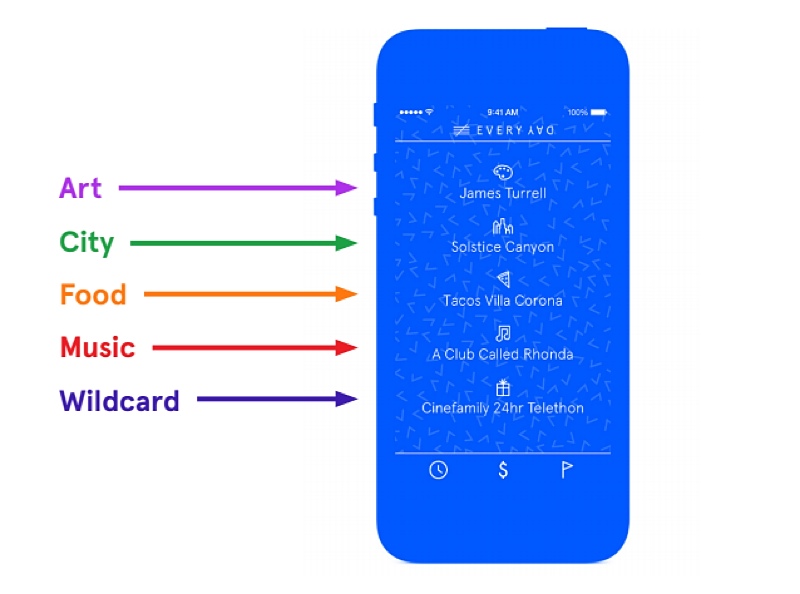
The scope of the app is fairly limited since it is only curated for events in LA, and even then it is limited to five things recommended by a trusted group of curators, as opposed to using a content or collaborative system. Rather than embarking on discovery individually, we wait every day to “discover” what is happening (the recommendations change every day), offering more of a wildcard/ surprise element to the app that differs from the serendipity offered by most other apps. While there is probably some engineering that goes into their research, the possibility of having systems engineered to satisfy one’s own preferences perhaps dilutes the cultural authority that curators traditionally have. While “Five Every Day” seems to restore such power to the curator, an increasing number of technological apps even outside the art world rely on these engineering systems to create a personalized experience for users. If “Five Every Day” were to expand and cover different geographic areas, I am interested to see how they manage the consistency of their recommendations, and whether they would develop their interface and jump on the “personalization” bandwagon.