Class Blog

Mapping Decadence

I decided to analyze the maps in Mapping Decadence, which used ArcGIS to map the locations between several writers in the decadent movement and their publishers. There are several tabs on this website in which you can look at a specific writer’s location compared to their publishers. These writers are Jean Lorrian, Joris-Karl Huysman, Marcel Schwob, and Rachilde. There is also a map that includes all the authors and their publishers under the “mapping decadence” tab. These maps show the location of publishers as red pins, and the location of writers as other colored pins. When clicking on a pin on the map, there is some further information about the name of the writer or publisher, the address of the location, years lived there, and the books published. There are also lines between some pins, which when clicked on provide some more information about the books published. What these maps reveal is that location played an important role in the relationship between writers and publishers. It is clear that the general trend is that the writers lived close to their publishers. However, there is a lot information that is left unsaid from these maps as well.

Through my own research, I found out that the Decadent movement was a late 19th-century artistic and literary movement of Western Europe. It flourished in France, which is evident from the maps being centered around the city of paris. Although this may be implied from the maps, it is never stated or explained, suggesting that the intended viewer of these maps has some background information on the topic. There is also no narrative provided about the author’s or publisher’s life. Important information, such as why the author moved, or the kind of neighborhood they lived in, is left unstated. The about section of the page links to talks about these maps that revealed a lot of important information about the maps that are not immediately apparent. For example, at least in the starts of their careers, many of these authors lived in poorer neighborhoods because they were not wealthy. There are also factors such as family connections that allowed these authors to be put in touch with important publishers that are never mentioned in these maps. Although these maps allow one to grasp the importance of location, they only tell a partial story.

Turnball states that all maps are perspectival and subjective, which is clearly shown in these maps. They were created by a scholar who has extensive background information about these authors and were utilized the very specific purpose of showing the significance of location in the author’s and publisher’s lives. The creator seemed to have meant these maps to be a part of a bigger story that the causal observer is probably not aware of, making the maps somewhat disconnected and difficult to fully understand for the casual observer. The mapmaker leaving out information about the stories of these authors and publishers lives makes a significant difference on how the maps are perceived by the general public.

If I were to create an alternate map, I would focus on making it more accessible to the general public rather than creating it for scholars and people who already background information. I would do this by firstly, making sure to include the definition of the decadence movement and perhaps bios of the authors somewhere. I would also include a timeline with the map to show how and when the author moved around. I would put in little annotations of why they moved in their timeline and include more of their narrative on each pin in the map. I think it would also be interesting to see how the authors interacted with each other, or perhaps the same publisher, so I would try and include the connections between authors as well by linking them together on the map.

Written by Risha Sanikommu
Week 7 Blog Post 6

For this week, I’ve chosen to analyze the Caribbean Cholera Map.  Cholera is an infection that causes diarrhea and severe dehydration, which could lead to death if untreated.  The website displays instances of Cholera outbreak, hurricanes, tropical storms, and news articles all in one map.  You could see it in map form, or in timeline form. The website is simple, with a simple user interface for most readers to understand. Unfortunately that is the only positive design choice for this website,, as it is riddled with series of bad design choices for using a map as a type of data visualization to creatively show audiences the cholera outbreak in the Caribbean.  

The problem starts from the moment you enter the website.  It starts out with the map that is too zoomed out from the Caribbean, that the markers are overlapping.  This standard setup means that Cholera outbreak, which is arguably the most important aspect of the map, is hidden behind under less insignificant markers.  Which leads to me the next flaw: we need more information.  Yes, it is great to have a simple UI but you also need to have ways of displaying information if and when the audience chooses to.  In this website, no matter how much you explore, it is virtually impossible to find what cholera is, why Havana is significant, or why they also chose to put in hurricanes, tropical storms, and news articles onto the map.  In that sense, this map is subjective in that the the assumption is made that the audience already knows the answers I have posed in the previous sentence.  In addition, the map does not display all news articles and cholera outbreaks, so the authors of the website are choosing which ones were the most significant.  By choosing limited data from plentiful data through the author’s point of view, the website is very subjective.  Thus, the point of view of this article must be those who currently live in the Caribbean, who already knows the significance of Cholera and Havana in that region.

By navigating the frustrating UI and confusing elements, the map reveals a great deal of information about exactly where cholera exactly happened, and at what time point.  With the combination of timeline and a map, the user can choose a time they would like, and find out the locations of the outbreak, and receive more information by clicking on the markers.  The map on the other hand fails to describe which part of Caribbean had the worst impact, and its intensity.  Therefore, I imagine an alternate map that is more intuitive, where the user can display all cholera outbreak, hurricanes, tropical storm, and news article, regardless of time, and a check mark to see only one or few of the 4 markers.  The time can then be flexibly restricted depending on what time interval the user chooses to.  Then, like an earthquake magnitude map, this map could reveal the intensity of the earthquake by having more affected area (i.e. more deaths in a certain time period) have stronger color or a circle with a wider radius that indicates the intensity of the outbreak.  

ReVilna

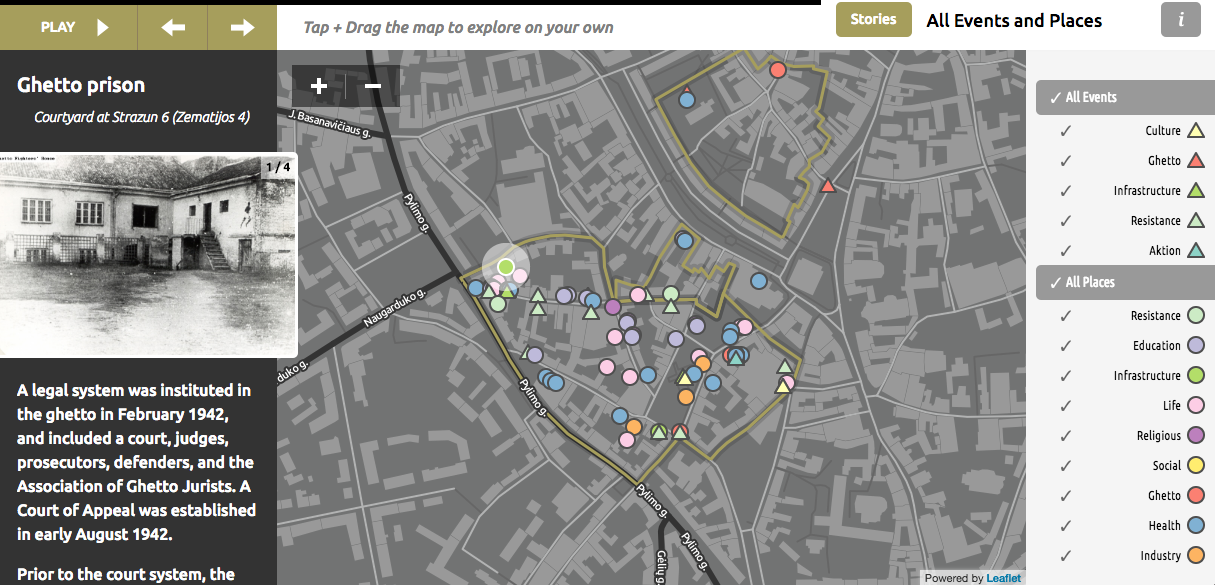
ReVilna is a digital humanities project that maps out the location and narrates the events of the Jewish ghetto located in the Lithuanian city of Vilnius during World War II. The map, which is split up into multiple “stories”, includes about two hundred individual points that are geographically tagged on a city map. Each point can be selected and represents a location of historical significance. Because the ghetto was eventually liquidated and very few residents survived, we have a limited amount of information remaining about what life was like in the ghetto during this time period. However, the narratives for each story quote extensively from different records that survived this time period, such as speeches, meeting records and official statements.

screen-shot-2016-11-07-at-11-46-36-am

Since the dots for each story are separate from the other stories, spatial information about the relationships between these dots is more difficult to find when the user doesn’t click on “explore on your own”. For example, the most important centers for activity within the ghettos are obscured because the map is split into separate “stories” and not gathered into a single map. This makes it difficult to see where the greatest concentration of dots would be located when a user is isolating a single narrative story. If a user were to focus on a single story instead of the whole, they would receive a very different perspective on what life in the ghetto was like: reading only the “Art and Culture” story would paint a much more peaceful picture than “Resistance and the FPO,” which is much grimmer and more violent.

The Vilnius map is definitely selective, as Turnbull asserts that all maps are. As the location of the Vilnius ghetto was a specific spot within the city of Vilnius, the map mainly focuses on a very small part of the city as a whole. Because the limits of the ghetto were clearly delineated this isn’t exactly an arbitrary decision on the part of the mapmakers, but it does eliminate some parts of the narrative that may have occurred outside of the ghetto and still influenced the lives of the people living within.

By combining a map with a narrative, the Vilnius map represents the perspective of some demographics more than others, and is, as Turnbull puts it, indexical. This map definitely represents the point of view of a Jewish person residing within the Vilnius ghetto, as most of its narrative concerns the day-to-day life of a ghetto resident. However, there were separate factions within this group of people, such as the Resistance and FPO which frequently came into conflict with the Judenrat, who were community leaders that tried to keep the peace between the ghetto residents and the Germans. The narrative of this map focuses much more on the actions and viewpoints of the Resistance members than it does on the Judenrat, and as such gives us a much greater understanding of the life of an FPO member than the life of a Judenrat member, or a ghetto resident who wasn’t associated with either group. An alternative map might focus more on the doings of a Judenrat member, or might perhaps trace the life events of individual people who resided in the ghetto, and whose actions we have more information about.

Digital Harlem: The “Everyday” Lives

The Digital Harlem Map is meant to represent everyday life in New York City’s Harlem neighborhood between the years 1915 and 1930. It utilizes information from legal records, newspapers and other archival and published sources. The map shows the borders of black settlements in 1920, 1925 and 1930.

2016-11-07

Users are able to toggle through the different layers of the map which include the number of arrests that were made as well as the information from police reports on the incident (address, date, time and crime). The amount of jobs available for Black people were quite low so although the population was predominantly Black/ African American, many of the police and newspaper workers were White/Caucasian. The point of view is skewed towards the ontology of the White, male police (and probably government) that wrote the reports and articles that the creators of this map used as sources. The map is supposed to show the everyday life within the neighborhood but the sources that are used do not necessarily depict that. It shows newsworthy events, arrests and the life of a boy, Fuller Long, who was put on probation for having sexual intercourse with his underage girlfriend. None of the events that were placed on the map were positive acts or events that happened within the community (which may show the bias and racism of the time). The narrative that the map is providing assumes that many of the arrests in the area are of Black people (in a historically Black neighborhood) and that they are bad, criminal people. It depicts them as people that were hardened criminals but also first offenders, ordinary residents acting out of desperation, poverty or anger, and which reveal all manner of things that would not ordinarily be labeled ‘criminal’. It also shows evidence of the role of gambling, violence and confidence men in the black community.

The map reveals the life outside of the contributions of the arts and music scene of the Black artists or the black middle class during the Harlem Renaissance. It obscures the community as being composed of broke, desperate criminals who are up to no good. It may also obscure the circumstances of the crimes/ arrests based on the biased and racist police reports.

If I were to come up with an alternate map, I would provide primary sources (diaries, narratives, interviews, etc.) and photographs of what everyday life may have looked like.  I would use sources that were not written by others not from the community. I would also incorporate other sources that also provide positive contributions or events to the community (not just the negative ones about crime). My map would have stories of individuals to avoid faciality so that people are not stereotyped or grouped based on race or ethnicity.

Blog Post, Week 7

For this week’s blog post, I analyzed the Digital Harlem mapping project, a collaborative research project in efforts to represent everyday life in New York City’s Harlem neighborhood in the years 1915-1930. The information is drawn from legal records, newspapers and other archival and published sources, particularly from the District Attorney’s Closed Case Files, Probation Department Case Files, Newspapers, Committee of Fourteen Papers, and W.P.A. Writers Program Collection. The map included a search function, allowing one to narrow down the results based upon type of event, date, charge/conviction, birthplace and occupation of the participant, race, gender, surname of participant, street, and location type.

It is interesting to note how the project creators claim, “Unlike most studies of Harlem in the early twentieth century, this project focuses not on black artists and the black middle class, but on the lives of ordinary African New Yorkers.” To me, this emphasis on the ordinary, everyday life was not accurately depicted because police arrests and newspapers only depict the out of the ordinary. Rarely do newspapers cover a family eating supper, but rather report on big events or rare circumstances. Similarly, altercations with law enforcement is anything but the norm. Additionally, these records are all based on state ontology and perspectives rather than the community. During a time when racial divides were so heightened, it is likely that those working in powerful positions for the media and law enforcement were not African. Additionally, the map included the option to search by surname since the sources constitute of public records; however, having one’s name in a searchable public record is anything but reflective of ordinary, and everyday life.

Hence, all aspects of this project to me, seemed more like a state ontology rather than a community one. I would change the sources of this map or create a more balanced picture by obtaining interviews from arrestees, family stories and records, jobs and economic activity, plays, music, etc. The more variety of sources, the more accurate the picture can be. As David Turnbull mentioned in his article, maps are always selective and the mapmaker determines what is, and equally importantly, what is not included in the representation. This Digital Harlem map, while a useful tool, provides an inaccurate representation of everyday life in 1915-1930 Harlem. The map reveals only those who have had interactions with law or media entities, and are documented in public record, and obscures the truth by claiming this represents all of Harlem.

19th Century Caribbean Cholera TimeMap

For this week’s blog post and critique of a digital humanities mapping project, I chose the 19th Century Caribbean Cholera TimeMap created by ten individuals from the John Hope Franklin Humanities Institute. This mapping project combines the use of a geographical map, timeline, and several variables followed across both of the media as well as further description by employing the use of published articles and news stories concerning the occurrences. The timeline covers three separate time periods including: 1833-1834, 1850-1856, and 1865-1872. On the two displays, the variables shown are cholera outbreaks, hurricanes, tropical storms, and news articles. It is clear to see from observing the set of data without delving into the it too much that the main goal of this project is to find a correlation between natural disasters, hurricanes and tropical storms, and the outbreak, spread, and general prevalence of cholera in the Caribbean.

David Turnbull puts forth the argument that all mapping data visualizations are perspectival and subjective. This assertion falls in line with the definition of “narrative” that we have been exploring in class. Both of these statements mean to elaborate on how the researcher or data collector is the individual who deems what is important in the dataset and what will ultimately be used to argue for a stance of their choosing. This means that in some circumstances that the data is somewhat misrepresented to promote the researcher’s own agenda.

Using this knowledge garnered from Turnbull and what has been taught thus far concerning narratives, one can see how this mapping visualization can be skewed. The researchers are attributing cholera outbreaks solely to the occurrence of natural disasters. This is an over-generalization because cholera is due to the consumption unsanitary water or food. While it is true that tropical storms and hurricanes play a role in causing cholera outbreaks, they are not the only cause. Only using this dataset, one would come to the assumption that cholera outbreaks were directly caused by tropical storms and hurricanes. In reality, there are many causes to cholera outbreaks including poor infrastructure of water and sanitation systems, geographical location, and economic status and industrialization of the country in question.

This map reveals that there is a correlation between the occurrences of tropical storms and hurricanes with cholera outbreaks in the Caribbean; however, it obscures what the other possible causes may be and whether or not these tropical storms and hurricanes are simply correlated or have an actual causal effect.

I believe a better mapping visualization for this project would involve other variables that could provide causation or correlation for cholera outbreaks, a shaded gradient scale of the country’s GDP, and provide the year that the country industrialized. The inclusion of these variables would further elucidate the cause of cholera outbreaks.

Week 7 Cholera Map

For this weeks blog post I chose to look at the Caribbean Cholera timeline created in 2011 by the John Hope Franklin Humanities Institute. A team of 10 people from Duke University Haiti Laboratory tells the story that correlates Cholera outbreaks in the Caribbean region to natural disasters such as hurricanes and tropical storms.

This visualization shows Cholera outbreaks in 3 different segments of history of significant outbreaks among the Caribbean Islands, the first one from 1833-1834, the second from 1840-1856 and the third from 1867-1872. This map tells a narrative through the interactive timeline that scrolls through the dates to create a simultaneously changing Google Map of the Caribbean Islands where points of major natural disasters will show up, with pinned points where the Cholera outbreak consisted and convincing news article titles regarding the outbreak. The map visualization shows evidence of massive hurricanes/storms which later cholera outbreaks were found in surrounding areas.

David Turnbull gives the argument that maps only tell a story from the perspective of the map designer. The way in which you select and provide information will create a specific narrative. Turnbull provides a systematic review of maps that analyzes how maps represent knowledge but also signify how different cultures and societies view events and ideas.

Due to the information that creates the data visualization for the map, it suggests that natural disasters were the only cause for the outbreak of Cholera off the South East coast of the United States. I looked up a little more about Cholera and found that it is a bacterial disease typically spread through unsanitary water or food. It says that it takes between 12 hours and 5 days for someone to show symptoms of Cholera so it seems unlikely to me that all Cholera outbreaks were due to natural disasters as the massive hurricanes in 1830 did not have evidence of Cholera outbreaks or news stories until 1833. The map obscures a narrative that proposes only one source for this disease.

I think the current map is very assumptive of causes and does not consider alternatives to what could trigger this bacterial disease. I think the information does not have enough proof, as there were tropical storms in 1831 and 1832 that did not have outbreaks to follow. The creator of this map wants to attribute all blame of Cholera on natural cause. There needs to be more details provided on type of storm and length as the points on the map are not convincing enough.

If I were to imagine an alternative map I would suggest providing information on the economy or state of the cities at the time. Many links show a strong correlation to poor infrastructure and sanitation at the time of Cholera epidemics and so this information is bias towards avoiding any information through the fault of economy and potentially the leader during that time period, who controls how money in spent on health practices that could potentially affect the Cholera outbreaks.

Digital Harlem

For this week’s blog post, I looked at Digital Harlem, a map that purports to give a vision of everyday life in Harlem between 1915 and 1930. To do this, it uses legal records, newspapers, and other sources to place different events on a map of Harlem. Some of the mapped events are innocuous ones, such as basketball games, church services, dances, parties, and the like, but crime holds a prime position in the user interface- Alongside fields such as “Type of Event”, “Birthplace of Participant(s)”, “Race”, “Gender”, or “Street / Intersection Name”, there is a drop-down field specifically for “Charge / Conviction”.

This is a vision of Harlem with crime at its center, which is extremely problematic for a map that claims to be a portrayal of “everyday life”. While there are ways in which this is a defensible position, there are a few problems. Law enforcement has historically been (and continues to be) brutal towards people of color- which can not be ignored in a historically Black neighborhood. It’s easy to take legal records as an objective measure of the number of crimes committed, or the extent to which a neighborhood might be deemed “dangerous”, and harder to historicize them in the context of the type of biases held by law enforcement during this period. In the “sources” section, it does attempt to clarify that most of the DA’s closed case files deal with ordinary indivduals who were “usually acting out of desperation or poverty”, but it’s not nearly so visible as the map itself, and many visitors will not read this. Moreover, it also becomes extremely fraught to put “Charge / Conviction” as a single drop-down box. The baseline for a charge is much lower than that for a conviction, and this makes each incident ambiguous along those lines, which can heighten the image of Harlem as a violent, or crime-ridden neighborhood, which reflects stereotypes of what a Black community is.

I’m not sure how to reclaim this; the strength of data visualization is that it communicates immediately, on a visual, pre-linguistic level. However, it’s at the level of language that it becomes (somewhat) easier to add nuance, since we can articulate specific moments or ideas and make them available for criticism and deconstruction. If we have to reduce an individual’s entire story to a single record of a robbery, there’s simply no space to explore any of the ambiguities or external factors besides those sanctioned by the state. This is why theory is important; rather than replacing the map, or reworking the map, it can be useful to rethink the map that is already there.

Week 6: Locating London’s Past, the Map

Locating London’s Past creates a multi-layered map of London, with John Rocque’s 1746 map of London as the basis, and later 19th century and modern Google map as additional layers. The direct comparison of maps from different time is made possible by geo-referencing and indexing the place names in Rocque’s map.

screen-shot-2016-11-07-at-8-51-05-amAs I browse through the map and play around
with switching between the maps, Turnbull’s statement that “those who are imbued with what is sometimes called ‘the Western world view’ think of objects as having fixed characteristics and defined boundaries and as having a position specifiable by spatial co-ordinates” comes to my mind (Exhibit 1, page 2).

As suggested by its name, the essence of the map is to “locate” London’s past, by geocoding the places in the old map so that they are in the same modern spatial dimension. Therefore, spatiality is the central framework through which users can explore the linkage between the past and the present of London.

However, as Turnbull argues, maps are the mapmakers’ interpretative representations of the world. Such subjectivity is much more prevalent in the maps created in the time periods before the advent of modern technology. Therefore, spatiality, an interpretation of the world much central in the modern maps due to the accuracy of technology, cannot fully embody the interpretations of John Rocque and the mapmaker of the 19th century map.

One interesting comparison I can think of is to directly compare how the style of portraying the world through maps has changed throughout time and what might account for that change. For example, in Rocque’s 1746 map, many boats are drawn on the River Thames, but in the 19th century map, such emphasis disappears. What might explain this change in portraying the River Thames?

To fully demonstrate the comparison of the maps’ styles, a single map that layers the three maps together can be created. While the similarities between the maps can be deemphasized by fading them into the background, the differences can be highlighted, with explanations that elaborate on the cause of the changes, possibly due to a shift in  social or cultural norms. In this way, the map can locate London’s past within the shifting social or cultural perspectives of different time, rather than the fixed spatial perspective of the present.

Digital Harlem

Select a DH mapping project from the following list and think about the way it uses maps. Think also about Turnbull’s contention that all maps are perspectival and subjective. What kinds of assumptions, and whose point of view, does the map you’ve selected reflect? What does the map reveal and what does it obscure? Imagine and describe an alternate map.

I chose to explore Digital Harlem for this week’s blog post. The Digital Harlem website showcases information from newspapers, legal records, and other published sources in order to present a dataset concerning everyday life in Harlem during 1915 to 1930.Unique to this project is the idea that it on the lives of ordinary African New Yorkers which is a rarity as generally only african american artists or the middle class have been publicly documented.

When first arriving to the page, an interactive map of Harlem and a search tool are displayed. The map makes the assumption that the location and expansion of the african community is an integral part of this story. As Turnball said “A map is always selective. In other words, the mapmaker determines what is, and equally importantly, what is not included in the representation”. However I have issues with this map as I feel like it defies Turnball’s notion and in doing so, leads astray from the goal of the project.

The map clearly focuses on the boundaries of where African Americans lived in New York City, however, I don’t think this is very effective in trying to showcase the lives of the ordinary person of this time. The map displays the boundaries of where these communities resided, the types of material the houses were built with and other misc. floor plan information. I think this map is a great piece of supplemental evidence to the story, however, I don’t think it should be the focus.

I think a map showcasing where the arrests occur and what specific arrests were made would be helpful to this narrative. One could label different colors if the arrest was due to peaceful circumstances or was a first-time occurrence. Also I think the map would be more useful if it highlighted the annual incomes of each household as it would show the range of demographics within these boundaries.