Class Blog

Neighborhood council Expenditures

The La Controller’s Office offers a series of data sets that describe the circulation and distribution of funding throughout the greater Los Angeles area. Specifically, I chose to focus on the data set entitled “CD 2 Neighborhood Council Expenditures”. Its purpose is to provide the yearly amount spent by neighborhood councils within the San Fernando Valley. It includes multiple datatypes such as account names( the neighborhood councils allocated to districts within the valley e.g. Van Nuys NC, Valley Village NC, etc); fiscal year, which in this dataset is condensed to the year 2014; and lastly the amount spent by the neighborhood organizations within that year.

The dataset appears rather straightforward at first glance. It shows that “Sun Valley Rec Center Field & Restroom” spent the highest amount in 2014, $357,121, a staggering amount compared to the second highest, which was Studio City at $35,957. What we may infer from this information is based on the digression of our ontological point of view. Having grown up in the san fernando valley, I understand firsthand the economical gap between areas of perceivable wealth and areas of perceivable economic deterioration. For example, studio city and valley village are both wealthy areas. This is supported not only by the dataset expressing that both of these cities spent the second and third highest on community sustainability, but also due to increased housing prices, and overall capital growth of the areas. One does not necessarily need a dataset to perceive the gap between these neighborhoods in comparison to other neighborhoods such as Van Nuys (spending 22,519 annually) , insofar that there are visual differences that describe these gaps. Such differences cannot be accurately or completely described in a dataset.

Wallack and Srinivasan’s essay on mismatched ontologies describes this division between community ontologies and bureaucratic ontological worldviews that may alter and reduce information to fit within a specific organizational system. This divide can lead to and promote already established economical inequality and instability within those communities.

If we look at the CD 2 Neighborhood Council Expenditures” we’ll see that Sun Valley has spent the most in 2014. We may want to infer that this is due to the city’s economical wealth, However this would be leaving out important information. In fact, despite the data shown, Sun Valley is far less stable economically then the cities listed after it. This could be problematic if we look at this data without having  a hold on its context.

For example, if neighborhood funding is based on yearly allocated funds, their may be a lack of funding for 2015, assuming that Sun Valley may have spent through their limit. This does not consider the likely debilitating circumstance that may have caused the Sun Valley Rec Center Field & Restroom to spend such a large quantity. As a result, potential future funding may alternatively be provided for cities that are already economically prosperous.
Dataset Analysis: Los Angeles Balance of All City Funds

The dataset analyzed today is from the L.A. Controllers Office and is specifically focused on the Balance of All City Funds dataset.

Datatypes

For this dataset, the data is organized into 42 categories of which include the following:

  • Fund
  • Fund Name
  • Cash
  • Department Name
  • Fund Purpose
  • Sources of Funds
  • Eligible Uses
  • Fund Category
  • Ending Fund Balance
  • Revenue
  • Disbursement

A record in this dataset is constituted as an individual funds profile entry based on the 42 categories above.


Interpretation

From Wallack and Srinivasan’s paper, Local-Global: Reconciling Mismatched Ontologies in Development Information Systemsa definition for ontology is given as “systems of categories and their interrelations by which groups order and manage information about the people, places, things, and events around them.” This definition for an ontology can then be interpreted as meaning that a dataset ontology is the underlying significance of how the datasets organization is used by its users to organize and facilitate the interpretations that the original creator intended for it. For the Balance of All City Funds dataset, its ontology points to an organization focused on delineating how each of the cities departments focus their budgetary spending.

This kind of ontology makes most sense for someone either working in the LA budget office overseeing how government funds are allocated or even simply a concerned citizen who might be interested in seeing how effective their tax dollars are being spent. Being able to sort by aspects like specific funds or even departments lets these individuals narrow down their search related to whatever they are specifically looking for in those categories.

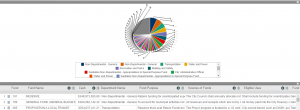
Looking specifically at department spending, we see that Transportation, Water and Power, and Recreation and Parks are the three highest non-general category departments in terms of cash.  capture


In terms of things that I found lacking, I do find myself wanting for more detail for some of the spending that the funds themselves are doing in terms of specific contractors and projects. The dataset is organized on a much more macro-scale which allows a viewer to see what kinds of departments might be successful and in trouble, but it doesn’t let you see the “why” for how those departments got into those positions.

If I were to remake this dataset into a different ontology, I would have it organized in a fashion that breaks down the assets and liabilities a bit more in-depth so if an auditor for that department used the dataset, they could more easily identify the pros and cons of that departments budgetary spending.


LA Procurement

I decided to analyze the procurement dataset, which contains records of what the City of Los Angeles has bought since Fiscal Year 2012. These records contain fiscal year, department name, vendor name, transaction date, description, unit price, fund name, and other information. The Los Angeles City Controller website also uses some of this data and visualizes it on data cards, making it more accessible, user friendly, and easy to understand. These cards show how much the city of LA spent on certain items. When you click on the cards, it tells you what the items are, why they were bought, and some other facts related to the item.

pic2
LA procurement data set
Data cards visualizing procurement data

Wallack and Srinivasan define an ontology to be a way to represent reality through “systems of categories and their interrelations by which groups order and manage information about people, places, things, and events around them.” This procurement dataset represents the city through the eyes of the ‘state’ or governing institution. It breaks down what is procured into how much it costs, where it came from, etc. but hardly provides any information about what it’s specifically used for or why it was bought, and what impact it had after being procured. All these questions that this dataset fails to address are what  actually impact community members, whereas the information it addresses about where it comes from, what fund is being used to pay for it, etc. are what the governing body is more concerned about. The data card visualizations are better catered towards the ontology of community members as they show information of what exactly the items are and why the items were procured, which is on the level that citizens experience these procurements in their lives.

The ontology of the procurement data makes the most sense through the eyes of a government official who is perhaps in charge of the yearly budget or has other fiscal responsibilities in the state. It is very easy to see from this dataset how much these items cost, where the money is coming from, who it’s being paid to, etc. which is exactly the information that government budgeters need.

Although this dataset attempts to make what the city is procuring, how much it is spending on these items, and where they are coming from more transparent, it leaves out important information on a community level, such as what neighborhoods or areas these items are being given to, why they are being purchased, to whom these items will benefit, and what impact these items will make on the general community. To a general member of the city, these are the aspects of the data set that are more important than how much an item costs or where it is coming from. It seems that the city controller website is attempting to bridge the gap with the data cards, which clarify the procurements to an extent, but many questions still remain unanswered. When I look at the data cards, such as the one describing the city spending $1,159,775 on leasing golf carts, although I am able to learn that they are used for the City’s municipal golf courses, I am left questioning what neighborhoods or groups in LA most benefit from this and why the city decides to spend money on golf carts rather than some other matter.

If I was to start over with data-collection and create the data from a LA resident’s point of view, I would include not only what was bought and how much was spent on it, but also a description of what purpose the items serve, where it is being used, how much more or less is being bought than the year before, and the impact it has on the community. For example, for the data record of 6,670 soccer balls being bought, it would perhaps include what youth leagues the soccer balls are going to, how many more soccer balls were bought than last year, and show that they were bought because there was an increase in people joining the soccer league. The data cards presented on the city controller site includes more of this information than the procurement data set does, so they are definitely a step in the right direction to bridge the gap between community and state ontologies.

Risha Sanikommu

Blog Post 3

I examined the Payroll by Position data set, which organizes the payroll information for all Los Angeles City Departments since 2013. The data categorizes financial details based on very specific job positions, even separating roles with the same name into a different row (i.e. “Senior Management Analyst II” versus “Senior Management Analyst I,” and even those position with the exact same name is distinguished by record number/ employee id). The job department title and year constitutes a record in this dataset, branching into 34 categories including: record number, class title, employment type, projected annual salary, Q1-Q4 payments, payments over base pay, & over base pay, total payments, base pay, permanent bonus pay, longevity bonus pay, temporary bonus pay, lump sum pay, overtime pay, other pay & adjustments, other pay (payroll explorer), MOU title, FMS Department, job class, pay grade, average health cost, average dental cost, average basic life, average benefit cost, benefits plan, and job class link.

In reference in Wallack and Srinivasan’s definition, this dataset’s ontology provides information on based on meta ontologies that may be mismatched with community ontologies, therefore leading to information loss and resulting inaccuracy. The data is collected and organized by the Los Angeles City Controller/Control Panel and therefore considered a large-scale dataset, making it difficult to incorporate into local, contextualized knowledge more specific to certain parts of the city. This ontology would make the most sense to a city official or manager, as it is helps them consider how much revenue is allocated to employee salaries and how to balance payroll for the most effective cash flow.

The dataset claims to hold a firm understanding regarding the payroll of a working class citizen of Los Angeles, as it lists a variety of job class levels from custodian to manager, part- and full-time, and lower- to upper-middle class salaries. Although the dataset provides a structure to determine which departments and offices is in need, the payroll information is monitored and controlled by the city and leaves out the perspective and input of the community. If the data-collection were influenced by the community ontology, the data would more resourcefully reflect societal concerns based off of economic conditions of certain regions, relevant skills and experience of individual employees/applicants, consistency for job roles and corresponding duties, etc.

Week 4 – Top City Earners

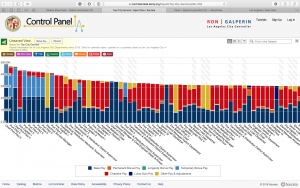
I thought the Top City Earners dataset from the L.A. Controller’s Office would be an interesting set to dive into. This dataset showcases the top salaries for Los Angeles city workers. These salaries are comprised of various factors such as base pay, overtime pay, other pay, and more.

The various data types are the occupations, and the amounts of money they are paid. These monetary values are also broken down into sections. These pieces of data comprise a record with occupation title and total pay. Wallack and Srinivasan describe ontologies as, “systems of categories and their interrelations by which groups order and manage information about the people, places, things, and events around them.” The ontology can be seen in the records for each occupation. The various categories data types add up to make total salaries. But when looking at each position, the data types combine in different ways. For instance, when looking at purely base pay, the Chief of Police and the General Manager & Chief Engineer of Water and Power earn the most. However, when factoring things such as bonus pay and overtime pay, the positions at the port earn the most. Another thing that is quite interesting is that firefighters seem to make the lowest base pay. Often, their overtime pay is double that of their base pay. Why is this the case?

screen-shot-2016-10-17-at-11-41-22-amSome people that may find this data useful are city officials who are in charge of the budget, and also taxpayers. City officials can see how much of the budget is going to what positions and how they affect the city as a whole. Taxpayers can see where some of their tax dollars are going, and how the city of LA is paying its workers. I would imagine people would wonder why some positions get so much bonus pay. The job descriptions and years of experience are missing from the data set. This would help to differentiate the positions and give context as to why they are being paid so much. This also helps in comparison. For instance, why does a port pilot make significantly more than firefighters or police officers?

When approaching this data again, it would be interesting to divide the records by job types such as firefighters, police officers, and port pilots. It would be interesting to see the pay distribution in the individual categories.

Top City Vendors


The information presented in the Top City Vendors bar graph represents only a slim variability of data types, as there are only three available: vendor title, dollar amount, and fiscal year. Records in this case are categorized squarely by time and amount.


Given that this dataset is one of the most straightforward lists to be found on the LA Controller’s site, I find its simplification to be indicative of many of the social and administrative problems apparent in all the respective datasets located on this site. We can view each of these datasets as not necessarily reflecting the biases of Ron Galperin, Los Angeles City Controller, but of the Los Angeles government as a whole, whose organization of Los Angeles’ funds is an opaque and mysterious affair.


As was already mentioned by my classmates, the data available in these sets are only readily accessible to the administrative elite or politically savvy; and I mean this in the sense that while this information is publically available, its precise and detailed information is kept guarded by bureaucracy and privileged knowledge.


For example, knowing that the city treasurer spent $501,200,595.00 in 2015 tells me nothing about what that money was actually spent on, leaving me, as a citizen of Los Angeles, in the dark about the administrative processes that deal with this city’s funding.
In remembering that Wallack and Srinivasan describe ontology as being any organization of differing variables based on a group’s common perception of knowledge, I believe it is safe to say that this information is organized for the benefit of those who are processing the data in the first place, which are Los Angeles city officials. This type of data organization privileges those already in an elite position, so I believe it is ineffective as a dataset meant for the civil population.


City Budget Expenditures for the city of Los Angeles

I chose to view the City Budget Expenditures for the city of Los Angeles. This dataset goes categorizes all information by budget year, fund name, account name, adopted budget, total expenditures, budget change amount, budget transfer in amount, budget transfer out amount, total budget transfer, encumbrance amount, pre-encumbrance amount, account group name, fund name, account, and department. This data set is a complete record of all expenditures by the city of Los Angeles from 2012 through prospective expenditures in 2017.

A record in this data set is constituted by the combination of several inputs in order to categorize an expenditure made by the city of Los Angeles through their specific city budget. This combination of data is used to organize all expenditures into an orderly format that is easily digestible and trackable by the viewer.

Wallace and Srinivasan define ontology as “the distinct systems of categories and their interrelations by which groups order and manage information about the people, places, and events around them.” This dataset’s ontology is how the city budget of Los Angeles is utilized by various city and local level governmental agencies. From viewing this dataset, the priority levels for the use of the city’s money can be distinguished as well as which groups are allocated what sum of money. This data will be found interesting from officials in the treasury department at local, city, state, and federal levels of government. Additionally, any individual wanting more information on the use of taxpayer money can be enlightened by information from this dataset. For example, a viewer of this dataset can find information on how much money Los Angeles spends on salaries for the Recreation and Parks department or how much money is used on the upkeep of the Granada Hills Pool and Aquatic Center by the aforementioned department.

While this dataset does a great job at showing what expenditures were made by the city and when they were done, it fails to go into enough depth to actually allow the viewer to fully comprehend what the expenditure actually accomplished. For example, when looking at the General Services Department category, one can see that just under $5.6 million was allocated toward a fund and account named “General Fund: Maintenance Materials.” This fails to shed any light on what was gained by this expenditure. I believe this dataset could be improved by including very brief one sentence descriptions of what was accomplished by the use of this money for each data point. While this may seem tedious, taxpayers should know what their money is going towards in their community. Furthermore, creating completely separate folders by year would make this dataset more readily understandable because viewing expenditures anywhere from 2012 to 2016 in the same area can cause the data to become murky.

Gender Breakdown of City Workers by Department

The datatypes available in the gender breakdown of city workers by department consist of year, department title, number of employees, numbers and percentage of male and female employees, their total salaries and averages, divided by gender, and a breakdown of the percentage of the payroll that was paid out to each.

The dataset’s ontology is a primarily gendered one, with an economically oriented epistemology, as it looks primarily at earnings and participation in the workforce, and uses gender to draw divisions within each department. It can function in a few different ways, but the clear overarching purpose is one of examining the role of gender in the workplace. Feminists, particularly, will find useful information here.

As far as the phenomenon described by the dataset, there are a couple of interesting points. Within many departments, more of the total payroll is distributed to women, but it’s only in Recreation and Parks that women actually show a higher average earning than men, and by a margin of less than $1000. This means that, in many cases, greater numbers of women are working than men, but that they tend to earn less on an individual basis.

As far as what’s left out, the dataset does insist on a binary categorization of male/female, which makes it incapable of accounting for intersex, genderqueer, and transgender identities, and the ways that those might affect one’s workplace participation and earnings. Studying this would require an ontology capable of accounting for a spectrum of identities rather than a binary.

Blog Post #3: LA Police Expenditures

Using the L.A. Controller’s Office website, I was able to access the dataset for Los Angeles Police Expenditures. The dataset includes a myriad of data types, including the ID Number, Fiscal Year, Department Name, Vendor Name, Transaction Date, Dollar Amount, Authority, Business Tax Registration Certificates, Government Activity, Fund Group, Fund Type, Fund Name, Account Name, Transaction ID, Expenditure Type, Settlement / Judgement, Fiscal Month Number, Fiscal Year Quarter, Calendar Month Number, Calendar Month / Year, Calendar Month, Data Source, Authority Name, and Authority Link. The record in this particular dataset is the sum of police expenditures for the city of Los Angeles, spanning June 2011 to January 2014. This sum totals up to nearly 4.9 billion dollars.

Wallack and Srinivasan would go on to describe ontology as ‘the distinct systems of categories and their interrelations by which groups order and manage information about the people, places, and events around them’. By this definition, a particular ontology works to build and enact paradigms within a social demographic and situate knowledge within a community. The Police Expenditures dataset collects and organizes information related to all police expenses and funds. Access to this dataset grants the Los Angeles community some level of clarity in relation to the LAPD. After parsing through this mass amount of data, citizens may develop a better sense of what funds are allocated where, and what gets prioritized by local law enforcement. A benign example being – how much is spent on veterinary funds, vs. how much is spent on training programs.

I found a major pitfall of the dataset to be its ambiguity. The spreadsheet is general and unspecific, pointing often to large monetary units categorized simply as “general funds” or “supplies”. Because of the dataset’s vague format, I’m inclined to believe the information is organized in a way decipherable primarily to those familiar with the rhetoric of L.A. law enforcement bureaucracy. Speaking as an L.A. resident and common citizen, I’m pretty lost on what the expansive term “supplies” might entail. I might be interested in knowing how much the city spends on firearms, vs. how much is spent on body cameras. After moving through such a considerable amount of data, I find myself still a little lost as to what is supposedly being “illuminated” by the data. The dataset seems to offer the facade of accountability– numbers, vendors, years, etc., while in reality revealing nothing citizens probably didn’t already know. If I were to rebuild this dataset, I would format the information in a way that is intuitive and legible to average L.A residents. This might mean specificity, or the creation of new fund and expenditure types. 

Blog Post 3 – Top Earners

For this week, I decided to analyze the Top Earners dataset from the LA City Controller’s Office. The data primarily looks at different occupations vs. the amount they earn. Their salary is further broken down into categories to help us better understand the data. The data types are the occupation, salary, and the types of pay. Some of the types of pay are base pay,  bonus pay, overtime pay, and others. A record can be described as the salary for each occupation. The recorded this information from payrolls from the year 2013, and are updated on a quarterly basis.

Wallack and Srinivasan define an ontology as “systems of categories and their interrelations by which groups order and manage information about the people, places, things, and events around them.” The ontology in this particular dataset is how a single record of salary is broken up into multiple parts to better understand how the salary is structured within different occupations. For example, we can see how a main chunk of the fire captain’s salary is made up due to overtime pay, whereas the port pilots is due to bonus pay. We can also compare the different base pays across occupations and whether the majority of their income is due to other varied factors.

screen-shot-2016-10-17-at-9-54-20-am

We can draw a conclusion that most of the highest earning individuals are port pilots, apart from that particular fire captain, in the top ten. This information is useful for researchers who would like to know how the salaries of these positions are divided and which occupations earn more on overtime vs. bonuses.

I found it interesting to see how the actually salaries were almost double the base pay, and it was very interesting to learn how they were structured. I think adding more details like how long the people held the position for, and how their salaries evolved with experience might have been useful to a researcher. It might also be helpful to see the gender of the person in this role and compare the differences in the salary of the same post between genders.