Vilna Ghetto

I chose to look at Exploring the Vilnius Ghetto: A Digital Movement. The site provides an in depth history of the Vilna Ghetto which was established in Nazi Germany. The site provides multiple maps describing events that were related to the operation and evolution of the Ghetto as well as the perimeter of the location within the context of Poland during World War II. The Ghetto was used as a geographical location of oppression and ostracization for Jewish citizens. Vilna became a place of horrific abuse, mass shootings, imprisonment, and forced labor.

That maps depict a time line of events and their geographic relationship to the Vilnius Ghetto. The events are displayed with clickable points on the map which once clicked go into further detail about the story described. To the left is a legend that indicates what story is represented by color of the dot. The stories begin in 1941 with the formation of the Ghetto and follow all the way up till the end in 1943. hThe information given is comprehensive and allows a linear read of the events while still providing room to expand these individual events virtually through the use of the map. In this way the user is not confined by linear narrative, but alternatively it operates as a a loose guideline to understand the progression and evolution of these events.

Though the events appear to be presented in a relatively neutral manner, the information of events given is horrendous. This juxtaposition between context and data visualization creates a gap between the subjective experience of the landscape and how it was perceived by the occupants of the Ghetto compared to its dry and seemingly neutral betrayal within the map. We are left to create our own narrative about these atrocities but are missing a key component of the perspective as the map displayed is relatively detached from these subjective experiences. Obviously the map is important in conveying this information but I think it is important to note the deep psychological impact that these experiences had and the failure to capture them just by data alone.

Moma Data Visualization

For our group, we were given the data sets that correspond to MoMa’s collection of artworks. The data includes the artists name, artwork, the age of the artist, the gender of the artists and the nationality of the artist listed. One of our groups main focus points is to explore the relationship between the artists gender and the time period in which they were working. I chose to use Google Fusion Tables to create a data visualization describing this discretion between male and female artists. I used a bar chart to represent this data, showing how there was a total of 1,635.369 female artists working in the 1930’s that are present within the collection. In opposition to a total of 3,612.951 males within the collection.

data-visualization

As you can see by the alluvial graph there is a a large gap between the male artists kept in the collection and the female artists obtained. Not only can we see a disproportionate difference between male and female artists in the collection, but we can see that there is a higher concentration of women artists working in the late 90’s than any other period. Furthermore, we see instances where gender is unclassifiable due to collaboration.

This data visualization allows a more direct visual understanding of the data represented within the spread sheets. We are able to see a physical transition throughout 1943 to 2012 as to the gender of artists collected. With this information we are able to infer our own ideas about what this information can mean. Without a visually intuitive framework, such hypothesis would be difficult to draw.

Neighborhood council Expenditures

The La Controller’s Office offers a series of data sets that describe the circulation and distribution of funding throughout the greater Los Angeles area. Specifically, I chose to focus on the data set entitled “CD 2 Neighborhood Council Expenditures”. Its purpose is to provide the yearly amount spent by neighborhood councils within the San Fernando Valley. It includes multiple datatypes such as account names( the neighborhood councils allocated to districts within the valley e.g. Van Nuys NC, Valley Village NC, etc); fiscal year, which in this dataset is condensed to the year 2014; and lastly the amount spent by the neighborhood organizations within that year.

The dataset appears rather straightforward at first glance. It shows that “Sun Valley Rec Center Field & Restroom” spent the highest amount in 2014, $357,121, a staggering amount compared to the second highest, which was Studio City at $35,957. What we may infer from this information is based on the digression of our ontological point of view. Having grown up in the san fernando valley, I understand firsthand the economical gap between areas of perceivable wealth and areas of perceivable economic deterioration. For example, studio city and valley village are both wealthy areas. This is supported not only by the dataset expressing that both of these cities spent the second and third highest on community sustainability, but also due to increased housing prices, and overall capital growth of the areas. One does not necessarily need a dataset to perceive the gap between these neighborhoods in comparison to other neighborhoods such as Van Nuys (spending 22,519 annually) , insofar that there are visual differences that describe these gaps. Such differences cannot be accurately or completely described in a dataset.

Wallack and Srinivasan’s essay on mismatched ontologies describes this division between community ontologies and bureaucratic ontological worldviews that may alter and reduce information to fit within a specific organizational system. This divide can lead to and promote already established economical inequality and instability within those communities.

If we look at the CD 2 Neighborhood Council Expenditures” we’ll see that Sun Valley has spent the most in 2014. We may want to infer that this is due to the city’s economical wealth, However this would be leaving out important information. In fact, despite the data shown, Sun Valley is far less stable economically then the cities listed after it. This could be problematic if we look at this data without having  a hold on its context.

For example, if neighborhood funding is based on yearly allocated funds, their may be a lack of funding for 2015, assuming that Sun Valley may have spent through their limit. This does not consider the likely debilitating circumstance that may have caused the Sun Valley Rec Center Field & Restroom to spend such a large quantity. As a result, potential future funding may alternatively be provided for cities that are already economically prosperous.

Inventing Abstraction

Inventing abstraction is an interactive website site based on MOMA’s 2013 exhibition that explores the trajectory of abstraction through modern art. The site consists of information on artists influential to the movement spanning from 1910-1925. With the information provided audiences are able to construct comparisons of participating artists, and understand the movement itself as an agglomeration of changing ideas that originally sought to undermine and challenge concepts related to how we construct and understand imagery.

Much of the Site’s source material is derived from the exhibition itself, as well as the exhibit catalogue, featuring in-depth information about the artists included within the show. The site also features videos and audio samples of contemporary artists speaking about specific works within the show and curatorial director Leah Dickerman explaining her intentions as they relate to the contextual history of abstraction.

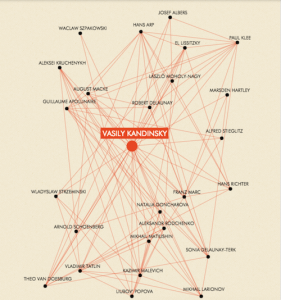
Leah Dickerman’s main argument within the show is to emphasize the interconnectivity of artists involved within  the movement, to dispel to the idea that abstraction was contrived in a space of isolation. The main bulk of the website supports this claim as it visually shows how many artists were in dialogue with one another.

In order to process this material, Dickerman sat down with her team of researchers and placed all of the artists in a Microsoft Excel spread sheet. From there, they would go through each artist and see if they were acquaintances of or in dialogue with any of the other artists within the list. They would then draw a line connecting the artists, quickly creating a complex web of interconnectivity.

The information is presented with an interactive map that allows the user to click on each individual artist to view who they had been in dialogue with. Artists who appear to be connected to a severe degree are labeled with a red font.


Vasily Kandinsky being the ‘most connected’, much of which can be attributed to his published works and the circulation of these writings. As the user clicks on each artists a new page appears that allows a more centralized and specific account of interconnectivity.

screen-shot-2016-10-02-at-10-50-15-pm-copy

As well as this complex web, the site lists each artist individually in alphabetical order, when a name is clicked on it will provide the web that displays the contextual role that each artist played within the movement, listing the work exhibited within MoMa’s exhibition as well as where they worked and art historical movements that they were invested in.

The website itself allows a helpful visual argument to Dickerman’s main point, which suggests abstraction evolved as a conversation and experimentation among artists within the early 19th century. The interactive quality allows the user to engage within this experience. However, the site does not seem to specify exactly what constituted as ‘being connected’ with another artist as it can be assumed that some artists may have been more direct dialogue than others. Regardless, the website is able to paint a comprehensive picture of the complex evolution of abstraction.