Blog

Week 5: Instagram in Museums

Museums have mixed feelings about social media (especially Instagram). While some, such as LACMA and the Broad, want their visitors to pass by and take photos to post on Instagram (the #FOMO is strong here), others want nothing to do with Instagram and how it seems to be just one more app that keeps people’s faces drawn to phone screens, and not the art. However, Sarah Hromack and Rob Giampietro say that museums are faced with less and less choices. With more and more authority being put in the hands of the viewer via the power of social media, museums can’t afford to turn blind eye to how it’s transformed the museum experience.

You could even say that museums have captured Insta-fever. Around two weeks ago, I ran across this article on The Verge that talks about how the Tate Modern in London is going to put a series of Instagram photos on display in the museum. Run by Amalia Ulman, her Instagram @amaliaulman is a performance piece. She is the main character, portraying a small town girl trying to make it in Los Angeles. Apparently, it was compelling enough for the Tate Modern to install a selection of her posts in their space.

What the Tate Modern is doing is taking their interactions with social media (especially Instagram) to a new level. While performative Instagrams are common (and to an extent, all Instagrams are performative), this is likely the first time a major art museum has decided that it would join the echelons of “art that belongs in a museum”. At the same time, Instagram is a form of digital storytelling via photography/videography, so it could also have been considered only a matter of time before a museum decided to install a series of Instagram posts in their halls. There are plenty of accounts dedicated to being performance pieces (such as the woman who tricked her family into thinking she was in Thailand) to expose just how constructed social media can be, and that is art in its own right, I guess. (At least, the Tate Modern seems to think it is.)


Week 5 – The Virtual Worlds of Youtube and Museums

In the article, “Museums See Different Virtues in Virtual Worlds” written by Anand Giridharadas, Giridharadas discussed the various ways museums, specifically the Metropolitan Museum of Art and the Brooklyn Museum, have outreached their information to further open its worldwide audience, especially through social media platforms. A part of the reading that struck a cord with me is the idea that the public no longer wishes to see the final “polished” product, but seeks the behind-the-scene views into the lives of the creators — best said by Sreenivasan :“You want to build an audience before you have the big launch, rather than just sit on something and have it appear.” As an avid youtube watcher, one of the biggest things that this reminded me of was the movie “Camp Takota” starring Grace Helbig, Hannah Hart and Mamrie Hart (all famous Youtube celebrities). Helbig has stated in numerous interviews that she attributes the success of the movie and its massive following to her two week video blogs where she took her youtube audience of her personal Youtube Channel (“itsgrace”)around the set, introducing the viewers to the cast, directors, producers and showing the making of the movie as it was being made. She claims that the video blogging experience made the viewers more invested into the movie (thus, more inclined to purchase the movie), as if the viewers were somehow a part of the movie by watching the making of it. Without the accolade nor publicity of professional film studios, this insight of behind the scenes information developed a more intimate relationship and bond to viewers. Helbig’s view and experiences would further the argument of Sreenivasan.

Screen Shot 2016-02-01 at 9.33.25 PM

Giridharadas also touches on the fine lines involved in creating shareable content that would speak to potentially anyone and everyone; yet, maintain its sense of credibility and scholarship in an internet world of cat memes and cinnamon challenge videos. This balancing act can be somewhat compared to the world of Youtube as well. Youtube relies on the factor of sharing videos to achieve “viral” success and even encourages this behavior to create viral content, yet aims to be seen as a more professional platform by creating music video award show and web show series. Although museums and Youtube are vastly different entities, they embed similar qualities in that they both aim to provide platforms that endeavor to showcase something reflects our culture to the public eye.

Week 5 Blog

All of the articles that we read for this week center around a very important theme which is how does one make museum exhibits more accessible without running into the problem of diminishing its value. I feel that sometimes technology can be a sort of spoiler in that one can’t see something online and then get a first impression of it in person which arguably would be a more meaningful experience. That being said I was delighted to read the New York Times piece on how there needs to be a balance between what pieces of art are made available online. The issue that this article deals with is that with such a high level of content available online, adding the art to stand next to the mass amount of media diminishes the value of the museum pieces or “watering down” to quote the article.  The article on Rhizome makes an excellent comparison with Youtube with an incredible amount of video available that not a single person could watch every video posted on youtube.

This reminded me of several articles that I have read that tell of the “tech bubble”. Essentially, the “tech bubble” is the high evaluations of technology companies and startup companies that are being overvalued because of how excited the market is. There is speculation that the bubble will burst, just like the real estate bubble in the early 2000s.

Vanity Fair Tech Bubble is Full of Hot Air

There is a danger in over saturating the market with so much content. I am not saying that technology should not be displayed online and distributed that way, however there needs to be a balance. I feel that as a digital humanities student, many people over look that like many humanities disciplines, there is no right answer but rather gray areas and debates. I don’t believe that there is a yes or no answer to wether art should be published online because it will diminish its value as a physical object but rather there needs to be a balance. Art online should inspire people to visit museums without spoiling all of the art and the experience of being in the museum in person.

Week 5

The part of the readings that I found to be the most interesting was in the Art in America article “The Museum Interface” written by Sarah Hromack and Rob Giampietro, in which Hromack discusses a group of people n New York she spoke to who chose not to attend what she perceived to be an important exhibit due to the high quanitity of social media exposure to the exhibit they had received. I feel like this example directly relates to what we’ve discussed in class, which is whether or not the digital experience of an exhibit can act as a replacement to actually experiencing the exhibit in person. Hromack made the point, which I agree with, that without physically visiting a museum and seeing a piece of art for yourself, you lose some sort of sensory reaction and perhaps sense of wonder. That indefinable quality that comes from the museumm experience, I don’t think will ever be replicated into the digital sphere until we are virtually able to enter the museum space and experience it as though we are there in person.

Still, I think that the role of digital exposure in the museum world is important. A growing trend in museum visitorship is to use social media and photography to look at art in a comedic sense through parody. Last year my family went on vacation to Italy, where we essentially took a museum tour of the country. While the artwork was impressive and awe-inspiring at a certain point interaction and interest with for example hundreds of similar statues of ancient Roman figures becomes limited. My sister and I thus decided to pose ridiculously with said sculptures and objects so as to liven up the experience. Though I was slightly concerned with disrespecting the museum and the art, I think humor can actually work really well in helping people who otherwise not be interested in art to actually appreciate what they are seeing. The article “Museums See Different Virtues in Virtual Worlds” touched on the comedic role of social media in the museum experience when it touched upon the mustache tour of the Met.

Multimedia Journalism + Online Museum Publications = ?

The reading that really got me thinking this week was the Rhizome piece by Orit Gat, “Global Audiences, Zero Visitors: How to measure the success of museums’ online publishing.” Gat argues that museums should not use online publishing solely as a means to expand their audience, although online presence seems like a no-brainer in this digital age.

I agree with Gat. The purpose of a museum is to advance knowledge and encourage discussion about culture, history and heritage. And online publishing, along with any effort by a museum should serve to advance this goal. According to Gat, the success of a museum’s online publishing can be measured in terms of the innate value that it specifically brings to its digital audience (i.e. zoomable images and interactive features that print magazines lack) and the meaningful conversations that it creates.

That being said, I guess the million-dollar question that we’ve all been trying to grapple with in class discussions is, how the heck do we imbue value to digital platforms used by museums – specifically, online publications in this case? One solution is to make the connection between text and multimedia more seamless and meaningful, and I think this is something that museum curators can learn from multimedia journalists. Of course, I am by no means saying that one is better or worse than the other.

For example, The New York Times creates beautiful and immersive visual stories that marry the benefits of multimedia and the written word. One example is Desperate Crossing, a story about the journey of 733 migrants across the Mediterranean Sea, most of whom were trying to escape the poverty of subsaharan Africa or the violent wars in the Middle East. The visual story offers readers an experience, not just facts and ideas. The full-screen photos and videos, which are specific to the bite-sized text displayed, add real-life context and continually project it in the readers’ minds, as opposed to images and videos intermittently embedded between paragraphs which I’ve seen in some online publications by museums. I can see the same multimedia style being applied to digital artworks that use photos and videos or for editorial content that aims to give visitors further context about a certain artist or artwork.

Screen Shot 2016-02-01 at 4.40.36 PM

And we can already see the same immersive multimedia/long-form style being applied to arts-related topics. Take this New York Times piece about architecture for instance: “Dear Architect: Sound Matters.” It incorporates both sound and video! I can see museums incorporating the same idea for digital tours of exhibitions.

It says: Hover for sound.

Also, this piece about the newly opened Whitney Museum of American Art in New York, “A New Whitney.” The 3D animation really enhances readers’ understanding of the space.

Screen Shot 2016-02-01 at 4.59.02 PM

Another benefit to using this multimedia narrative form is that it encourages collaboration across various art fields: photography, film, 3D visualization, animation, etc.

The possibilities are limitless.

Week 5: Art Snapchats

In “The Museum Interface,” Hromrack and Giampietro talk about facilitating “meaningful interactions with art that might occur in the gallery, via Web-based applications or in new hybrid spaces that merge the real and the virtual.” But how can curators control for these interactions to be meaningful, educational, and appropriate when technology has allowed for more freedom in digital engagement? Museums have utilized Instagram, Tumblr, Twitter, Facebook, and online blogging platforms among many other digital tools to further expand and connect with both the local and global audience. And while the number of likes, followers, comments, and retweets can be quantified and measured, it does not necessarily translate to meaningful interactions as Orit Gat points out in his article.

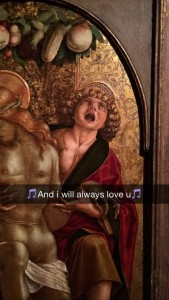
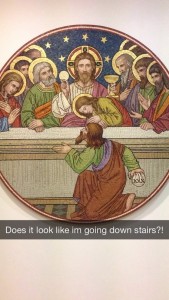
A case in point is the way museum visitors use Snapchat to interact with the art. Due to the short lifespan of the captured photo, people behave and interact differently as opposed to careful posing, filters, and comments in Instagram. To catch the Snapchat users’ attention, funny, witty, or even inappropriate comments are added to the photo, which not only affects the way the art is encountered and experienced by those viewers but also leads to blatant disregard of the artist’s work and the curator’s intended experience. Buzzfeed has a couple articles dedicated to some of the saved Snapchats out there in the virtual world showcasing the ways users have interacted with art. In a way, these snapshots have become a form of art in itself since they are forms of expressions and interpretations of the users. But it poses a challenge for museums to balance their role as the caretaker of the collections while also enabling scholarship and digital engagement with the public. Giampietro says, “The new hyper-visibility is difficult because it can transform a unique installation into commodified image; the work’s lasting political power could easily be mistaken for a fleeting trend.” And these Snapchats of art pieces, although very funny, have completely removed the objects from their resonance, ignoring any means of meaningful interaction. Perhaps this is one of many reasons why museums have prohibited pictures in the gallery.

enhanced-buzz-17557-1402423688-4
picture from Buzzfeed
enhanced-buzz-16376-1402422455-32
picture from Buzzfeed


*Some more links to the Buzzfeed page:

http://www.buzzfeed.com/donnad/16-more-hilariously-inappropriate-art-history-snapchats#.hj8v5y79KP

http://www.buzzfeed.com/jessicamisener/put-these-in-a-museum#.lfn7EN2MBZ

The Museum Interface: “Flattening” Interpretations or Inciting New Ones?

One of this week’s readings stems from the magazine Art In America, and combines the perspectives of experts to discuss and prompt critical questions pertaining to the use of digital platforms and supplementations in the museum world. What certainly stood out to me was the overall concern for works’ interpretations- specifically, who has the “say” in how people, regardless of experiencing a museum collection or piece in person or online. Rob Giampietro, a renowned leading designer and writer for Google Design, explains this best in the article, stating the example of Instagram as a method of digital delivery that is both compelling and undermining of museum experiences, particularly using the installation “The Sugar Sphinx” by Kara Walker. He says, “In Instagram’s interface, pictures of Walker’s installation appear stamp-sized on a phone’s screen, flattened in all dimensions, their likers and commenters quantified.” It’s interesting how when even the dimensions of a work or installation is put online in, say, a museum collection, it is still lacking in the experience of scale; Walker’s Sugar Sphinx is huge, but when captured in an Instagram photo, it’s size is immediately somewhat downplayed.

However, Giampietro adds, “These images may document the installation, but they also document and identify each photographer’s individual presence in the space.” Instagram images, especially when captured by a user at the installation in real time, creates an interpretation that is altogether unique and different from that of other, similar Instagram images. If one were to see a collage of all the Instagram photos of Walker’s Sugar Sphinx, every single moment captured is an entirely separate interpretation and experience of the installation; something that is only brought out of documenting through social media photographs.

The new hyper-visibility is difficult because it can transform a unique installation into commodified image; the work’s lasting political power could easily be mistaken for a fleeting trend.

A formal photo of The Sugar Sphinx versus the variety of photos of it seen on Instagram, with commentary and initial reactions usually being rather vulgar.

dpearxpgipyjuwv0yofa

Giampietro later concludes, “Those discouraged from visiting Walker’s installation in person because of its ubiquity on social media may have been discouraged not by what the installation itself offered but by what its flood of representations removed: the sense that an encounter with the work could be personal or transformative.” The numerous capturing of the installation may take away a real-life experience when seeing it in a museum setting, but it also allows users to interpret art in their own way; the argument thus lies in the allowance or legitimacy in interpretation,a s museums have long worked toward giving further context to works which essentially “give” us interpretations rather than leave room for them.

Mayhem In The Museum, Or Museum Etiquette In The Digital Age

The theme of this week’s readings was a discussion of how the online exhibit is coming to replace the traditional museum experience. In Art in America, the authors specifically noted how many of their peers willingly avoided exhibits because they felt they got all they needed, just from the pictures online. I appreciated how the Met, as mentioned in the Times article, used their online presence to give visitors a behind the scenes look at the museum’s new artworks, like showing the piece being unwrapped upon arrival. I believe that things like this are the best way to ensure that the tangible museum remains relevant: giving some of the picture but not all of it to entice viewers to visit, unlike the institutions which show all of their collection in an online database.

This made me wonder about the benefit of being able to take pictures in museums at all. In the Art in America piece, the authors mentioned Domino’s Sugar Baby, an anatomically accurate and enormous nude woman/ sphinx Karen Walker made of Domino’s sugar. I remember at the time of the exhibit SO MANY people were taking pictures to make it look like they were doing inappropriate things with the sculpture. Here are some examples:

sugar baby
Photo via bustle.com
NEW YORK, NY - MAY 10:  People view Kara Walker's "A Subtlety," a seventy-five and a half feet long and thirty-five and a half feet tall sphinx made in part of bleached sugar at the former Domino Sugar Refinery on May 10, 2014 in the Williamsburg neighborhood of the Brooklyn borough of New York City. The show opened today, is free to the public and will run until July 6th.  (Photo by Andrew Burton/Getty Images)
NEW YORK, NY – MAY 10: People view Kara Walker’s “A Subtlety,” a seventy-five and a half feet long and thirty-five and a half feet tall sphinx made in part of bleached sugar at the former Domino Sugar Refinery on May 10, 2014 in the Williamsburg neighborhood of the Brooklyn borough of New York City. The show opened today, is free to the public and will run until July 6th. (Photo by Andrew Burton/Getty Images)

We have become desensitized to blatantly disrespectful behavior in public for the sake of online virility, and users may err on the side of trivializing artwork to make it social media friendly. The respectful, quiet behavior that was expected in the museum setting is no longer a social norm. I believe the only way to solve this may be to forbid people from taking pictures in the museum altogether.

Week 5- Is art beating technology?

How much should museums interact with digital technology and at what point does technology surpass the experience of the art piece? I remember a few years ago there was a particular piece at the Hammer Museum where visitors would walk into a blacked-out room where a large wooden shed stood. Upon entering, they would see one wall completely made of sharp metal spikes that came to a center. Visitors could also walk around outside of the shed and see the perspective from the outside. Somehow I cannot imagine a digital version of this piece. Although pictures would be cool, there were certain moods that helped make up the piece. Indeed, a particular perfume was sprayed on the spikes each morning giving them a scent which added to the art. Just like the Sugar Baby exhibit, digital visitors would lose out on certain experiences that could only be gained by seeing it in first person.

Full body experiences seem to be the new form of artwork surrounding the visitor with a sensation. Digital technology cannot do much to this end and instead we may be left with a second-rate form of art. As the Rhizome article says, museums need to “digitize to survive” but perhaps artists are becoming aware of this by trying to draw the public out of their phones into full body experiences. After all, is it really an art experience if you view it through the same device you use to write papers, go on social media, and watch cat videos? I think that although museums are evolving to incorporate and use digital technology more, artists are responding by making pieces that cannot be into digital form. Besides, art is usually something shocking that forces the viewer to think differently than they had before. Perhaps art is rebelling against this new digital age?

Cataloging Items

This week’s readings focused on categorizing objects, works of art, and artifacts. “Data standards not only promote the recording of information consistently but are also fundamental to retrieving it efficiently. They promote data sharing, improve content management, and reduce redundant efforts.” Data standards are important for the efficient use of artistic objects. However, as we discussed in DH 101, categorizing cultural objects is inherently racist as it imposes Western ideals on work that wasn’t created for, or by, Westerners. Therefore, although data standards are limitlessly important, we must take care when creating categories that pay respect to the true meaning of the art work.

For example, the simple category “place of creation” or “country of origin” could become a category of dissonance and contention because of all the rampant tension and historical indiscrepancies relating to the borders of cities or countries. If something was created in modern day Russia in the 50’s, was it created in Russia or in the USSR? And how can we remedy these issues to ensure no unintended offense occurs when attempting to categorize objects.

The issues with substandard metadata are apparent in the social media/ blog site Tumblr. On Tumblr, you can tag items with anything you want. There are rarely suggested terms that would remain constant for every object. Though Tumblr content tends to be trashy memes rather than important high art, the issues with inconsistent data are the same: objects become nearly, if not totally, impossible to find. Therefore we cannot discount the importance of controlled vocabulary and metadata for all objects.