Inventing Abstraction, 1910-1925 was originally an exhibition at the Museum of Modern Art that celebrated abstraction as a new and bold style of art. It ran from December 23, 2012 to April 15, 2013. It was then made into a digital project that explores the early history and development of abstraction through presenting a network of modern artists and their productions of art.
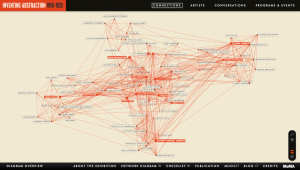
The content of the project consists of various sources, such as photographed images, and audio and video recordings, which build up the portfolios of artworks by the featured artists. Brief texts and captions describing the artworks are included, as well as additional audio commentaries by other artists for selected pieces found under the tab “Conversations”. The original artworks were gathered from the Museum of Modern Art and other art institutions, and processed into digital sources for web accessibility. Paintings and sculptures were photographed, while poems and other performances were audio- or video-recorded. Information about abstraction, the artists involved, and their works were put into texts and the artists’ names were organized alphabetically. Relationships between the artists were identified by the connecting vectors on the diagram.
The website was built and designed by Second Story. It firstly provides an introduction to abstraction, and then leads to an interactive diagram with a simple click on “Explore Connections”. The diagram illustrates the connections between the artists who were featured in the exhibition at the Museum of Modern Art for having influenced the development of the new artistic style. These relations are shown through the connecting vectors and the names of the artists with the most connections are highlighted in red. The artists’ biographies, including their works, their birthplace, the places they worked in, and their interests, can be found on a separate page by clicking on their names. In addition to the diagram, the website organizes further information about abstraction and the project into different tabs for easier navigation. While the diagram is a helpful visual that emphasizes the connections between artists, the complete list of the featured artists, along with their information, is also provided under the “Artists” tab on top for a more thorough exploration of the project. The Museum of Modern Art also hosts performances and events, which can be found under “Programs & Events”, in order for viewers to experience abstraction first-hand. The bottom tabs include an overview of the diagram, PDF files of the network diagram and the checklist of all the artworks featured in the exhibition, information about the exhibition and the publication, links to related music and the blog, and the credits for the online project. The intuitive web design produces a user-friendly website and the categorizing of information into various tabs allows viewers to gain deeper insights about the project and its topic.
I think you did a great job of explaining all of the intricacies of this digital project by going into detail about all of the sections of the website and how they work together. It might have helped with clarity if you organized your post by sources, processes, and presentation, just to make sure the reader can easily identify which level you are talking about at a given point. But, overall, I really enjoyed reading your post!
I like how you introduced the topic and then delved further into the project. You explained how the site is organized with extreme detail and I could visualize it without visiting the actual site. However, I would have liked it if you would have included a couple more images of the site, so that it would add to the visualization of the website for the reader. Overall, your blog post explains the website in great detail and definitely got me intrigued about the subject.