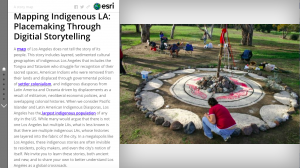
The Mapping Indigenous LA project seeks to create digital story maps that help to chart the geographies and sacred places of peoples indigenous to Los Angeles. With emphasis on the Gabrielino/Tongva and Tataviam, American Indians, and the indigenous diasporas from Latin America and Oceania, this project incorporates community-based research collaboration in order to tell the ongoing stories of indigenous peoples. The project seeks to counteract the notion that settler colonialism entirely eliminated native inhabitants, or that we should study the Tongva only in the way that Christian missions have affected them. The project’s story maps intend to document a more complex and inclusive version of indigenous peoples’ experiences throughout their continuing presence in the Los Angeles basin and surrounding islands.
The project’s website provides several story maps which document indigenous people’s experiences. These story maps incorporate photographs, videos, and maps as source materials in order to convey complex cultural geographies. For instance, late nineteenth century maps of Los Angeles that are used in the story map Mapping Indigenous LA were taken from UCLA Library Special Collections. Other sources come from books that are listed in the Resources section at the end of each story map. Because the project relies on community-based research, some materials also come from individual indigenous community members, as well as groups such as the Gabrielino/Tongva Springs Foundation.
The project creators combined all these sources into interactive narratives in the form of story maps. To create the story maps, they used esri’s mapping software ArcGIS. More specifically, the creators used one of esri’s Story Map application templates: the Story Map Journal app. In the Story Map Journal format, someone viewing the Mapping Indigenous LA story map, for instance, can scroll through written descriptions appearing in the left panel, while corresponding images, videos, and maps appear in the right panel. Some images, like maps, are interactive and allow the viewer to click on certain parts of the map to learn about the indigenous history of each. Also, when the viewer clicks on links within the written descriptions, different images appear on the right panel, thus allowing the viewer to see different parts of the narrative at will.
The Mapping Indigenous LA website itself matches the format of other websites associated with UCLA, with the same blue navigation bar that you find on MyUCLA. The homepage incorporates images that link to the story maps and other materials hosted on the site. There is also a brief description of the project’s aims, though the “Research Scope” section provides a more thorough explanation as to the project’s goals and parameters. In addition to providing several story maps, the website also contains a “Create Your Own Story Map” section, which provides thorough instructions for anyone who would like to contribute a story map to the project. This section details the process that the project creators used in order to create their story maps, but it also defines the nature of the project as ongoing and inclusive of many members of LA indigenous communities.
The website is presented clearly and is not difficult to navigate, though I found it necessary to read several sections of the website before I could grasp the purpose and scope of the project. The story maps are similarly easy to navigate, but require the viewer to interact extensively in order to extract all parts of the narratives.
Wonderful post! I also appreciate how the Mapping Indigenous LA project has a few pages in Spanish under the “En Español” tab, including “Sobre Nuestr@ Proyecto,” “Nuestr@ Equipo,” and “Mapas de Historia.” However, the only fully translated page is “Sobre Nuestr@ Proyecto”; the other “Spanish” pages merely have Spanish titles but the body text is all in English. If this website was redesigned in the future, I would hope that the content would be accessible to not only Spanish-speaking users, but also to users who speak the languages of Gabrielino/Tongva and Tataviam, American Indians, Latin America, Oceania, and other indigenous groups added by the public.