Week 2: Haiti

Upon reading Julia Gaffield’s “Haiti’s Declaration of Independence: Digging for Los Documents in the Archives of the Atlantic World,” the Maya Codex came to mind. The Haitian’s declaration of independence’s unknown whereabouts, and Gaffield’s attempt to further uncover it, was a great in-debt research through many different sources. Haiti’s history would not be fully accountable if it were not for the different travellers from different areas documenting it in their own accounts (even if there was some sort of bias). The Mayan culture is widely known for their unique language and creation of the Mayan codices. There are only four known surviving Mayan Codex manuscript, and it is incredibly difficult to decipher. Scholars studied the codex for years: comparing it to other languages, attributing some of the images as representations of animals, and finally coming up with a translation that may or may not be perfect.

The Maya lived in parts of Mexico and Central America, until the Spanish conquered them. The Spanish destroyed majority of the Maya writing, only leaving the four, as mentioned above. It is interesting because many of the documentation we have of the Maya is through Spanish accounts, just like Haitian history was documentation was found in Britain, Denmark and the United States, among other places. The four remaining Mayan Codex are in Paris, Madrid, Dresden, and New York. History is never accounted by one point-of-view. History is collected through different people, cultures, and biases.

While the Haitian declaration of independence was thankfully found through hours and hours of research, the Mayan culture is not so lucky. Despite popular belief, the Mayan culture still exists in many regions of Mexico/Central America. Even though we cannot bring back all those burned Mayan manuscripts, the living Maya are trying to continue the language. There are classes that teach the codex and are trying to keep in alive. There has to be an effort from scholars and the living Maya to keep the language alive. The surviving manuscript should not only be seen as an artifact of a supposedly dead culture, but it should be studied and seen by the remaining Maya.

To conclude, Haitian history would be harder to track down if it were not for the account of foreign travelers. The declaration of independence would not have been found if it were not for the consistent effort of a scholar to uncover it. Foreign travelers document the Maya culture, as well. There has to be communication between different countries in order to know more about the Maya and Haiti history, because it seems that their history has spread out to the rest of the world.

You can view examples of the Mayan Codex on ARTstor: http://library.artstor.org/library/welcome.html#3%7Csearch%7C6%7CAll20Collections3A20maya20codex%7CFiltered20Search%7C%7C%7Ctype3D3626kw3Dmaya20codex26geoIds3D26clsIds3D26collTypes3D26id3Dall26bDate3D26eDate3D26dExact3D26prGeoId3D26origKW3D
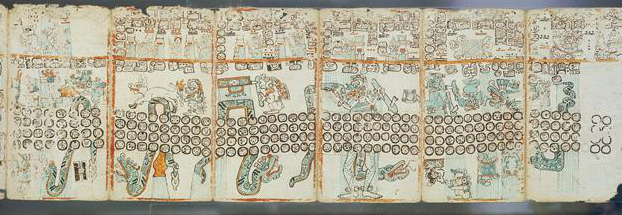
Screen Shot 2014-10-13 at 10.58.05 AM


Madrid Codex

Week 2: Past, Present, and Future Classification

Sperberg-McQueen’s “Classification and its Structures,” made me realize that grouping subjects based on specific properties is not as simple as it seems. Classifying a field is a complex task because of the many details and rules accounted for when distinguishing properties of the object being classified. I have always thought of classifying as a process of identifying the “odd” object out of a group and then disregarding it as an object that should not be classified in that specific group. However, I did not take into account the many rules of classification. It is difficult to classify fields because many are often classified as n-dimensional spaces, which means such a system includes “increasingly fine distinctions” of subfields. For example, the Dewey Decimal Classification system includes many smaller subclasses that branch off from larger classes. Sperberg-McQueen referred to the success of the classification within the Dewey Decimal System more than once.

Sperberg-McQueen’s journal made me think of the father of taxonomy, Carl Linnaeus, and his first famous publication. According to online article “Systema Naturae- an epoch making book,” Linnaeus’s Systema Naturae, written in latin, classifies the animal, stone, and plant kingdoms, which were fairly new to the classification world in 1735. He used a system known as binomial nomenclature, which in some form is used today and gives species a two-part name in order to classify them into different genus and species. Linnaean’s works of classification led to greater discoveries and millions of improvements within the rules of not only the classification of organisms, but also the classification of any object.

Classification systems are necessary in order to organize and then further understand information. Online classification systems and archives can be taken for granted in society. Many people forget about the work involved in creating any form of organized records especially when it comes to the Internet. Since the Internet is something that society relie on, more classification systems and archives are needed for online management and hopefully will not be taken for granted.

Works Cited:

“Systema Naturae – an Epoch-making Book.” Linné On Line. Ed. Roland Moberg. Uppsala Universitat, 2008. Web. Oct. 2014.

Week 2: Why does Haiti matter?

After reading Julia Gaffield’s “Haiti’s Declaration of Independence: Digging for Lost Documents in the Archives of the Atlantic World,” I couldn’t help but to think of how her accomplishment became world famous. Reading her passage about how the “story quickly spread around the world, broadcast on news networks and printed in over 50 national and international news sources,” I was curious as to why the story picked up. She’s made it known that the devastating earthquake was just weeks before her discovery, and we all know that the earthquake made major news (I don’t personally know a single person who wasn’t aware of the disaster in Haiti). But I’m still curious as to why this find made international fame. My basic knowledge of businesses is telling me that whatever will make more profit will be made more important.  But why was Haitian news profitable? Was it because of the (at the time) recent earthquake and death toll? Was it because of the involvement of many other countries in the making of the document? Is it the fascinating and compelling story of a lost document being found? Perhaps the adventure of discovery?

enhanced-buzz-wide-16105-1374675255-7(Buzzfeed.com)

When I read Gaffield’s section about her discovery becoming international attention I had been reminded of the TIME MAGAZINE comparison. Though one can find it on any other website, Buzzfeed has popularized the comparison of American versus the rest of the world’s TIME Magazine covers. What you are able to see is that the cover of Burma’s President, Thein Sein, is replaced with New Jersey’s governor Chris Christie. “Reinventing College” replaces “Reinventing India” and a large photo of Mitt Romney replaces a cover with the title “Pakistan’s Darkest Heart.” Though the obvious answer might be that the audience is different in the case of one cover that graces the rest of the world ‘s magazine, “The Tragedy of English Football.” Why would Americans be interested in English Football? They wouldn’t. So that cover wouldn’t make money. So they don’t print that cover, they print a more relevant one. But does that mean Americans aren’t interested in the Egyptian Revolution? Fine, American’s don’t care about England’s football or Queen, but the covers still printed in Asia. It still printed in the Middle East and Africa. It strikes me curious as to what the reasoning is on what is considered news “worthy” and what isn’t. So that still begs the question as to why the story of Haiti’s lost document gained such grand importance. It’s a fascinating thought that I urge all my classmates to think about the next time they read the headlines of any news.

Works cited:

Gaffield, Julia. “Haiti’s Declaration of Independence: Digging for Lost Documents in the Archives of the Atlantic World. The Appendix 2, no. 1 (January 2014)

Schwartz, Hunter. “Time Magazine Covers In The U.S. Vs. The Rest Of The World.” Buzzfeed.com (July 2013)

Week 2 Blog Post

Although the underlying purpose of metadata has been in use for far longer, the term and it’s digital application has only been practiced since the early 2000’s. In the past, rich documents, important historical artifacts, art and the like were all tracked manually. If scholars (and the cultures those scholars study) took care in documenting and preserving their history, metadata would be in the form of an archiving system—a system to categorize by context, content and structure. Modern day libraries, for example, use the Dewey decimal system (or one of the like) in order to track and sort their resources. Sometimes, information is not so well documented and tracked. In the case of Haiti’s Declaration of Independence, it took traveling to seven countries and digging through countless “lost” documents in order to track the original. Julia Gaffield, a Duke scholar who headed this mission, was able to uncover the declaration because of attention to metadata centering lost documents—each newly discovered piece served as a clue. Check out the full article of her mission here. Once the original declaration was found, it was presented to the public in a digital form—a form cheaply and widely accessible to all.

It is relatively obvious that in our newly digital world, the prominence and importance of metadata has increased drastically. Metadata gives you all the basic information you need to know about a source: it’s author, date of publication, and even changes that have been made since the creation of the original. Metadata is like the key to an online “work”. As information—about just about anything—becomes more widely accessible, our system of collecting and recording metadata becomes all the more critical. It is critical not just for recording and tracking historical documents (like that of Haiti’s Declaration of Independence), but also for modern life, business and transactions. In fact, collections of metadata are becoming increasingly critical in company’s marketing efforts.


Target has got you in its aim
“Target has got you in its aim”

Do you remember the Forbes article  that was published in 2012 about Target, and how they had sent target-ed maternity ads to a teenager…before her family even knew she was pregnant? Well that is a modern example of how metadata has been, and will be used. Target, and many other companies, collect massive amounts of data about their customers. When you shop at Target, you are assigned a customer ID from the moment you walk in the store. That ID is tied to your credit card, name and email address and that becomes “a bucket that stores a history of everything you’ve ever bought and any demographic information Target has collected from you or bought from other sources” (Hill).  Although Target and other companies have adjusted their marketing tactics to make their ads a little less obviously targeted, it is virtually impossible to avoid them as a consumer in the digital world.

Target’s targeted ads were some of the first to really break headlines. Now the practice is all over the news, and being able to collect information on consumers is worth millions. Facebook, Snapchat and the like are highly valued companies—because they collect extremely useful information on you, the consumer. They can then turn around and sell that information to companies, who can send you personalized mailers, emails and sidebar notifications of just the things you want (maybe even before you know you want them). Because of all of the metadata that can be collected on consumers and redistributed to corporations, marketing tactics have and will continue to change drastically. And remember, the collection of this kind of data has only really been around for the past 14 years—imagine how marketing will adapt and change in the next decade.


Works Cited:

Hill, Kashmir. “How Target Figured Out A Teen Girl Was Pregnant Before Her Father Did.” Forbes. 16 Feb. 2012. Web. 13 Oct. 2014. <http://www.forbes.com/sites/kashmirhill/2012/02/16/how-target-figured-out-a-teen-girl-was-pregnant-before-her-father-did/>.

Gaffield, Julia. “Haiti’s Declaration of Independence: Digging for Lost Documents in the Archives of the Atlantic World.The Appendix 2, no. 1 (January 2014).

Week 2: The Global Network is Nothing New

When reading Julia Gaffield’s article “Haiti’s Declaration of Independence: Digging for Lost Documents in the Archives of the Atlantic World”, I was fascinated by the fact that Haiti’s most important historical document had been lost in the archives of another country’s museum for almost the entirety of it’s existence. Gaffield was able to succeed in the hunt for the Declaration while so many others had failed before her because she took a different perspective on the time period of Haiti in the early 1800s. She understood that Haiti was a part of an interconnected web of trans-Atlantic trade which included the exchange of goods, ideas, and people. Therefore, confining the search to Haiti alone would never have allowed the full story to be uncovered. This phenomenon brought my summer trip to Italy to mind. When I visited the ruins of Pompeii, I was surprised to learn about how most of the artifacts had been excavated then shipped off to museums away from the site, or had disappeared altogether. While the most known artifacts still reside close by in Naples, I wondered what else was out there in the world from Pompeii that any tourist in Italy would not get the chance to see. After looking through the Archaeological Superintendence of Pompeii’s online timeline of the history of the excavation (http://www.pompeiisites.org/Sezione.jsp?titolo=History+of+the+excavation+of+Pompeii&idSezione=1003), I realized there was an unimaginable amount of Pompeiian treasures that had been lost to time as excavators had taken undocumented artifacts away from the site since its discovery in 1748. Since then, the southern region of Italy has been occupied by two foreign powers, France and Spain, each of which instituted their own excavation teams and practices at Pompeii. According to the site, during the French occupation, a task force of 1500 men (both civil and military) worked at a fast pace to unearth many of the ruins, but paid little regard to preserving what they unearthed. In 1811, the French marshal and crowned King of Naples Joachim Murat instituted new excavation regulations  to reduce the amount of artifacts removed from the site, showing  that items were being taken away from Pompeii by the workers. His wife, Caroline Bonaparte (Napoleon’s youngest sister) spread the news of the findings of Pompeii all throughout Europe in written letters. Our society today treats the idea of a global network as novel and that our world is experiencing a newfound exchange of goods, cultures, and ideas. While the emergence of the Digital Age has definitely expedited this exchange, the act of sharing in an international network is nothing new. If Haiti’s Declaration of Independence traveled through this network to England in the early 1800s, many priceless artifacts of Pompeii must have made their way to Spain, France, and other parts of the world in the hands of the workers or as a result of the interconnected monarchies of this time period. Luckily for us, the technologies of the Digital Age open doors to missing connections and create the possibility of discovering things that were once thought to be lost in time. Perhaps these tools can one day be used to find some of the missing treasures of Pompeii.

Week 2: Metadata across the pond

bm

This week’s readings brought me back to my studies abroad at the University of Sussex in England. After completing an economics course to fulfill requirements for my UCLA major, I had the choice of many intriguing electives for the second half of the summer session. One class in particular, titled “Museums & Material Culture,” stood out, so I decided to give it a shot. Other than weekly field trips to museums around the country, we spent class time focusing on how curators make decisions on which objects to display, and how to classify them into different categories. As soon as I started to dive into the article “Classification and its Structures,” it reminded me of this museums course. Sperberg-McQueen defined ‘classification’ as having the purpose to first of all group together objects with shared properties, coupled with the ability to distinguish between things “which are different in ways relevant to the purpose of the classification.” This definition brought back memories of our field trip to the British Museum in London, where a curator sat us down and gave us a lesson on how they classify their massive collection of objects. While my time browsing objects in museums was spent looking at physical collections instead of digital images, both pertained to deciding what information is relevant, along with taking into account how information can be divided, and the long-term implications of decisions made by a curator, which is similar to someone who sorts out a digital archive.

As I continued to read through the articles, I kept thinking of the curator at the British Museum. Annie Gilliland’s article “Setting the State,” which focuses on the increasing amount of metadata available, reminded me of the vast database the museum boasts. Back in 1998, the British Museum began to put its massive collection online, which allowed viewers to click through about 260,000 exhibits (link). Now that the museum’s collection has expanded to eight million objects, the database has grown accordingly. The process of information analytics is utilized to produce the metadata, which can be worked on in order to find similarities between various objects.

Meticulous attention to the creation of metadata has become crucial in today’s digitally obsessed world, paired with the vast expansion of digitally accessible information. With a collection that is commonly regarded as the largest and most comprehensive in the world, careful systematic utilization of metadata has proved to be of the highest importance for the British Museum.

Week 2: Missing Fragments in History

wright-brothers-002-l


Julia Gaffield’s article, Haiti’s Declaration of Independence: Digging for Lost Documents in the Archives of the Atlantic World explores the significance regarding the absence of historically-enriched documents and the restlessness that can follow.  Soon after becoming the second independent nation in the Americas, Haiti’s copies of its Declaration of Independence somehow disappeared.  This document not only represented its origins, but provided a symbolic statement that argued and gave credibility to its independence as a nation.  Even after two centuries, Haiti’s own Declaration of Independence remained lost, with no leads on its whereabouts.

Haitian-Declaration-of-Independence

Eventually, through vigorous research and devoted traveling, Julia Gaffield discovered copies of the document.  This not only brought closure, but ease to the country that had recently endured a devastating earthquake.  Though a great ending, this discovery brings to light the reality of other significant documents that may remain unfound.  Over at the National Archives, (http://www.archives.gov/research/recover/missing-documents.html#pres) many documents are presented as still missing.  Cases such as these re-emphasize the importance of indexing in order to close the gaps in history that continue to persist.  Dr. Carl Sagan once said, “You have to know the past to understand the present.”  Thus, without a past, one lacks a fundamental foundation to thoughtfully utilize for the future.  In order to prevent this, archives become crucial in respects to preserving the past and the information to be learned from it.

As a result of Gaffield finding the two copies of the Haitian Declaration of Independence, historians became encouraged to conduct their research in new ways such as extensive traveling and caused new discoveries to be made regarding Haiti’s history.  These positive changes to the present were influenced by historical documents and indicate how archives and proper indexing can be so important.   A sense of reconnection can be restored by bridging the chronological gap that once stood, as is the case in Julie Gaffield’s article.

The issue of unfound documents is further illuminated by CBS’ 60 Minutes special which focused on the many national artifacts, such as the Wright Brothers’ patent, that have gone missing in the libraries and museums they were once held.  Therefore, as individuals who learn from the past and thirst for knowledge, the issue of lost historical items becomes relevant to everyone.  Those of us who have experienced and grown up alongside the digital age may take for granted just how much information we have access to.  Not only is archival work difficult and fatiguing, but it places the archivist with a great responsibility of managing the world’s history and accurately documenting significant events.  Hence, the more information that is archived and can be obtained, the more we know of ourselves.


Work Citied:

1. Gaffield, Julie. “Haiti’s Declaration of Independence: Digging for Lost Documents in the Archives of the Atlantic World-Vol. 2, No. 1.” The Appendix Combined. N.p., 5 Feb. 2014. Web. 12 Oct. 2014.

2. ThinkExist.com Quotations. “Dr. Carl Sagan quotes”. ThinkExist.com Quotations Online 1 Sep. 2014. 12 Oct. 2014 <http://en.thinkexist.com/quotes/dr._carl_sagan/>

3. http://www.archives.gov/research/recover/missing-documents.html#pres

4.Ho, Erica. “Thousands of Historical Treasures Missing from National Archives.” TIME. N.p., 31 Oct. 2012. Web. 12 Oct. 2014.

Week 2: Library of Congress

Of the examples of classification structures that Sperberg-McQueen introduces in his article, his discussion of different classification systems used in cataloguing books immediately made me think back to some of the systems I have encountered. Sperberg-McQueen provides examples of the modes of classifying and separating books under the Dewey Decimal System, a system I am sure many of us encountered in school or public libraries. The classification that UCLA employs, as do many other large libraries, is the Library of Congress system. Someone has already discussed the Dewey Decimal Classification system so I’ll devote my blog post to a bit of the Library of Congress Classification.

The Library of Congress divides works into broad categories that are each ascribed a letter of the alphabet. From there, the primary letter of classification can be followed by another letter that denotes a specific field in that genre of writing. For example, the class ‘N’ refers to fine arts, and a subclass ‘NB’ denotes sculpture while the subclass ‘NK’ refers to decorative arts.

Library of Congress, Class N

This first letter or first two letters of classification can then be followed directly by a number that also narrows the scope of the subject. Taking the decorative arts subclass ‘NK’ as an example, a book classified as NK 7310 falls within the ‘other art and art industries section’ of decorative arts, more specifically it falls into the ‘metalwork’ category.

Library of Congress, Subclass NK

At this point any further letters or numbers that follow will specifically reference the work’s title, niche within the field of reference, author, year of publication, edition number, and sometimes whether the work has been translated. To continue the previous example, a book categorized as NK 7310.3 A78 R3813 1985 refers to a book on Art Deco jewelry of the 20th century, written by Sylvie Raulet (hence the R in the classification), and published in 1985. For a more complete overview of how the Library of Congress organizes works see here.

In an earlier blog post, another classmate points out the problem of classifications systems filtering data which can unintentionally lead to a loss of information (as touched upon by the article on the Haitian Declaration of Independence). Some books and sources are not so easily put into a category because they encompass so much information. The Library of Congress has a very good system in place to classify materials but it is hard to create something that is entirely foolproof. This leads me to  wonder who or what has the last say in classifying a book? Is it the job of a group of humans or is there some sort of database/technology in place to resolve this conflict?

Positive Representation

This week’s reading, “Haiti’s Declaration of Independence: Digging for Lost Documents in the Archives of the Atlantic World” caught my attention because it presents a challenge that present day society faces: if it isn’t on the internet, it doesn’t exist. Though this was not directly the situation with the Haitian Declaration of Independence, it is called into question through the assumptions that were made about the source. Many people believe that everything they would ever need to know is on the Internet and represented accurately. However, this concept has been refuted on multiple occasions, the discovery of the original Haitian Declaration of Independence being one of them. Once this original document was found, it gave the survivors of Hurricane Katrina a sense of nationalism. This sense of a properly represented self and presence on the internet that the original document gave the Haitians reminded me of the Native Peace Project, created by Professor Srinivasan from the Information Studies department at UCLA, which he describes in his paper “Indigenous, Ethnic and Cultural Articulations of New Media”. This project focused on representing the history and traditions of the San Pasqual reservation. Professor Srinivasan worked directly with the San Pasqual people to discover ways that he could assist them in creating a website that could hold all of their histories and honor their traditions without being influenced by other aspects of modern society. He also worked to ensure that the community goals that they held were represented on this page. This project worked in an attempt to represent the peoples in their own way, rather than having outsiders attempt to represent them. The project reminded me of the Haitian documents in this aspect because the nations were able to gain a sense of national identity through the words of their own people, rather than the comments of others.

The project also mirrored the Haitian documents because it served as a means to connect people who have been displaced from their original home. In the case of the Native Peace Project, the Internet allowed a connection for all of the 19 related reservations that were displaced from their original location on the sea to ones that were better for agriculture and across borders. The website became a place to reflect shared aspects of memory and aspiration among all of these individual groups. Similarly, the discovery of the Haitian Declaration of Independence acted as a unifying factor for people of Haitian descent to positively connect with during a time of national hardship, and allowed their community to focus on the goals of their Declaration in the rebuilding of their home.


Invisible Metadata

Pinterest Display


Metadata, a system of information recollection or recording is used everywhere around us. We are in a period where everything we do and see is pretty much recorded one way or another, especially on social media sites. In most cases we do not even realize the extent of our information being collected and processed. Being an architecture major, I search for design inspiration everywhere I go. The easiest and fastest method is through the Internet. One particular site called “Pinterest” offers thousands of pictures related to the topic or word you type in the search bar. Like Facebook and Instagram, sites which are known as the most used for the gathering of metadata, Pintrest sorts and collects an array of information through people’s posts, likes, and “hashtags”. The information offered by Pinterest is a public resource that all can use to search the web for specific images. Websites like this have large archival systems that allow users to browse using their words of preference, or browse a randomly generated selection of images. One can type in “interior design” and an array of images with those words in the description will pop up. Not only will the image appear, but if you click on the picture, it will take you directly to the source of it.  An article by TechNews states that Pinterest’s “[…] guided search will help you discover when you didn’t know how to ask for things to begin with.”  This site is a creative way of searching for images that interest you and also have a chance to browse its original source.

Many users don’t realize that Pinterest it is indeed a large archive of metadata. Every picture a user posts must have a description, original links, and must be categorized within select word choices. Pinterest also allows users to share the image, store it in their “board” for others to see, e-mail it or even share it on another social media site. As described in the Getty article “Introduction to Metadata”, metadata has a couple primary functions. By “liking” or sharing the information provided on Pinterest, the user is recycling the metadata, it is reusing it and posting it on their behalf, and also preserving the image by doing so.

Pinterest indeed contains a large amount of metadata, it allows users to interact with this data and reuse it in the digital world. Websites such as Pinterest are attractive and user friendly which explains their popularity yet behind the easy to use interface is a complex system of information and data being customized to the users preference.


Links:

  • http://www.techtimes.com/articles/6081/20140425/pinterest-puts-metadata-to-good-use-with-guided-search.htm
  • http://www.pinterest.com/search/pins/?q=interior%20design&term_meta%5B%5D=interior%7Ctyped&term_meta%5B%5D=design%7Ctyped