Upon reading Julia Gaffield’s “Haiti’s Declaration of Independence: Digging for Los Documents in the Archives of the Atlantic World,” the Maya Codex came to mind. The Haitian’s declaration of independence’s unknown whereabouts, and Gaffield’s attempt to further uncover it, was a great in-debt research through many different sources. Haiti’s history would not be fully accountable if it were not for the different travellers from different areas documenting it in their own accounts (even if there was some sort of bias). The Mayan culture is widely known for their unique language and creation of the Mayan codices. There are only four known surviving Mayan Codex manuscript, and it is incredibly difficult to decipher. Scholars studied the codex for years: comparing it to other languages, attributing some of the images as representations of animals, and finally coming up with a translation that may or may not be perfect.
The Maya lived in parts of Mexico and Central America, until the Spanish conquered them. The Spanish destroyed majority of the Maya writing, only leaving the four, as mentioned above. It is interesting because many of the documentation we have of the Maya is through Spanish accounts, just like Haitian history was documentation was found in Britain, Denmark and the United States, among other places. The four remaining Mayan Codex are in Paris, Madrid, Dresden, and New York. History is never accounted by one point-of-view. History is collected through different people, cultures, and biases.
While the Haitian declaration of independence was thankfully found through hours and hours of research, the Mayan culture is not so lucky. Despite popular belief, the Mayan culture still exists in many regions of Mexico/Central America. Even though we cannot bring back all those burned Mayan manuscripts, the living Maya are trying to continue the language. There are classes that teach the codex and are trying to keep in alive. There has to be an effort from scholars and the living Maya to keep the language alive. The surviving manuscript should not only be seen as an artifact of a supposedly dead culture, but it should be studied and seen by the remaining Maya.
To conclude, Haitian history would be harder to track down if it were not for the account of foreign travelers. The declaration of independence would not have been found if it were not for the consistent effort of a scholar to uncover it. Foreign travelers document the Maya culture, as well. There has to be communication between different countries in order to know more about the Maya and Haiti history, because it seems that their history has spread out to the rest of the world.
You can view examples of the Mayan Codex on ARTstor: http://library.artstor.org/library/welcome.html#3%7Csearch%7C6%7CAll20Collections3A20maya20codex%7CFiltered20Search%7C%7C%7Ctype3D3626kw3Dmaya20codex26geoIds3D26clsIds3D26collTypes3D26id3Dall26bDate3D26eDate3D26dExact3D26prGeoId3D26origKW3D
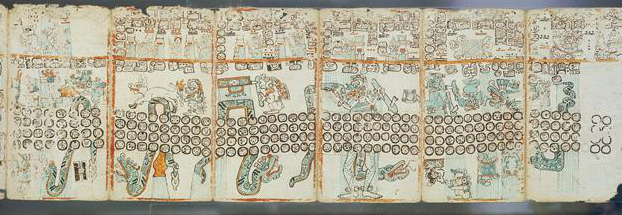
Madrid Codex