Walter “Walt” Whitman was a prolific American poet, essayist, journalist, and humanist in the 1800s. His poetry collection Leaves of Grass was highly controversial during its time for its “obscene” and explicit sexual imagery. Nonetheless, Walt Whitman was one of the most influential poet and writer in the world. The Walt Whitman Archive is a research and teaching tool that aims to make Whitman’s work accessible to all types of audience, establishing the most comprehensive records of his work.
For my first blog post, I decided to reverse engineer the Walt Whitman Archive, which can be found at: http:/whitmanarchive.org/.
SOURCES
The archive includes a compilation of Whitman’s works drew from resources in libraries from all around the world and private collectors. This vast amount of work include not only his major life work such as Leaves of Grass and its six different editions, but also his other writings which include prose essays, letters, notebooks, fiction, manuscript fragments, marginalia, and journalistic articles. The Archive also make his translations, reviews, criticism, biographies, and portraits available.
PROCESSING
The Archive provides a very clear description of the processing procedure on the About page, in Editorial Policy Statement and Procedures. The processing section gives description of how each type of data is analyzed so the computer can understand it. For example, poetry and prose manuscripts are processed differently than the Leaves of Grass Editions. The creators of the Archive color scans or photographs the manuscripts to make the images digitally viewable online. For the Leaves of Grass and its editions, the text was replaced with Text Encoding Initiative (TEI)-conformant Standard Generalized Markup Language (SGML) encoding by the Electronic Text Center at the University of Virginia. However, the Whitman Archive standardized these SGML files into eXtensible Markup Language (XML). When data is converted into a digital format, the creator has the power to preserve aspects of the hard copy. For example, in Whitman’s editing reviews, the Archive staff did not preserve the display or the typographic features including typeface, ornamentation, and other aspects of the layout. However, for poetry in reviews, the formant such as indentation of poetic liens or line breaks was still preserved.
PRESENTATION
As for presentation, the Archive was very simplistic, clear, and easy to navigate. Different tabs are for different types of work: “Published Works” which include books by Whitman, periodicals, and translations; “In Whitman’s Hand” includes manuscripts, notebooks, and scribal documents; “Life & Letters” include biography, chronology, and letters; “Commentary” includes bibliography, criticism, disciples, and reviews; “Pictures & Sound” includes audio and portraits of Whitman; and finally, “Resources” include downloads, manuscript catalogs, teaching, and more. The Leaves of Grass editions are uploaded as text along with a colored image and an “about” page. The Site Tour gives a very comprehensive guide on navigating the website. The search function at the top of every page also makes it easier to access specific information that people want. The following images gives a sense of the overall presentation of the website.
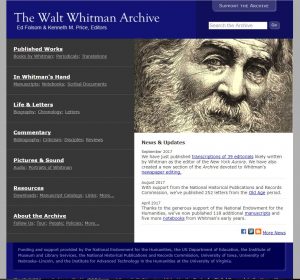
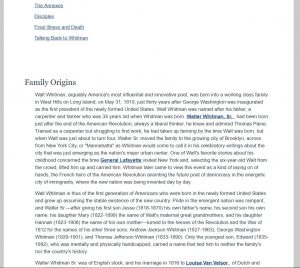
For me, I would like the website to be a little less plain, more creative, and interactive. I understand that this Archive is an exhibition of the primary sources. In addition, it would also be nice if there’s a small description of who Walt Whitman is on the Home page since the Archive is a researching and teaching tool for all.
I completely agree on your point that I wish this project had been presented in a more creative way. For example, why not include audio of Whitman’s poems or perhaps even a virtual library that allowed the user to pull out manuscripts? This presentation seems very scholarly and library-like, but I wish there were more forms of interpretation in addition to analysis.