The Walt Whitman Archive is unique in how it attempts to to document such a large amount of the poet’s work, not just poems, as one would expect, but also includes Whitman’s journalism, personal letters, and the notes about his poem. However, it is well worth the effort to document all these aspects of the poet; Whitman lived a multi-faceted life that can not be summarized by his poetic publications. Here, the Walt Whitman archive attempts to present the various sides of Whitman that his writings and portraits have captured.
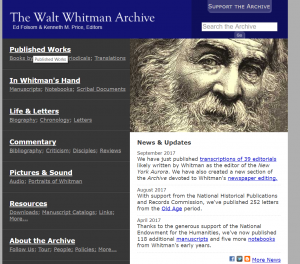
The breakdown of this website can be found in the about section of the online Archive. First let us examine the sources that were used to create this extensive collection. Of course, the directors must use the poetry that was published, however this include all 6 volumes of Whitman’s Leaves of Grass. The inclusion of all the different publications is to show the change in the Whitman’s works throughout the later part of his lifetime. In addition, the archive uses first hand notes of Whitman’s poems that document his editing process and his feelings about the works. However, some of the most interesting sources include the Whitman’s journalism from the his early life that started before his poetic works. Other sources include, his personal letters, both his own and the correspondents, short stories, single published and unpublished poems, and portraits. Another unique aspect of the archive is that it includes works about the author, such as biographies and analysis of the works in the collection.
The Whitman archive has a textual based organization meaning the collections presented have a basis to specific works and primary sources. From this, the archive then employs a “spinal organization” that mirrors the organization of Whitman in his own works. This organization allows for various material, works and authors to be able to collaborate on a single piece. Further breakdown of the organization reveals that the pieces are not only organized by time but also by the linguistic elements that are in the piece. Along with that, since Whitman was a pioneer in poetry, the linguistic components that furthered the poetic field are used to structure the organization. However, there are still connections between the technical and thematic elements in order to show how these elements combined to give Whitman a unique style and voice. This combines to give the audience the opportunity to analyze the texts in many different perspectives.
The archive is presented to us a homepage with easy to navigate tabs that indicate where works, audio, portraits, and other information about Whitman can be found. So if a student wished to access the early journalism of Whitman, they would click on Published Works, Periodicals, Editorials and Journalistic articles. From there the audience can choose which publication they would like to explore and the article within it. The presentation is simple text in order to clearly communicate the substance of the works and make it possible for the audience to easily understand and access.This is in contrast with many other digital archives we have already encountered in this class which placed an emphasis or a visual presentation of the works. However, the Whitman archive uses clear text and HD pictures and audio where possible in a simple format that is closer to the traditional archives many scholars are accustomed to. In the “About” the site indicates it uses HTML and other free source codes such as XML and METS. The reason for this is to encourage contribution from various collaborators such as other free archives, librarians, and scholars who wish to contribute. This allows for a more compact and efficient database that is no cluttered.
Hi, I enjoyed reading your implication on Walt Whitman Archive. To be honest, when I first saw the Archive, I did not feel encouraged to navigate the it, since it was visually not too captivating compared to other websites. But soon after I started probing the information, I realized it is developed in a way that is the most efficient and familiar to encompass and convey the large amount of data, especially data about a person. Even though I for a moment imagined the Walt Whitman Archive to be constructed as a virtual reality simulation of his personal bookshelf like John Ashbery’s Nest, I got reassured that it would be then less organized notwithstanding more attractive. It is very fascinating that his whole work of arts and life story can be neatly aligned in a single page, with options of further exploration. I like how you reverse engineered even possible source codes and explain different tabs to help easier navigation. I hope I can create a webpage like this someday for the author I personally admire. Great job!
Hi! Like my peer, Yu Na, I also was not captivated by the site but your detailed description provoked me to want to learn more about Walt Whitman. What I liked about the archive is how neatly and intuitive it is to use. Often when a lot of information is thrown at me in an unorganized format, I tend to leave the website. This clearly laid out important categories which then probed me to explore categories of my choice. Personally, I particularly enjoyed the “In Whitman’s Hand” category. Something about seeing how artists work whether it is writing poetry, music, or prose, is fascinating and gives some insight about who they are and their writing process.