For this blog post, I decided to work with the Caribbean Cholera Map. This particular digital humanities project illustrates the outbreaks of the cholera disease around the Caribbean area. While simultaneously utilizing both a timeline and a set of points within a google map, it tells a very compelling argument of how these outbreaks are tied to naturals disasters, such as tropical storms and hurricanes. By depicting that these outbreaks occur subsequently after the storm on the timeline, the project logically proves that the origins of cholera were due to natural causes. The project managers were able to supply news journals and articles as evidence to further prove this. However, this project only reinforces David Turnbull’s argument of how maps have the ability to manipulate the narrative without meaning to.
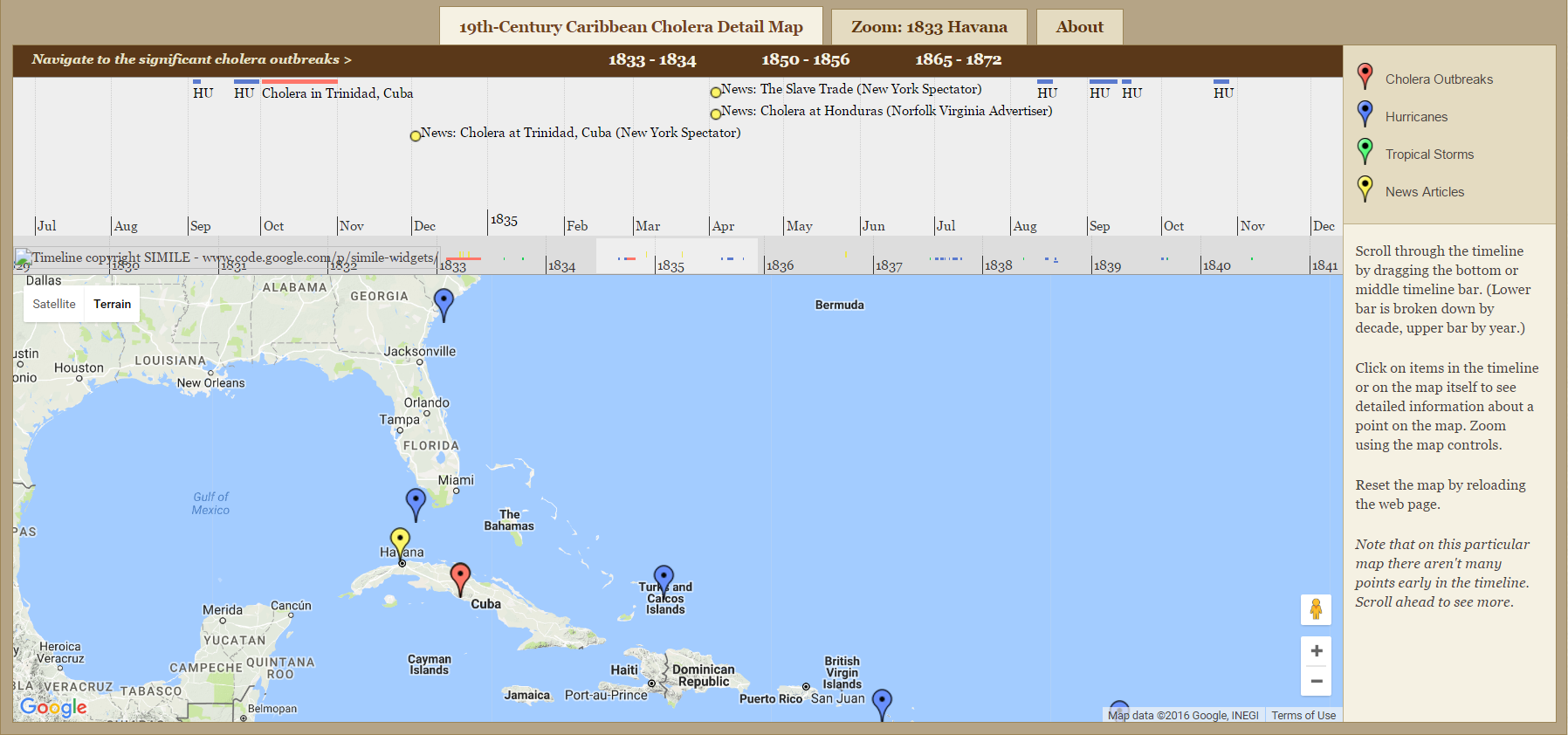
The fact that it only provides information about the natural disasters implies that these storms are the only causes of the cholera outbreak. It assumes that there aren’t any other types of causes of cholera because it omits these possibilities on the timeline. According to my outside research, the first cholera outbreak originated in Russia through trade routes. Who is to say that human contact from the slave trade and poor conditions on the boat didn’t contribute to further development of cholera, yet it isn’t evident in the timeline.
Since this current map is very vague and generalizes the causes of the outbreak, an alternate, yet ideal map for this particular project would specify what other factors may have played into the causes of the outbreak. In the timeline, there are other storms that occur around the Caribbean area especially in 1937 to the early 1940s without an outbreak to cholera following it. This goes to show that there may have been another factor played into this, otherwise there would be multiple cholera outbreaks throughout that listed time period. Or could it possibly be because of the intensity of the storm? The map only provides us information of the duration and coordinates of the storm, but there could be very light storms that can go on for days as opposed to a heavy one. The map should provide some sort of measurement of the storms if possible. Also another question the map could answer is, what determines an outbreak of a disease? It’s very subjective in the sense that one definition of an outbreak can be very different to another. This goes to show how subjective maps are because it’s all about perspective.
I found your commentary on this project very interesting. Although I did not choose to do this one myself, I did take a look at it while reading your project and found that it did hint that natural disasters were the reason for this outbreak. Interesting to see that they left out other possibilities and the phrase “correlation is not causation” echoed through my mind the whole time. I think your map with measurements and the overall idea that diseases should be explained as a whole would better this project.
Oh wow, it was interesting reading your take on this map because I did the same one but kind of thought of it differently than you did- especially regarding the suggestion of a different type of map. It would definitely be more helpful to see more information about the storms itself to see if there was actually a direct correlation between the storms and the outbreaks. For me, I just assumed that the assumption that the creator was making between the storms and the outbreak was too weak so I abandoned the thought of even researching that even further, but I really thought your take on the new map was interesting 🙂
I did not choose this map for this assignment, but I thought that your critique of the site was very interesting. By generalizing outbreaks of cholera to only storms, really disregards the people who were affected by it. I also thought by including your own outside research really helped to solidify your points that maps, too, are subject to the bias of perspective.