Course blog

On Metadata

The first time I heard the term metadata was on the news about Edward Snowden. After hearing the news about the NSA and their machines collecting metadata, I started hearing the word everywhere. But I still did not know what it meant and why data about data was so important. And if you knew me, you will find that I am not a very tech savvy person. I, therefore, sought out the introduction to metadata by Anne J. Gilliland and an article about Edward Snowden entitled, “Can Snowden finally kill the ‘harmless metadata’ myth?” by Stilgherrian to see if we really need to be concerned about metadata. I found out from the introduction to metadata that it is used “to arrange, describe, track, and otherwise enhance access to information objects and the physical collections related to those objects.”  And, according to Gililand, that it is a term used by “cultural heritage information professionals such as museum registrars, library catalogers, and archival processors”. I supposed that the catalog number on books in the library would be considered metadata. Another example I could find in my everyday life was the terminology for rules in my Latin textbook. We use these terminologies to quickly identify a word and see its grammatical function. It seems that it was no incident that one of the first works of Digital Humanities was on Thomas Aquinas.  Now that I have some idea about metadata, I still did not know why people should really be concerned that their metadata is exploited online. After all, the purpose of the internet is to share information.

I then found  an article about Edward Snowden where he is quoted as saying that “Metadata is extraordinarily intrusive. As an analyst, I would prefer to be looking at metadata than looking at content, because it’s quicker and easier, and it doesn’t lie.”  This quote means that the metadata on the internet is more valuable than its content. Metadata can be “traced” from the content put on the internet. This is why Snowden calls it “intrusive.” I assume that the system that the government use to track metadata is sophisticated enough to trace metadata from all sorts of contents. From Gililand’s article we can understand the practical application of metadata and, it seems, the same application is being applied to people. Should we then care that our metadata is being collected by the government?


Work Cited:

Stilgherrian. “Can Snowden Finally Kill the Harmless Metadata Myth?” ZDNET. 16 Sept. 2014. Web. 13 Oct. 14.                http://www.zdnet.com/can-snowden-finally-kill-the-harmless-metadata-myth-7000033717/

Gilliland, Anne J.  “Setting the Stage”. The Getty Research Institute. Introduction to Metadata. Web. 13 Oct. 14                                                             http://www.getty.edu/research/publications/electronic_publications/intrometadata/setting.html

Week 2- Preservation Matters through the Lens of Clifford

Reading “Preservation Matters” by Chon A. Noriega,  immediately brought to mind  James Clifford’s The Predicament of Culture.  Clifford is an art historian and professor at UC Santa Cruz who is known for his discussion of the preservation and presentation of non-Western art.  In the chapter “On Collecting Art and Culture,” he explains how the dominant Western paradigm categorizes and thus archives art for posterity.  According to Clifford, non-Western art is sorted according to the standards of the West: craft and fine art.  This imposition of non-native categorization often separates bodies of  work and fails to preserve the art in a way which honors its original attention.

In reading Noriega’s article, I got stuck on the notion of what creates an accurate archive.  As an archive needs to be collected by a person, or group of people, it will, without a doubt, bear the viewpoint of those who created the archive.  I loved that Noriega included his interactions with the artist, Harry Gamboa Jr, especially the conclusion that  it was impossible for the artist to have an “accurate account of (his) personal history” because he had always been in the process of keeping an archive (5).  Even though it logically seems that the artist should be the objective authority of his own work, it is impossible to deny that the creator every archive holds a bias.

Noriega’s account of building up the UCLA Chicano Studies Research Center (CSRC) into an archive which provided real use and value for both the scholarly community and Chicano/a heritage community is what brought me to think of Clifford’s discussion of categorization.  Noriega explains that in order to put information into an archive or resource, that information must be extracted from the community of its origin.  In his position as the director of CSRC, his aim was to not “extract” information, thus removing it from the community, but to create a resource where the material could serve its community in a new way, a constructive rather than destructive force.  This made me think of how Clifford argues that by placing non-Western heritage artworks in a museum setting, they can often loose their original meaning as they are often misinterpreted and can no longer carry out their intended function.  (example: by removing a funeral mask from its indigenous community, one is not only taking away a ceremonial object, but also placing it in a setting for which is was not intended to be interacted with)

While Noriega’s account is more related to creating accessible information, rather than an argument regarding the placement of artifacts, both articles brought up questions for me about how data is sorted.  Improper categorization can result in lost information and searching for information through a lens different from the one used to organize is often a fruitless search. (example: searching by tags or keywords which were not applied to the object in database, though they may be valid descriptions of said object) The construction of the archive is itself, in many ways, the construction of a specific argument.  If anything, Noriega’s article sheds light on the misconception that an archive is inherently whole, rather archives should be viewed as a continual development based on the viewpoint of the collector(s).


The Predicament of Culture on the Harvard Press Website

Results of Technology in the New Age – Haiti

What I found most interesting about the Haiti article is that something as small-scale as a dissertation could have such an impact on an entire country. When Julia Gaffield set out to write her dissertation about Haiti, I’m sure she didn’t expect to bring hope to all of the people of Haiti. She reminded them that they had already overcome something incredible and had gained their independence, which helped them to believe that they would be able to again rebuild after the devastating earthquake. Mostly I like the article because it illustrates how one person can cause such a massive effect on something else. That it only takes one to create a wave, or ignite a spark or start a revolution. Julia was determined to learn more about Haiti even though the odds were against her and luckily for the entire world, she was that one person that cared enough to make a difference.

Unfortunately, this reminds me of the article I read very recently about the spread of the cholera disease in Haiti. It is a painful reminder that it is still a third world country and although there have been advancements and although the discovery of their Declaration of Independence was crucial during such a hard time for them after the earthquake, Haiti is still in desperate need of help. It was heartbreaking to read that over 8,000 people have died from this disease that was introduced into their country by United Nations peacekeepers.

The article by Julia Gaffield about her dissertation and the archives demonstrates how useful it is to have archives and technology to be able to share such wonderful news. It it truly incredible that something one person found can be so easily shared around the world in order to create a larger impact. Sadly, we are also reminded of the work we still have to do in this world, seeing as countries such as Haiti still don’t have proper health care in the year 2014.


Gaffield, Julia. “Haiti’s Declaration of Independence: Digging for Lost Documents in the Archives of the Atlantic World-Vol. 2, No. 1.” The Appendix Combined. N.p., 5 Feb. 2014. Web. 12 Oct. 2014.

Cave, Damien. “Lawsuit Against U.N. on the Spread of Cholera Epidemic in Haiti Advances.” The New York Times. The New York Times, 08 Oct. 2014. Web. 12 Oct. 2014.

Classifications in Practice

I walked into a super market the other day and immediately noticed that the food was divided by type. The vegetables were in one area near the fruit, the dairy had its own refrigerator and the frozen food was kept in two aisles worth of freezers. While most things are hard to classify and even when they are those classifications are arbitrary, it makes sense to classify food because of their differing shelf lives. But even in the simple categorization of food there are some problems and even with “n” amount of categories there are still an infinite amount of categories not included, as mentioned in the McQueen article. A tomato is in the vegetable section but it has seeds like any fruit would, but there was no “vegetables with fruit-like qualities” sign adorning the top of an aisle. Citrus fruit is grouped together but they aren’t arranged by sour-ness. This line of thought is definitely nit-picky and unrealistic but it just shows that there is an infinite number of possible ways to categorize something as simple as food.

The level to which we categorize data and how categorize it effects how our reader interprets said data. When we leave out the infinite amount of categories we are leaving out an infinite amount of interpretations. It’s up to presenters to decide how the data gets organized and what message they want to send. One-dimensional schemes are often the simplest to understand but leave out a lot of information. N-dimensional schemes are the most informative but as n increases the difficulty of categorization increases for the presenter and it is harder for the reader to understand as well. Because categories highlight differences between things the most legible scheme is the simplest one with only two groupings that have clear boundaries, for example: true or false, legal or illegal, 0 or 1. This static grouping is effective when the differences are based in science but become ineffective when analyzing data from the ambiguous humanities realm. Linnaen taxonomy works because it’s based on morphology and DNA but the gender binary is arbitrary because it is based on loose social constructs.

I think this is the central crux of digital humanities. Like the super market, we have to arrange our data so it’s understandable to the reader and can be easily sorted through. But we are presented with a challenge because data from the humanities does not always fit into a nice, neat category. How do we arrange our data and what are we saying with whatever classification scheme we end up using?

Works Cited:  Haliburton, Andrew. Bicycle Needs. 2010. 2010 EVC, Palm Springs. Andrew Haliburton. Web. 13 Oct 2014.

Metadata in Advertising

When I came across the term “metadata”, my initial thought was, “That sounds like something complicated.” However, after learning about metadata for this weak’s reading, I realized how important metadata is in today’s society and digital age. To put it simply, metadata is information about other data. Whatever that information is, its function is to describe, explain, locate, and facilitate the retrieval, use or management of resources. Therefore, without metadata, surfing the web and leisurely tasks such as looking up an artist or song title become almost impossible. For today’s post, I wanted to discuss how I encountered metadata when I was looking to buy a used motorcycle on craigslist.

Metatags in Metadata

Craigslist.org is a classified advertisement website where people post goods and services for something in return. Over this past weekend, I was looking to buy a used motorcycle so that I can commute from home to school and back without spending too much money on gas, parking, etc. I thought that a motorcycle, although more dangerous, would fit my needs better than a car. I didn’t have that much money to spend so I went on craigslist to find a good deal on a motorcycle. Of course, like any other search engine, one would have to type in the item that he wants into the search engine. Here, metadata is at work for the purposes of discovering new information. In this case, it facilitates the identification of all the different possible sellers of that specific item.  In the reading, this was called “descriptive metadata” which is one of three types of metadata. Descriptive metadata can include elements such as title, abstract, author, and keywords.

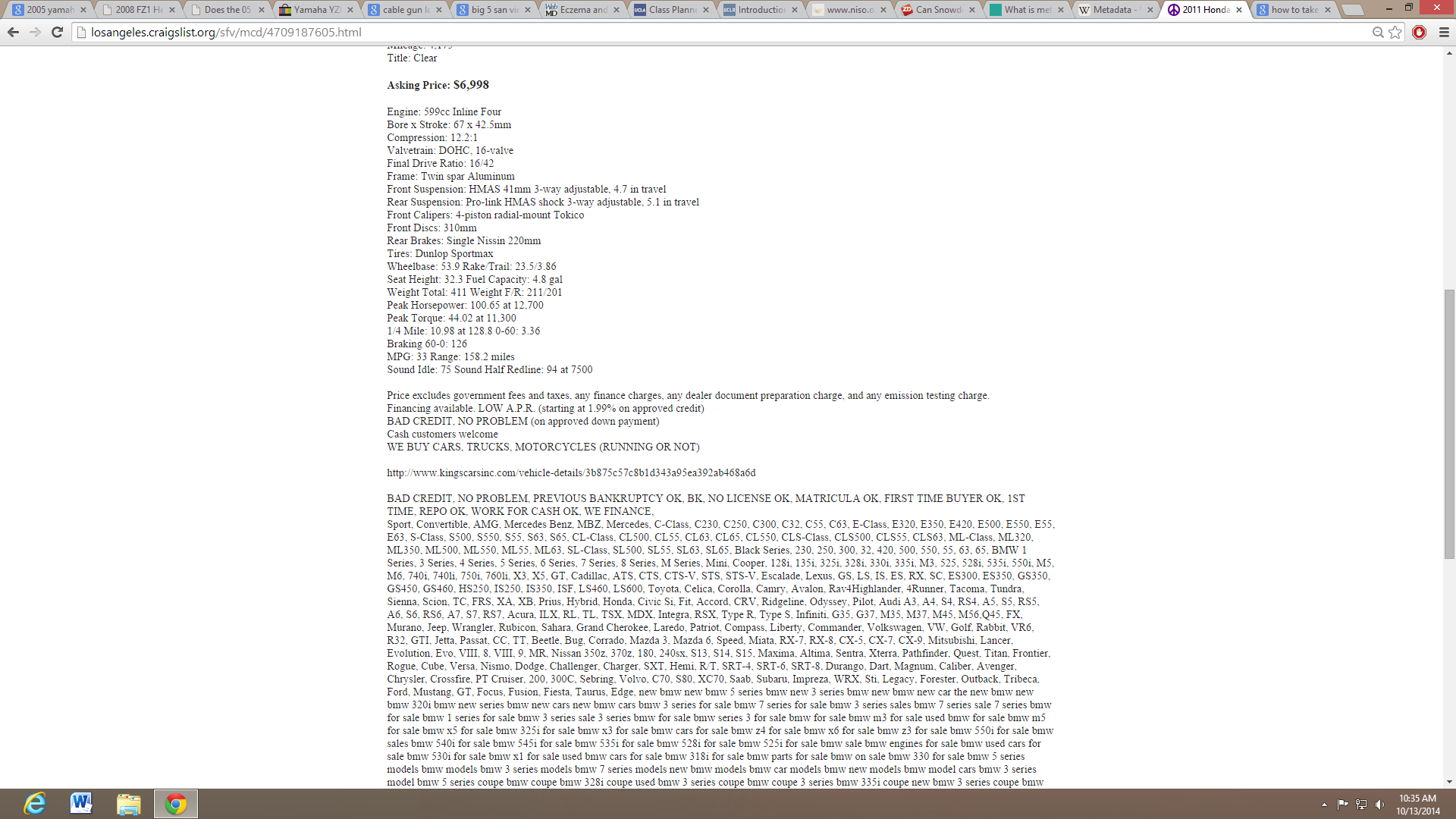
Through my endeavors to find a motorcycle on craigslist, I was able to see how metadata made my search experience a lot easier.  Not only was I able to type in the different models of the motorcycle that I wanted but I also was able to narrow down my searches and filter certain descriptions in order to find the perfect item for my individual need. For example, I was able to set a minimum and maximum price rage, click a checkbox for certain parts, and even filter out the posts without pictures. Since the search can get very specific, most sellers implement “metatags” so that their item will appear on various search specific results. I included a picture of what I mean on this post. In the bottom of the seller’s post, the seller would add keywords of popular motorcycle companies, the model, the year, and type even though it wasn’t the motorcycle that they were selling. They did this so that their ad will show up in different searches which results in a larger target audience.

Week 2: Haiti

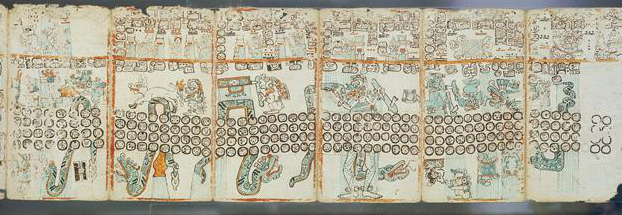
Upon reading Julia Gaffield’s “Haiti’s Declaration of Independence: Digging for Los Documents in the Archives of the Atlantic World,” the Maya Codex came to mind. The Haitian’s declaration of independence’s unknown whereabouts, and Gaffield’s attempt to further uncover it, was a great in-debt research through many different sources. Haiti’s history would not be fully accountable if it were not for the different travellers from different areas documenting it in their own accounts (even if there was some sort of bias). The Mayan culture is widely known for their unique language and creation of the Mayan codices. There are only four known surviving Mayan Codex manuscript, and it is incredibly difficult to decipher. Scholars studied the codex for years: comparing it to other languages, attributing some of the images as representations of animals, and finally coming up with a translation that may or may not be perfect.

The Maya lived in parts of Mexico and Central America, until the Spanish conquered them. The Spanish destroyed majority of the Maya writing, only leaving the four, as mentioned above. It is interesting because many of the documentation we have of the Maya is through Spanish accounts, just like Haitian history was documentation was found in Britain, Denmark and the United States, among other places. The four remaining Mayan Codex are in Paris, Madrid, Dresden, and New York. History is never accounted by one point-of-view. History is collected through different people, cultures, and biases.

While the Haitian declaration of independence was thankfully found through hours and hours of research, the Mayan culture is not so lucky. Despite popular belief, the Mayan culture still exists in many regions of Mexico/Central America. Even though we cannot bring back all those burned Mayan manuscripts, the living Maya are trying to continue the language. There are classes that teach the codex and are trying to keep in alive. There has to be an effort from scholars and the living Maya to keep the language alive. The surviving manuscript should not only be seen as an artifact of a supposedly dead culture, but it should be studied and seen by the remaining Maya.

To conclude, Haitian history would be harder to track down if it were not for the account of foreign travelers. The declaration of independence would not have been found if it were not for the consistent effort of a scholar to uncover it. Foreign travelers document the Maya culture, as well. There has to be communication between different countries in order to know more about the Maya and Haiti history, because it seems that their history has spread out to the rest of the world.

You can view examples of the Mayan Codex on ARTstor: http://library.artstor.org/library/welcome.html#3%7Csearch%7C6%7CAll20Collections3A20maya20codex%7CFiltered20Search%7C%7C%7Ctype3D3626kw3Dmaya20codex26geoIds3D26clsIds3D26collTypes3D26id3Dall26bDate3D26eDate3D26dExact3D26prGeoId3D26origKW3D

Screen Shot 2014-10-13 at 10.58.05 AM


Madrid Codex

Week 2: Past, Present, and Future Classification

Sperberg-McQueen’s “Classification and its Structures,” made me realize that grouping subjects based on specific properties is not as simple as it seems. Classifying a field is a complex task because of the many details and rules accounted for when distinguishing properties of the object being classified. I have always thought of classifying as a process of identifying the “odd” object out of a group and then disregarding it as an object that should not be classified in that specific group. However, I did not take into account the many rules of classification. It is difficult to classify fields because many are often classified as n-dimensional spaces, which means such a system includes “increasingly fine distinctions” of subfields. For example, the Dewey Decimal Classification system includes many smaller subclasses that branch off from larger classes. Sperberg-McQueen referred to the success of the classification within the Dewey Decimal System more than once.

Sperberg-McQueen’s journal made me think of the father of taxonomy, Carl Linnaeus, and his first famous publication. According to online article “Systema Naturae- an epoch making book,” Linnaeus’s Systema Naturae, written in latin, classifies the animal, stone, and plant kingdoms, which were fairly new to the classification world in 1735. He used a system known as binomial nomenclature, which in some form is used today and gives species a two-part name in order to classify them into different genus and species. Linnaean’s works of classification led to greater discoveries and millions of improvements within the rules of not only the classification of organisms, but also the classification of any object.

Classification systems are necessary in order to organize and then further understand information. Online classification systems and archives can be taken for granted in society. Many people forget about the work involved in creating any form of organized records especially when it comes to the Internet. Since the Internet is something that society relie on, more classification systems and archives are needed for online management and hopefully will not be taken for granted.

Works Cited:

“Systema Naturae – an Epoch-making Book.” Linné On Line. Ed. Roland Moberg. Uppsala Universitat, 2008. Web. Oct. 2014.

Week 2: Why does Haiti matter?

After reading Julia Gaffield’s “Haiti’s Declaration of Independence: Digging for Lost Documents in the Archives of the Atlantic World,” I couldn’t help but to think of how her accomplishment became world famous. Reading her passage about how the “story quickly spread around the world, broadcast on news networks and printed in over 50 national and international news sources,” I was curious as to why the story picked up. She’s made it known that the devastating earthquake was just weeks before her discovery, and we all know that the earthquake made major news (I don’t personally know a single person who wasn’t aware of the disaster in Haiti). But I’m still curious as to why this find made international fame. My basic knowledge of businesses is telling me that whatever will make more profit will be made more important.  But why was Haitian news profitable? Was it because of the (at the time) recent earthquake and death toll? Was it because of the involvement of many other countries in the making of the document? Is it the fascinating and compelling story of a lost document being found? Perhaps the adventure of discovery?

enhanced-buzz-wide-16105-1374675255-7(Buzzfeed.com)

When I read Gaffield’s section about her discovery becoming international attention I had been reminded of the TIME MAGAZINE comparison. Though one can find it on any other website, Buzzfeed has popularized the comparison of American versus the rest of the world’s TIME Magazine covers. What you are able to see is that the cover of Burma’s President, Thein Sein, is replaced with New Jersey’s governor Chris Christie. “Reinventing College” replaces “Reinventing India” and a large photo of Mitt Romney replaces a cover with the title “Pakistan’s Darkest Heart.” Though the obvious answer might be that the audience is different in the case of one cover that graces the rest of the world ‘s magazine, “The Tragedy of English Football.” Why would Americans be interested in English Football? They wouldn’t. So that cover wouldn’t make money. So they don’t print that cover, they print a more relevant one. But does that mean Americans aren’t interested in the Egyptian Revolution? Fine, American’s don’t care about England’s football or Queen, but the covers still printed in Asia. It still printed in the Middle East and Africa. It strikes me curious as to what the reasoning is on what is considered news “worthy” and what isn’t. So that still begs the question as to why the story of Haiti’s lost document gained such grand importance. It’s a fascinating thought that I urge all my classmates to think about the next time they read the headlines of any news.

Works cited:

Gaffield, Julia. “Haiti’s Declaration of Independence: Digging for Lost Documents in the Archives of the Atlantic World. The Appendix 2, no. 1 (January 2014)

Schwartz, Hunter. “Time Magazine Covers In The U.S. Vs. The Rest Of The World.” Buzzfeed.com (July 2013)

Week 2 Blog Post

Although the underlying purpose of metadata has been in use for far longer, the term and it’s digital application has only been practiced since the early 2000’s. In the past, rich documents, important historical artifacts, art and the like were all tracked manually. If scholars (and the cultures those scholars study) took care in documenting and preserving their history, metadata would be in the form of an archiving system—a system to categorize by context, content and structure. Modern day libraries, for example, use the Dewey decimal system (or one of the like) in order to track and sort their resources. Sometimes, information is not so well documented and tracked. In the case of Haiti’s Declaration of Independence, it took traveling to seven countries and digging through countless “lost” documents in order to track the original. Julia Gaffield, a Duke scholar who headed this mission, was able to uncover the declaration because of attention to metadata centering lost documents—each newly discovered piece served as a clue. Check out the full article of her mission here. Once the original declaration was found, it was presented to the public in a digital form—a form cheaply and widely accessible to all.

It is relatively obvious that in our newly digital world, the prominence and importance of metadata has increased drastically. Metadata gives you all the basic information you need to know about a source: it’s author, date of publication, and even changes that have been made since the creation of the original. Metadata is like the key to an online “work”. As information—about just about anything—becomes more widely accessible, our system of collecting and recording metadata becomes all the more critical. It is critical not just for recording and tracking historical documents (like that of Haiti’s Declaration of Independence), but also for modern life, business and transactions. In fact, collections of metadata are becoming increasingly critical in company’s marketing efforts.


Target has got you in its aim
“Target has got you in its aim”

Do you remember the Forbes article  that was published in 2012 about Target, and how they had sent target-ed maternity ads to a teenager…before her family even knew she was pregnant? Well that is a modern example of how metadata has been, and will be used. Target, and many other companies, collect massive amounts of data about their customers. When you shop at Target, you are assigned a customer ID from the moment you walk in the store. That ID is tied to your credit card, name and email address and that becomes “a bucket that stores a history of everything you’ve ever bought and any demographic information Target has collected from you or bought from other sources” (Hill).  Although Target and other companies have adjusted their marketing tactics to make their ads a little less obviously targeted, it is virtually impossible to avoid them as a consumer in the digital world.

Target’s targeted ads were some of the first to really break headlines. Now the practice is all over the news, and being able to collect information on consumers is worth millions. Facebook, Snapchat and the like are highly valued companies—because they collect extremely useful information on you, the consumer. They can then turn around and sell that information to companies, who can send you personalized mailers, emails and sidebar notifications of just the things you want (maybe even before you know you want them). Because of all of the metadata that can be collected on consumers and redistributed to corporations, marketing tactics have and will continue to change drastically. And remember, the collection of this kind of data has only really been around for the past 14 years—imagine how marketing will adapt and change in the next decade.


Works Cited:

Hill, Kashmir. “How Target Figured Out A Teen Girl Was Pregnant Before Her Father Did.” Forbes. 16 Feb. 2012. Web. 13 Oct. 2014. <http://www.forbes.com/sites/kashmirhill/2012/02/16/how-target-figured-out-a-teen-girl-was-pregnant-before-her-father-did/>.

Gaffield, Julia. “Haiti’s Declaration of Independence: Digging for Lost Documents in the Archives of the Atlantic World.The Appendix 2, no. 1 (January 2014).

Week 2: The Global Network is Nothing New

When reading Julia Gaffield’s article “Haiti’s Declaration of Independence: Digging for Lost Documents in the Archives of the Atlantic World”, I was fascinated by the fact that Haiti’s most important historical document had been lost in the archives of another country’s museum for almost the entirety of it’s existence. Gaffield was able to succeed in the hunt for the Declaration while so many others had failed before her because she took a different perspective on the time period of Haiti in the early 1800s. She understood that Haiti was a part of an interconnected web of trans-Atlantic trade which included the exchange of goods, ideas, and people. Therefore, confining the search to Haiti alone would never have allowed the full story to be uncovered. This phenomenon brought my summer trip to Italy to mind. When I visited the ruins of Pompeii, I was surprised to learn about how most of the artifacts had been excavated then shipped off to museums away from the site, or had disappeared altogether. While the most known artifacts still reside close by in Naples, I wondered what else was out there in the world from Pompeii that any tourist in Italy would not get the chance to see. After looking through the Archaeological Superintendence of Pompeii’s online timeline of the history of the excavation (http://www.pompeiisites.org/Sezione.jsp?titolo=History+of+the+excavation+of+Pompeii&idSezione=1003), I realized there was an unimaginable amount of Pompeiian treasures that had been lost to time as excavators had taken undocumented artifacts away from the site since its discovery in 1748. Since then, the southern region of Italy has been occupied by two foreign powers, France and Spain, each of which instituted their own excavation teams and practices at Pompeii. According to the site, during the French occupation, a task force of 1500 men (both civil and military) worked at a fast pace to unearth many of the ruins, but paid little regard to preserving what they unearthed. In 1811, the French marshal and crowned King of Naples Joachim Murat instituted new excavation regulations  to reduce the amount of artifacts removed from the site, showing  that items were being taken away from Pompeii by the workers. His wife, Caroline Bonaparte (Napoleon’s youngest sister) spread the news of the findings of Pompeii all throughout Europe in written letters. Our society today treats the idea of a global network as novel and that our world is experiencing a newfound exchange of goods, cultures, and ideas. While the emergence of the Digital Age has definitely expedited this exchange, the act of sharing in an international network is nothing new. If Haiti’s Declaration of Independence traveled through this network to England in the early 1800s, many priceless artifacts of Pompeii must have made their way to Spain, France, and other parts of the world in the hands of the workers or as a result of the interconnected monarchies of this time period. Luckily for us, the technologies of the Digital Age open doors to missing connections and create the possibility of discovering things that were once thought to be lost in time. Perhaps these tools can one day be used to find some of the missing treasures of Pompeii.