Link to google fusion table: https://www.google.com/fusiontables/DataSource?docid=18oG2QeEwibGmFDhhoSQnuaddQ6fkAsqtf1bsihTp
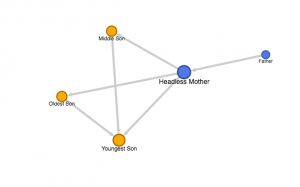
The work of fiction I picked is a short horror story that primarily focuses on the headless mother and her three sons, with a short mention of the father who decapitated her. This network graph illustrates which characters talked to which characters, and since it is directional, we can also see who was speaking to whom. The mother (somehow without her head) speaks to all three of her sons, her oldest son and middle son all call out to the youngest son at some point, and the father at some point presumably told the mother the reason why he cut off her head. The graph shows how the characters are related to one another and how they are not limited to just one connection – one character to speak to multiple other characters and also be spoken to by more than one character.
Some limitations about this graph is that even though it’s directed, it does not seem to reflect bidirectional relationships, so we cannot tell if characters respond back or if it’s a two-way conversation. It also does not reflect the strength of their relationship (e.g. the graph is not weighted based on the number of words they spoke or how long their conversation took) or what their conversation was about. It only shows arrows going one way and so we don’t know if certain characters are actually more closely connected to others based on the strength of that edge. It also seems like you cannot add multiple edges between the same two notes to showcase different types of connections, such as whether their conversation was positive or negative. If this graph was also applied to other stories, you could incorrectly assume that one character was very popular (or was the focus of the story) just because they spoke to a lot of other characters, when in reality the people they spoke to could have never responded. And you could also have stories with very few characters that actually had very deep and lengthy conversations, but the graph would not be able to represent that with the way it currently is. Perhaps adding more factors and details could help with the display of the nodes and edges in the network graph.