For this week’s blog post, I chose to read the short story “The Seventh Man” by Haruki Murakami. I chose this story because something about the titled appealed to me, and I enjoyed Murakami’s other works so I figured I’d give this story a shot. Anyways, the story begins with the narrator who opens the scene with a group of people huddled together telling stories. During this time, we are introduced to the Seventh Man, around whom the story focuses on. The Seventh Man then begins to tell a story of his own, a story which proves to be the main focal point of the tale. Below I have included a screenshot and link to the network map of the characters for “The Seventh Man” :
goo.gl/dGU3UH
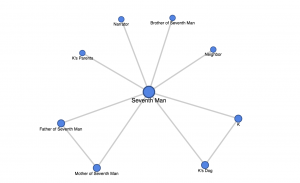
What I like about this graph is that it becomes instantly clear that the main character is the Seventh Man, if the title wasn’t already a clue. I built the edge list around characters who appeared in the same scene in the story. As shown on the graph, all the characters are linked through the Seventh Man, although there are a few links between some characters. The graph also reveals the simple nature of the short story, as seen with the few numbers of characters.
On the flip side, this graph fails to cover the structure of the story. For example, someone who did not read the story and just looked at the graph would assume all the characters existed in the same story. Yet, the structure of “The Seventh Man” is that it is really a story within a story, told to us by the Seventh Man and relayed by the narrator. The graph gives no indication of this structure. Furthermore, the network map only shows connections between the characters, but does not reveal how deep or intense the connections are. According to the graph, the Parents of the Seventh Man would have the same importance to the Seventh Man as the Neighbor. However, as seen in the story, this is clearly false; the Parents are a lot more central to the Seventh Man and the story as whole than the Neighbor.
As seen through my example, network analysis maps can be very useful in some situations and not so useful in others. Primarily, network maps make it very easy to see which nodes are more vital or central to whatever it is being analyzed. At the same time, network nodes also allow users to quickly pick out interrelated nodes or characters. However, network analysis maps are not good at showing the depth of connections, unless otherwise specified through some kind of legend. These maps also tend to ignore other aspects of whatever it is being analyzed; in this case for example, only looking at the characters fails to reveal story structure.