Behind the Scenes of Robots Reading Vogue
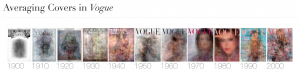
Robots Reading Vogue is a collection of data driven experiments to learn about fields from gender studies to computer science. This is done through analyzing color patterns, cover images, word usage, amongst other metrics. It is a joint project created by Lindsay King and Peter Leonard, who are both part of the Yale University Library staff. This blog post will primarily focus on Averaging Covers in Vogue.
Sourcing
Robots Reading Vogue is comprised of over 2,700 covers, 400,000 pages, and 6TB of data. Vogue has produced thousands of issues since 1892. Averaging Covers in Vogue analyzes the covers in one year, every ten years. This project sources data from Condé Nast and ProQuest LLC. Original Vogue material is copyrighted by Condé Nast, and the Vogue Archive from ProQuest contains digitized pages of Vogue from 1892. Some other experiments used data such as word usage, advertising, pricing, and color information.
Processing
Averaging Covers in Vogue overlays all of the covers for issues in one year. This generates a “mean RBG value for each pixel.” Lindsay and Peter wanted the covers to align exactly when possible to generate the clearest possible pattern. They hand-aligned layers before generating pixel averages because raw data, combined with different scanning and photography methods, would not create strong images.
Presentation
The final presentation of this experiment is a series of images. Some interesting conclusions can be made. In 1970 and 1980, the VOGUE headline is in the same position on the cover in every issue. Because of this, the average pixel image has VOGUE shown as crisp as it is in one cover. The average pixel generation shows a fuzzy model who is relatively in the same position and has similar head angle. The visualization of 1940 shows a stark contrast. The VOGUE title is barely recognizable and the cover image is a disoriented mess. This means that each cover is unique from one another in terms of types of people, positioning, and word placement. These mid-century covers were artistic and individual, while the 1970 and 1980’s showed a “visual rut,” where covers resembled each other and showed little diversity.
Vogue is one of the few magazines that has been published for over a century with relevant information and also has been completely digitized. This allows for thorough analysis and understanding of digital humanities. Averaging Covers in Vogue shows the stylistic change of Vogue covers throughout the decades.
Hi! I really liked reading your post and how you broke the reverse engineering down into steps and went into lots of detail in each step. I am a huge fan of Vogue and appreciate how you mentioned they have completely digitalized their archives, as they sometimes post about the history of the magazine or share old articles with readers (recently they had Sarah Jessica Parker on their YouTube page narrating the past 150 years of the magazine with pictures and references from the original magazine). Overall great post!