Introduction

The Digital Humanities project that I chose to reverse engineer is the Walt Whitman Archive. I studied Whitman’s works in one of my courses last spring quarter, so I was interested in learning more about him. The Walt Whitman Archive serves as a tool for those who want to research America’s most influential poet, from scholars to everyday readers. It aims for consistent growth as more and more of Whitman’s notebooks, manuscripts, and letters are discovered, collected, and studied.
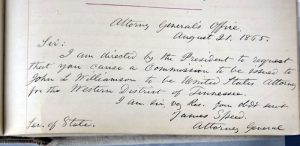
In Whitman’s Hand (Scribal Documents): James Speed to William H. Seward, 21 August 1865
Source
The project staff is filled with scholars from various universities in the United States, along with others who have made significant contributions, such as editor-scholars, informational professionals, technologists, and students. These individuals have worked to compile Whitman’s writings–including poems, prose essays, fiction, letters, marginalia, notebooks, manuscript fragments, and voluminous journalistic articles. The Archive‘s plethora of resources continue to grow as they draw from libraries and collections all around the world. I appreciate the diversity and collaboration of the team to ensure that all of Whitman’s work is gathered and recognized in the Archive.
Processing
Within the large project of the Archive, the staff is dedicated to several ongoing projects. One of the valuable methods of processing data is editing, from Whitman’s poetry manuscripts to his Civil War writings. Another recent project, “Whitman as an Author before Leaves of Grass,” focuses on digitizing Whitman’s pre-1855 fiction, journalism, prose, and notebooks. The Archive not only provides Whitman’s writings, but there are also images that have been copied and audio recordings that have been produced through collaborations with numerous libraries and collections. For this project, there are multiple methods of processing and analyzing the vastly available data.
Presentation
The Walt Whitman Archive website is simple to navigate and highlights its content over its aesthetics. In this way, it proves to be an effective research and educational tool. Under the section titled, “Technical Summary,” the staff explains its humble beginnings from 1995 to 2000 as a “prototype HTML site aimed at making a large amount of material available to users quickly.” Since then, the Archive has added content in the form of more sophisticated, structured data. For instance, XML (Extensible Markup Language) encoding has been incorporated for the textual content. The team behind the website works hard to present Whitman’s work in a way that is simplest and most effective in terms of user experience. Through XML encoding, users will be able to search Whitman’s work more successfully, especially for the sake of research. Their long-term objective is to digitize all of Whitman’s written documents into “faster-loading, high-quality” JPEG images.
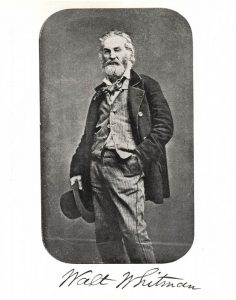
Gallery of Images: Whitman in Boston, 1859-1860
Hi Catherine, I really liked your work! I chose to reverse engineer this project too, and I think you could have elaborated more on the specific methods used in processing the information eventually put on the site. I felt that what we touched on for the presentation section was quite similar, including the parts about the tour as well as the various sections in the website.
Was there any effort to identify anonymous work that could have been attributed to Whitman? I know there are some DH methods out there that are decently reliable in identifying author prose and diction. Obviously an author as great as Whitman would have a huge library of non-anonymous work, but nonetheless, he could have some hidden gems so to speak.
Hello! I really liked how you interpreted all the data from the webpage. I also reverse engineered the Walt Whitman Archive and I failed to notice the XML encoding, so I found that really valuable and something I will be more attentive about in the future. Great Job!
Hello! I liked that you divided your blog post into three segments (sources, processing, presentation) as it was much more readable this way. I think you did a great job explaining the processing and presentation part of this DH projects since you explained the motive/intention behind using certain methods and I really appreciate that.
I really liked how you explained this project. I thought your analysis was very thorough, and you made it very clear in each section what the project was trying to accomplish. I thought it was very evident that you knew a lot about this project since you mentioned that you studied Walt Whitman previously.