I decided to take a closer look at Merchant’s Chicana Diasporic project. According to the introductory page, it is a research hub; a digital space where a varied collection of multimedia sources are brought together to create a complex narrative.
The data collected for this project has a clearly defined scope, following the Chicana Caucus of the NWPC from 1973 to 1979. The specific focus of the topic allows for the project to thoroughly explore it, selecting data from the most relevant sources without being overwhelmed by information from the rich history of the Chicana Diaspora. The project presents information from a range of historical sources in different forms of media. It is the culmination of eight years of research–Merchan

t calls it a “recovery project”, as historical materials (especially those relating to a marginalized group) are often not preserved and readily available. The collection of data might include the transcription of texts and digitization of ephemera like posters and handwritten notes. Metadata for these various sources was also collected–I was impressed by the easily accessible metadata for images appearing beside the text, with links to the original source as well as different file formats.
The processing part of this project follows the collection and digitization of materials, and I think it is most apparent in the network diagram on the “How to Navigate this Site” page. While each page addresses unique concepts, they are all related under the larger Chicana Diasporic narrative. While I’m not entirely sure of the technical process behind creating and visualizing such a network, I know that concepts had to be defined and categorized within a hierarchical organization of content–the blue dots and orange dots representing different organizational levels. Reflective pages discussing the process behind the project are sprinkled throughout the site, breaking down the challenges and reasoning behind it from Merchant’s point of view. The project takes on a dual narrative, as the processing and resulting narrative are discussed simultaneously. This value of transparency, often seen in DH projects, provides insight for users who may want to replicate and build upon the process for future projects.
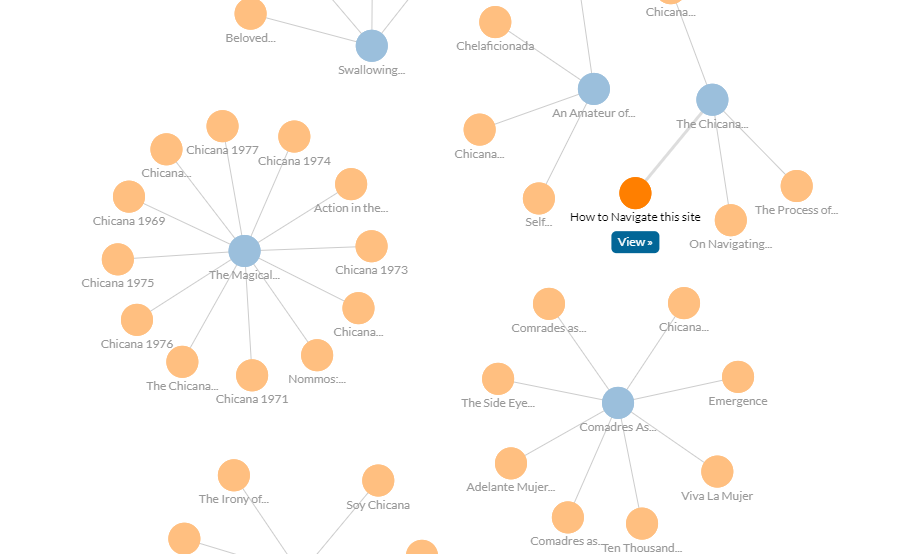
The project is presented online, “The Process of Chicana Diasporic” clearly identifies the products used to create the site. The the network of concepts and pages emphasizes the non-linearity of the Chicana narrative, with no definite start or end and no set pathway to follow. However, navigation of the site was somewhat linear–from the home page, the bottom of each page offered a link to the next page as users scroll click through different topics, instead of offering users a variety of links from which a unique path could be chosen. I prefer this guided navigation of the site, as I often find that trying to navigate large networks can be overwhelming. When each node and branch is loaded with information, it can be hard to keep track of what I have and have not seen, and even where to start. It took me a moment to wrap my head around the scope of the project, but once I did it was easy to navigate and understand how the different parts came together.
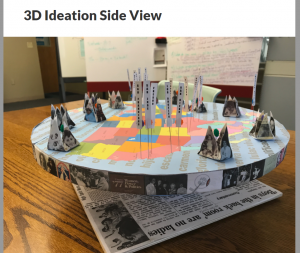
A part of the presentation that I found especially interesting was the 3D ideation of the project, which exists as a sort of large sculpture, physically mapping out the concept in the Chicana Diasporic project. This model reflects some of the limitations of working in digital space, and how it limits our ability to spatially engage with concepts. However, the model was made digitally accessible, to an extent, through images and video. I’m interested in learning more about how DH projects translate physical experiences into digital spaces.
I really enjoyed reading your honest experience and understanding of using the site, your post shows you clearly explored the site thoroughly. The insertion of images into the text was really helpful in that you had screenshot and then cropped the images to show the necessary section relevant to your text, as well as hyperlinking them accordingly was really helpful as a reader. Really personal and interesting post!
I also reverse engineered this website and found it to be a linear experience as well. In addition to that, it was overwhelming to navigate the website without the assistance of the guided navigation feature as you mentioned, but eventually became easier to use. That being said, it included good information and the physical mapping of the concept really was cool!
I agree with you and others that the website did have a linear progression, since the more non-linear pathways felt a little disjointed narrative-wise. I really appreciate that you included the 3D Ideation of the project, since it seems to be an offline materialization of the online experience. I think your post raises some questions that we should all be thinking about the limits of the digital medium, and how best to bridge the gap between the offline and online visually.