Course blog

Week 6: The Study of Studies


BlankTimeline

What I found to be interesting when reading “Demystifying Networks”, was how Scott Weingart argues that it is necessary to know all of the ways to study sciences.  As he mentions this includes the studies of culture, philosophy, history and even sociology.  He then discusses how science tends to have certain periods of innovation and prominence, while other times where it was taken back.

After continuing to read his research plans and the goals he had for conducting it, I became curious to know at what times were methods of sciences (ex. Astrology, Sociology, etc.) found to be especially useful or followed and whether there are any patterns.  For example, when we think of philosophy there are certain periods throughout human life that come to mind.  We often associate this method of study with figures such as Plato, Socrates, John Locke and even more contemporary individuals.  They are each known for their individual views.

Then there are studies of sciences such as Sociology that did not “exist” until far later, where it became accepted as a means of specific study.  A timeline could possibly indicate it’s time origin and display where it was most active and the periods where innovation seemed to decrease.

Though I could not find any sort of data visualization that seemed to correlate with this interest of mine, I think it would be a possible task and possibly an interesting one at that.  We would be able to see the amount of influence each study of science has had and when in time did it have the most influence.  Additionally, there may be other ones that no longer exist now.  Either way, I find that the lack of this gathered data to be peculiar and hope that it does find its existence sometime in the near future.


Source: http://www.scottbot.net/HIAL/?page_id=22226

Week Six: The Power of Network Analysis

Scott Weingart’s, “Demystifying Networks” discusses the basics of networks and the power of network analysis—when used correctly. Creating a network visualization can be done for most projects, but using the correct methodology for these visualizations is incredibly important as well. Because networks are “any complex, interlocking system,” which reduces to “stuff and relationships,” network analysis can illuminate relationships in large sets of data. Online, social networks are formed around almost anything, from intellectConnect to Goth Passions to Facebook. The objects studied within these networks are considered “interdependent rather than independent” from one another and require “relationships [in order for researchers] to understand” what’s going on within the network. The “stuff” within the network defines what kind of network it is. For example, the “stuff” within Facebook is people and these individuals have different attributes (such as DOB, Location, High School, etc.) and create various multimodal networks. Every individual has a relationship with someone else within Facebook, creating a relationship, and each type of relationships have a type of edge, “defined…by the nodes they connect.”

However, can relationships be seen even with individuals are not within the Facebook network? A study, “One Plus One Makes Three (for Social Networks)” shows that connections can be deduced between members and non-members through member’s confirmed email contacts. The study found out that:

Social network platforms…have direct access to two different sets of relationships: on the one hand, the mutually confirmed contacts between platform members; and on the other hand, their members’ unilateral declarations of their acquaintance with non-members. The edges in both are an abstraction and a subset of the edges in the latent social graph… with the help of machine learning, social network operators can make predictions regarding the acquaintance or lack thereof between two non-members with a high rate of success…These are the first results on the potential of social network platforms to infer relationships between non-members.

This study exemplifies the power of social network analysis, as even those ijournal.pone.0034740.g001ndividuals who have chosen to not participate in a social network (in this case Facebook) can be inferred by machine technology as being connected to a member of said network. No matter what, individuals are unable to escape social networks, for being an individual requires the need to engage with at least one person a day, and these interactions inevitably lead to connections. Even when not participating on a social networking site, these connections can still be predicted. There is no safety from the net!


Horvát, Emöke-Ágnes, Michael Hanselmann, Fred A. Hamprecht, and Katharina A. Zweig. “One Plus One Makes Three (for Social Networks).”PLOS ONE. PLOS ONE, 6 Apr. 2012. Web.

Scott Weingart, “Demystifying Networks.” Web.

Week 6: Demystifying Networks, Untangling Wikibinges

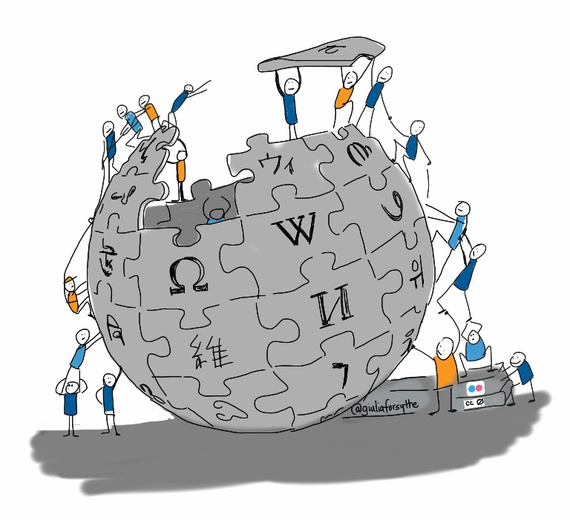
A super-network of information.

As someone who is (still) relatively new to Digital Humanities, I found Scott Weingart’s post, “Demystifying Networks”, incredibly helpful and interesting because it helped to answer a lot of Digital Humanities I knew and didn’t know I found confusing. In his post, Weingart goes through a quick-guide to what kinds of digital tools should and should not be used in certain projects. Emphasizing the project over the tool being used, Weingart urges his readership to look first to the needs of their project rather than the “coolness” of the tool they are drawn to using. In doing so, Weingart expresses as sense of reverence for both the “tool” and the “project” as not identical puzzle pieces that can be appropriated in any way we might want, but unique variables that require a great amount of understanding and consideration. Extending this ideology as he continues his explanation into network analysis and “nodes”, Weingart discusses the different kinds of nodes, or connection patterns that are used. Here, he outlines a major difficulty Digital Humanities faces as it incorporates tools from the sciences into the humanities. While the sciences works with largely uncomplicated connections between nodes, the Digital Humanities is rich with connection because its trademark ambiguity is largely due to the massive amount of influences that can contribute to a single node. Warning his readership of using a tool to analyze a network that doesn’t accomodate for the kind of complex networking that the Digital Humanities requires, Weingart emphasizes useability over convenience since “given that humanistic data are often uncertain and biased to begin with, every arbitrary act of data-cutting has the potential to add further uncertainty and bias to a point where the network no longer provides meaningful results” (Weingart).

Weingart’s discussion of the meaningfulness of connections, regardless of amount or level of complexity, reminded me of Wikipedia and the abundance of links each and every entry is peppered with. Allowing the reader to read an article and click on hyperlinked text to more articles to flesh out knowledge on your initial entry of inquiry, “Wikibinges” are understandably tempting as the site allows anyone with any degree of knowledge on the article’s subject to deepen their conceptualization of a subject. My own late-night Wikibinge started with “pumpkin pie”, and subsquently lead to “Starbucks”, “Moby Dick”, “Nathaniel Hawthorne”, and finally “allegory”. With each and every Wikipedia article a “node”, readers reading one article strewn with hyperlinks are actually being bombarded with an entire network of nodes that connect each of these nodes together. Thus, for Wikipedia, networks are hyper-“spaghetti and meatballs” set of angles Weingart describes of the Digital Humanities, as Wikipedia strives to capture the same kind of multi-facetedness that information ambiguously influences and is influenced by. While insistent curiosity can be blamed for late-night Wikibinges, perhaps we can also now assign some blame to Wikipedia’s “hyper-noded” articles as well.

Weingart’s article: http://www.scottbot.net/HIAL/?p=6279


Simple Stuff: A Network Analysis of Foodstuff Trade

A Network Analysis of Food Flows within the United States of America

Food is stuff.  By stuff I mean items we could quantify and classify with qualitative interpretations.  In theory, it sounds pretty easy to categorize them, monitor them, and then discuss them–through visual representations; however, it’s not so simple when you break things down.

In this vibrant, alluring visual above, you could see each state displays the relationships between foodstuff imported and exported in the United Sates.  It looks simple, yes, but if you look closely, you may get lost.  In an interesting article published in the Environmental and Science Journal, researchers explored the relationships between the 50 states when it comes to foodstuff commodities trade.  These relationships, referred to as “edges,” by Scott Weingart, allow us to conceptualize how food stuff moves from one to sate to another.  If you look at the states on the upper right heading clockwise, you will see states, such as Illinois, Louisiana, and California occupying the three largest areas.  According to the study, these states generate the most traffic-flow of foodstuff.  Additionally, if you compare Louisiana with Illinois, you will see a larger white/disconnected gap between Louisiana and the colors sprouting out.  What that indicates is the amount of imported commodities vs. exported.  While California has a well-balanced representation of imported and exported goods.  What does this mean and why does it matter?  Well, one way you could interpret this would be to say that the Midwest region, with the exception of California, plays a large role in our American food system dominating about 50% of the visual.  The Midwest is know to have vital landscapes and climate for favorable food production.  This could go into further, deep discussions ranging from politics, to history, economics and so forth.

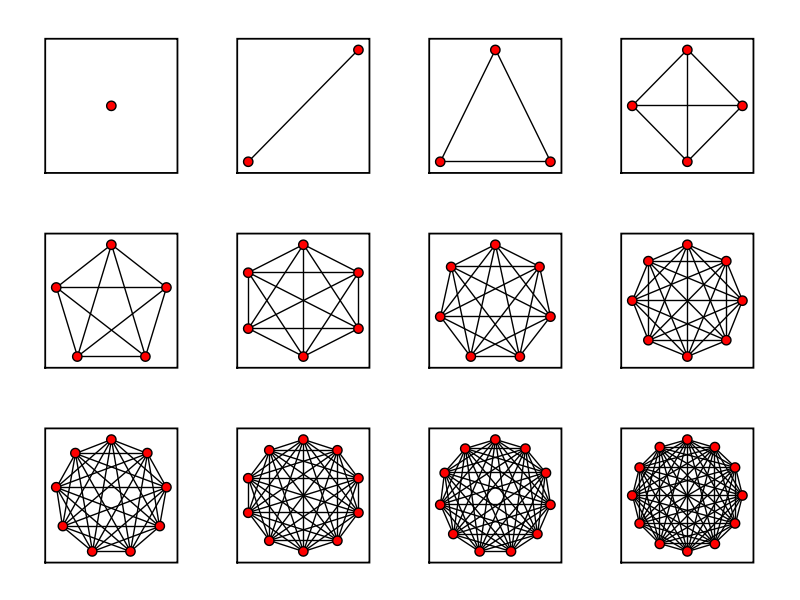
The “dense” network, what we see above,  illustrates  what Scott Weingart explains as “[a] network of nodes where almost everything is connected to everything… ” (Demystifying Networks).   Weingart describes nodes as stuff, generally speaking.  The nodes we see, or rather don’t see embedded in this visual, are food commodities categorized in the following manner: “cereal grains, other agricultural products, animal feed and products of animal origin, nec, meat, fish, seafood, and their preparations, and, other prepared foodstuffs and fats and oils” (A Network Analysis of Food Flows within the United States of America).  Vague categories, I know.  Nonetheless, all foodstuff fits nicely into all of those categories.  Weingart goes on to state that we  need to make our networks “sparse” to maximize efficiency, from a humanistic perspective.  The network analysis I provided in this week’s example is not necessarily humanistic, in fact, it’s scientific.  To say that this network analysis needs to be less edged is incorrect, nor do I wish to propel that argument.  Put simply, the data visualization I present is to give an example of a network analysis that displays complexity without “artificially cutting out” any edges.”  This goes back to past readings where we discussed the relationships between Humanities scholars and Science scholars in the digital humanities realm.

Digitalizing six degrees of separation

As Kieran Healy explores on his “Using Metadata to find Paul Revere”, simplifying the networks through using metadata that begins with 1’s and 0’s to connect members (listed in rows, summing up to 254) who belonged in same organizations (which started with only seven), and multiplying the matrix with another matrix that sums up to 254 people again, or in a similar sense, using 7×7 for multiplying different organizations, can create a social network that connects millions of people.

“Notice again, I beg you, what we did there. We did not start with a “social networke” as you might ordinarily think of it, where individuals are connected to other individuals. We started with a list of memberships in various organizations. But now suddenly we do have a social networke of individuals, where a tie is defined by co-membership in an organization. This is a powerful trick.” (Healy)

The difference between this project and other social networks is, as Healy mentioned, that the team wasn’t tying to create a social network but created a metadata with list of organizations and their members, which enabled the project to have a multiplied result of metadata.

Such whole concept of connecting people through their common denominators, from family and mutual friends to organization relations, had become a huge boom when Six degrees of separation was first publicized. The theory that everyone is connected through six or fewer separations to anyone in the world was first studied in 1929 by a Hungarian author Frigyes Karinthy. As the theory continued to develop, in 2001, a Columbia professor Duncan Watts recreated this concept on the digital world in an experiment where he attempted to deliver a package to a random group of people, the result of the average intermediaries was six.

“I read somewhere that everybody on this planet is separated by only six other people. Six degrees of separation between us and everyone else on this planet. The President of the United States, a gondolier in Venice, just fill in the names. I find it A) extremely comforting that we’re so close, and B) like Chinese water torture that we’re so close because you have to find the right six people to make the right connection… I am bound to everyone on this planet by a trail of six people.” (Six Degrees of Separation Website)

The theory has been widely popular, especially after the actor Kevin Bacon has launched SixDegrees.org, connecting him to any actors or actresses in the world; and the same concept has been used on many social media platforms ranging from Facebook (mutual friends), LinkedIn (n-dgree connections), and Twitter (follow suggestions).

This concept of creating matrix of metadata is shrinking the world and re-defining the “small world” as a part of science-backed digitization, and it’s only very interesting to see where this technology can be used to create other forms of connection than mere personal connection, forming a new type of networking system and bringing professionals together to collaborate etc. creating even bigger and unimaginable impacts.

Network Analysis of Hamlet

“Demystifying Networks” was unusually interesting to me, since networks are indeed mysterious now that I realized that I have given little thought to what is a network. I have heard the term network many times, usually when the subject is about the internet, and always thought of it as how information or things are interrelated.
Scott Weingart explains in “Demystifying Networks” that nodes are the assortment of “stuff”. For instance, an assortment of different shoes are nodes. And each pair of shoe is a node. A pair of shoes has a brand, size, and color. Therefore a node may include these attributes. He further explains that nodes can have types; therefore we can include the brand of each pair of shoe as a node type. This will create a different set of nodes that has different attributes. This process of adding different node types from one node can extend, making the node multimodal. A pair of nodes is considered bimodal. We can make a bimodal node multimodal by adding another type of node from the second node. We can add products, and this will create a different node with particular attributes. Weingart addresses the pitfalls in Digital Humanities where the amount and types of nodes are too much and too complicated for the tools of network-science. Also, he furthers this argument by noting that the result of the network analysis from Digital Humanity nodes can mean something else. He explains that, “Humanistic data are almost by definition uncertain, open to interpretation, flexible, and not easily definable”.


These nodes are the characters from Shakespeare’s Hamlet. This is an example of how data visualization can over simplify the meaning of the information. It is also an example of how the network can be open to interpretation. The network analysis of the characters does not explain their relationship to one another. The relationship of Hamlet with the Ghost is open to interpretation. The ghost, supposedly the ghost of Hamlet’s father, can be an impostor or a delusion and may be Hamlet himself. Because the data visualization is “open to interpretation” and is” not easily definable”, a good understanding of the text will be required for the data visualization to be useful. The idea that Hamlet is the center of this network is in itself debatable. A reading of the text can bring just a good an understanding of Hamlet without the network analysis. Multiple network analysis can be a way to address the complexity of the work.


Work Cited:

http://www.scottbot.net/HIAL/?p=6279

https://www.google.com/search?q=hamlet+network+analysis&espv=2&biw=1600&bih=799&source=lnms&tbm=isch&sa=X&ei=eS1hVOrwEc2rogTozIDIDg&ved=0CAYQ_AUoAQ#facrc=_&imgdii=_&imgrc=P0Yb1RqgHswh_M%253A%3BLRtXYYDmiRRyiM%3Bhttp%253A%252F%252Fwww.newleftreview.org%252Fassets%252Fimages%252F3020501large.gif%3Bhttp%253A%252F%252Fnewleftreview.org%252FII%252F68%252Ffranco-moretti-network-theory-plot-analysis%3B600%3B524

Week 6: Applications of Social Network Analysis

I really genuinely enjoyed reading Kieran Healy’s “Using Metadata to Find Paul Revere” this week. However, because the network being analyzed was active centuries ago and has already been documented to such a great degree, it would have been easy to dismiss Healy’s application of social network analysis as not especially relevant or groundbreaking. I found that using the narrative of the American Revolution was a very creative way to introduce the concept of social network analysis and create an analogy for current policies regarding metadata use. Although the story of the “Royal Security Agency” keeping an eye on the patriots was used as a framing device for an explanation of social network analysis, the story was interspersed with several tongue-in-cheek references to our own security agencies’ use of “metadata” to track “terrorists,” demonstrating the power of social network analysis and its potential use in the modern world.

I found another article about the application of social network analysis that might be helpful if anyone didn’t pick up on some of Healy’s allusions. “Life in the Network: the Coming Age of Computational Science” argues that because of the amount of data we generate over the course of the day, it would not be very difficult to get a comprehensive picture of our lives given access to said data. Social network analysis, or computational social science, occurs on a grand scale at large companies and government agencies, but the authors of “Life in the Network” maintain that even if computational social science were to be adapted to fit a model focused on academia, it would not offer the general public any more access to knowledge.

There appear to be many issues associated with social network analysis, especially regarding privacy concerns, which can be seen as either an obstacle in the advancement of computational social science or an argument against the practice of social network analysis. The article provides several examples of data collection in the area of computational social science, like the examination of group interactions through email data and the use of GPS to track movement, and offers ideas as to the questions such studies could address. The data that is involved in those studies is considered “self-reported.” However, because data is now generated at such an overwhelming rate and in so many different ways, it does seem possible that plenty of data is being collected and analyzed without us being entirely aware.

Demystifying Networks – Relationship Networks

relationship_network_social

The part of this reading that stuck out the most to me was the idea that putting data into networks is like trying to fit “square pegs in round holes.” We always assume that everything we want to explain can be explained – but this might not be the case. In order to put items into graphs or networks, you pull out the similarities between the items to relate them to other things. In this process, some of the complexity may be lost because the network doesn’t represent the individual uniqueness of each item. But even so, as he mentions in his blog post, networks become seemingly less useful when they are more complex and dense. In this sense, it makes it seem to me that networks should be used to show relationships between things that maybe are simple and don’t have a lot in common but are somehow connected in some way.

In my opinion, the most interesting types of networks are those that involve relationships between people. Part of the reason I became interested in Digital Humanities in the first place was because I find it fascinating to interconnect technology with real people. In networking relationships, you can put on display a relationship that is not visible in the real world. You can take feelings and connections and make them tangible. This really is putting a square peg in a round hole, though, because relationships aren’t meant to be networked. Humans and human qualities aren’t meant to be translated into computer code – and yet, we’ve done it! The easiest and most concrete example of this would definitely be a family tree. It displays visually the ties between people using edges. We may not know exactly how we are connected to a family member way in the past, and this network visualization would be able to tell us this. Relationship networks are just the most fascinating to me because it still captures something so real. It is much easier to understand the relationship between a book and its author and to put it on paper to show the relationship, but relationships between people are so complex that to stick them on a graph with lines connecting them to a few other things simplifies their depth tremendously. But this is what networks are all about, translating something into a manner of understanding that can prove a specific point.

Weingart, Scott. “Demystifying Networks.” Scottbot. N.p., 14 Dec. 2011. Web.

Week 6: Airplane Networks

title

http://www.aaronkoblin.com/work/flightpatterns/

Demystifying Networks by Scott Weingart describes the beginnings of networks and how they can be used today within the digital humanities setting. Before the reader gets too excited on networks, Weingart gives a few warnings when dealing with networks – 1) yes networks can be used on an project, but that does not mean they should be. Networks only work for certain projects, and we must not get carried away when using them otherwise they will appear and become misused. 2) “methodology appropriation is dangerous” in that the methods and procedures one used on one network are not the same when working with a different set of data. Borrowing these methodologies can be even more dangerous because the users lack the knowledge to apply them correctly.

Weingart also covers “stuff”. Within his topic of stuff there are nodes, the connectors and organizers between the stuff. Nodes have attributes, or contain data on the stuff. Demystifying Networks uses books as the example of stuff. Different examples of books (dictionary, Poe collection, Harry Potter, etc) are the nodes. The title, number of pages, and author are node attributes. The next overarching topic is “relationships”. Weingart nicknames them “edges”, and defines them by the nodes that they connect. Continuing the book example, he takes person Franco Moretti and lists the edges that contain Franco Moretti – that he is an author of Modern Epic and Graphs, Maps, and Trees.

I took a network created by a UCLA alumni and applied what I learned from Demystifing Networks. Aaron Koblin is a Design Media Arts graduate (especially cool since I’m also in DMA) who represented visually and interactively the network of flight patterns across the United States. The project is part of a series called Celestial Mechanics, “a plalanetarium-based artwork installation that visualizes the statistics, data, and protocols of manmade aerial technologies. However, these specific renderings show the altitudes, makes, and models of over 205,000 different aircrafts being monitored by the FAA on August 12, 2008. You can filter which aircraft you wish to see, zoom in on specific areas of the map, and even download high quality images for your desktop backgrounds because the resulting maps are so gorgeous.

With this example, defining the stuff, nodes, and relationships are more difficult because there is no database available to the public. I can say that the stuff is each individual airplane with its unique destination; the nodes are the airports (connecting the planes together); the attributes of the stuff is the aircraft, its altitude, the number of passengers, the flight number, etc; the attributes of the nodes is the size of the airport, the address, how many terminals it has, and if it’s an international airport or purely domestic; and finally, the relationship between the planes and airports could be which airline owns the plane and if its available at the airport. Visually, I don’t think there’s a more stimulating network graphic than this one. But with the promising future of networks, undoubtedly someone will take inspiration from Koblin’s work and stretch the boundaries of beautiful network visualizations.

Finding media you can use on the Web

I can illustrate this post with this cute picture of a puppy because the Flickr user 23am.com has licensed it CC BY — meaning I can do whatever I want with this picture as long as I credit him or her. Here’s the original photo.

Since you’re going to be using lots of different media for your projects, it’s probably a good idea to go over what kind of things are safe to post and re-post on the Internet.

Alas, we’re not legally allowed to reuse and remix anything we want. Say, for example, I wanted to illustrate this post with this photograph of Hillary Clinton and Benjamin Netanyahu. Sadly, I cannot, because it’s under copyright by the European Pressphoto Agency. (In practice, would anyone know? I don’t know. But it’s good to be aware of these things.)

Fortunately, smart people have thought about the problem of reusing and remixing stuff you find on the web. And there are a few categories of media that you’re safe to use.

Creative Commons licenses are designed to be less restrictive than regular copyright licenses. By attaching a Creative Commons license to something you create, you can give other creators various levels of permission to re-use your stuff:

  • Other people can do pretty much whatever they want with your stuff — remix it, tweak it, whatever — as long as they give you credit. That’s called CC-BY.
  • Other people can do whatever they want with your stuff, as long as they give you credit and allow others to do the same with the stuff they make from your stuff. That’s CC-BY-SA.
  • Other people can post your stuff, but they’re not allowed to remix it or create derivative works from it and they must give you credit. That’s CC BY-ND.
  • Other people can repost and remix your stuff, as long as they give you credit, but their new works must be non-commercial. That’s CC BY-NC.
  • Other people can remix your stuff, as long as they use it non-commercially, give you credit for it, and give other people the same license terms with the new work. That’s CC BY-NC-SA.
  • Other people can share your work, as long as they credit it to you, but they can’t change it in any way or use it commercially. That’s CC BY-NC-ND.

There’s also a category of stuff that’s under even fewer restrictions than Creative Commons licenses. That’s material in the public domain. Works enter the public domain in a number of ways: they age out of copyright restrictions, they’re published by the government, or the creator explicitly dedicates his or her work to the public domain. If work is in the public domain, you can do whatever you want with it. This chart is the best guide I know to determining whether something is in the public domain. A good general rule of thumb: If something was published before 1923, it’s probably in the public domain.

Finally, even if something is under copyright, there’s a chance you can use it, depending on the way in which you use it. The name for this category is “fair use,” which generally means you’re using a portion of the work for a non-commercial purpose, and your use won’t detract from the work’s commercial value. Fair use is murky, more the product of a set of decision calls than one hard-and-fast guideline. Here is a worksheet designed to help you evaluate whether you can use something under fair use.

Finding this stuff

A number of search tools make it relatively easy to identify material that you can remix and repost.

  • Creative Commons Search allows you to search for images, music, video, sound with different levels of CC licenses.
  • My favorite way to locate CC-licensed images is to use Flickr’s advanced search feature.
  • Everything on Wikipedia is published under a CC license or is in the public domain.
  • The Internet Archive offers a wealth of video, texts, audio, and other media to reuse.
  • Many DH people are aware of the importance of CC licensing and explicitly attach CC licenses to their work. For example, if you look closely at the bottom of Bethany Nowviskie’s blog, you can see that she’s licensed it CC-BY.

So look for the Creative Commons license, or check to see if something’s in the public domain, and you should be good.