Back in high school, I had quite the embarrassing secret. I’d always loved playing games. When I was 7 my dad bought me a mac and I played games like Pajama Sam, Treasure Cove, or Barbie Detective. Over the years, I accumulated quite the collection of consoles, including a Nintendo 64, a Gamecube, as well as an Xbox 360. But around the 9th grade, a different kind of gaming sensation entered into my collection: the World of Warcraft (or WoW) took its place within my interactive media canon.
The reason I’m bringing up such a formidable yet relatively awkward and humiliating phase of my life this week is because I feel as though there are interesting parallels to be made regarding topics in network analysis, topic mapping and metadata with WoW and MMORPGs (Massively Multiplayer Online Role Playing Games) in general. In his blog post, Scott Weingart defines networks as “any complex, interlocking system.” In the game, there are an overwhelming number of possibilities of network analyses that can be created because of the overwhelming quantity of metadata available regarding game players and related player statistics. What I found so fascinating about the possibility of using WoW data to create network analyses after reading Weingart’s post was the fact that in many ways because we’re talking about an interactive computer game in which users make choices about their race, class, realm type, as well as their social interactions with other people while playing online, this environment might represent a place where the digital humanist and computer scientist can both extract data and conduct different types of network analysis.
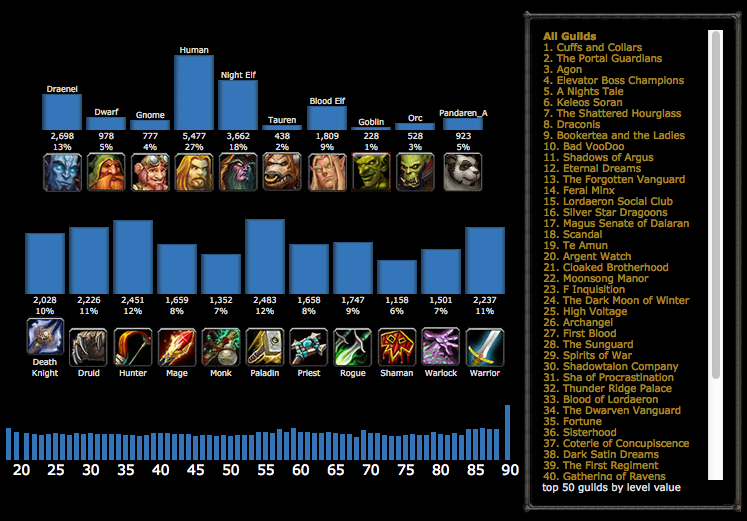
A visualization of guilds, and players by race, class and level on my old server, Moon Guard [RP].
From the digital humanist’s perspective, a scholar might look at individual players on the server as “nodes”based on race, class, level or even a player’s name and use the guild system as “edges” to draw connections between these agents. In doing this, a scholar interested in online social interactions may be able to determine how different social groups on the server are configured and make inferences from that relationship. Using a unimodal schema, centrality of each agent could be determined to analyze its importance to the network in general.
I think there are a lot of other possibilities and applications for analyzing data taken from other MMORPGs, not just WoW. I also believe WoW could be a potentially valuable resource to discuss in our “ALT Narratives” project group when discussing online communities and narratives created socially with a preexisting lore or framework provided by entertainment companies like Blizzard (the creators of WoW).