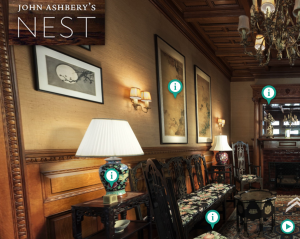
For my blog post, I decided to write about the Yale Digital Humanities’ project, John Ashbery’s Nest, which is a virtual reality tour of the Pulitzer Prize winning American poet’s home. The project, which can be found at http://vr.ashberyhouse.yale.edu/# gives viewers an in depth, interactive look at the center hall in the home, and the history behind the items Ashbery had inherited or collected. According to the website, the project is broken down into audio provided by John Ashbery and David Kermani which details the meaning behind the items in the homes, as well as Ashbery reading his poems while text gives context to the artifacts (source: http://ashberyhouse.yale.edu/about/introduction-0 ). The page also includes 3D photography and video, giving the viewer the opportunity to see the house from every angle, and presents itself as very lifelike and realistic, with a guide greeting you at the door before you enter the home. Inside, you can zoom in and zoom out, thanks to the meticulous photography provided by everyone who worked on the project (source: http://ashberyhouse.yale.edu/about/acknowledgments ). The house doesn’t let you stray from the given path, or find out information on items that aren’t flagged to be viewed, but it does let you zoom in and out to explore. The project combines the current state of the house with details from John Ashbery’s past, such as the homes of his parents and grandparents, complete with photos of the candelabra on his mantle as it was when it belonged to his grandparents. The website mainly uses virtual reality as a way to explore the website, giving curious viewers an in depth peek into the acclaimed poet’s longtime home. The added features of hearing John Ashbery himself read his poems and looking into his family’s past, as well as the history of his home, creates a bond and connection between the poet and people curious about his life, which is a really unique and new opportunity that society now has thanks to virtual reality, which creates a voyeuristic experience for viewers. An interesting fact is that the project was actually created with the help of John Ashbery, rather than by someone in charge of his estate or as a way to look into history. Rather it gives viewers the opportunity to look into the home he lived in at the time (he passed away recently) and see into the way his home looked as he inhabited it.
I really enjoyed reading your post and learning more about this project. I thought about doing my blog post on this same project as well because the 3D/virtual reality aspect really intrugued me. I also like how you critiqued the project and how it only allowed a minimal view into Ashbery’s home and belongings. When I first started exploring it, I thought it was going to let the viewer into the entire home and look at different rooms. I guess that might’ve been a little too difficult and complicated to pull off. I might have missed it but I see that the source is considered the text from some of his poems as well as audio snippets of him talking and the presentation is the actual virtual tour of the home but what counts as the processing? How was that information analyzed and made sense of?
Hi,
Because I didn’t do my reverse engineering post on this project, it was very interesting seeing how you were able to dissect it. I loved this project due to the combination of 360-degree filming along with the panoramic display. This project really demonstrated the endless combinations and possibilities of using digital tools, and I loved how this project presented their findings in a way that was not overwhelming. Overall, great post!