“Robots Reading Vogue” is a digital humanities project marking the meeting point of data mining and fashion trends through the fashion magazine Vogue. The Vogue Archives precisely files over one hundred years of the popular fashion magazine that is recognizable to people of all ages. The digitally recorded 2,700 covers and 400,000 pages allowed for an unending flow of research possibilities. Yale students took to analyzing these pages of advertisements, visuals, topics and many other details to create the various projects featured on the interactive web page. Their digital humanities projects give us a better understanding of gender studies, social history, consumer trends, digital research and more.
Source:
Peter Leonard and Lindsay King headed the “Robots Reading Vogue” project where students dug through the main source: The Vogue Archive, created by ProQuest filled with over a century’s worth of digitally marked up Vogue magazines. The archives cover every print since 1892, allowing for the perfect primary source for the students’ academic study.
Processing:
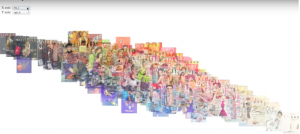
Students process the Vogue Archives by mining through the years of magazines and finding specific information related to their topic. Each of these various topics required a different method of searching for relevant information. Some of these projects required searching through pictures for their information.
For example, “Vogue Covers in Colormetric Space” required plotting the magazine covers into the digital tool ImagePlot and analyzing the hues, saturations and color contrasts of these images. If certain covers were not present, they may also have needed to scan the images onto a computer. From these covers, the students searched for trends and connections between covers and the year published.
“Diana Vreeland Memo Generator” is another project that uses the process of searching for the 200 memos by Diana Vreeland, a former Editor-in-Chief of Vogue. To find these memos, students found the relevant memos and organized the information into a database. Because the final presentation would generate random new memos, these archived memos were typed into a Markov chain model to find the statistics on possible strings of words that Diana Vreeland might write in her memos.
Presentation:
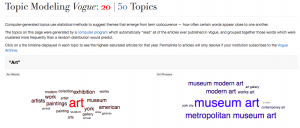
After the data is compiled, students presented their findings in many forms. “Topic Modeling Vogue”, for example, presented the findings of word distribution into word clouds allowing the reader to quickly understand the topic being presented and its relevance to words surrounding it. The project “Averaging Covers in Vogue” gave an example of a project that did not focus on just text. Instead, the covers and findings were represented through digital image overlays that presented findings for the readers to visualize. These various projects add up to the final “Robots Reading Vogue” database that is web-accessible and interactive for students and researchers like us to use.
Really nicely done, Sophia!
Sophia,
This blog post is wonderful! I also really loved this digital humanities project because it took a magazine that most of us know and love and digitized it in a really awesome way. I appreciated your comment about how this database is web-accessible and interactive for students and researchers to use. I think that’s what makes digital humanities projects powerful to begin with. Overall, this post was extremely easy to follow and told me all about “Robots Reading Vogue.”
Hi Sophia! Like the previous comment has said, your post is very clear, insightful, and easy to follow! I chose to reverse engineer a different project, so your post really helped me gain a deep understanding of “Robots Reading Vogue.” One thing that I really liked about this project is that the data and analyses are presented in numerous ways, providing viewers with various perspectives as well as unveiling the endless possibilites digital technology provides to studying humanities. Also, from what we’ve learned on Trouillot’s method to “doing” history, archives and other historical records include only the parts of history to which communities have attributed meaning and importance. Many, including myself, probably did not know the usefulness and meaning to archiving Vogue magazines, and this project clearly revealed its importance through new understandings of gender studies, social history, consumer trends, and more.