How can robots read Vogue? Data mining, of course!
Robots reading Vogue is a project launched by Peter Leonard and Lindsay King, Yale’s Librarian for Digital Humanities Research, and Art, respectively. The ambitious project sets out to explore the magazine’s rich history and its trends, both visually and content-wise.
Sources
This is only possible because of the Vogue Archive; Launched by ProQuest and Condé Nast in 2011, the Vogue Archive digitized all of the magazine’s covers and content since its first publishing in 1892. Unsurprisingly, the archive is also the main source of this digital humanities project.
In order to gain a more comprehensive understanding and analysis, Leonard and King also referred to other materials, such as memos, books and articles, in addition to the Vogue Archive. Altogether, these form the 6TB of data and the basis of the analyses made by Leonard and King.
Processing
Leonard and King processed over 2700 covers and 400000 images, which allowed them to identify trends in Vogue over the century. Using slice histograms, topic modelling, colormetric analysis, and n-gram searches, the authors of the project managed to break down the trends in magazine covers, circulation, advertising, as well as topics and content of the magazine. Using Markov chains of words memos from ex-editor-in-chief of American Vogue, Diana Vreeland, Leonard and King was able to generate randomized memos that mimicked her writing style.
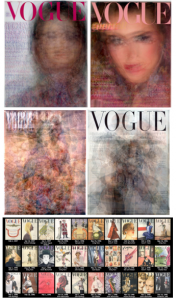
I found the dissection of magazine covers really interesting: in particular, I was fascinated at how the cover averages in the 1970s and 1980s clearly indicate that the covers were similar in terms of the models’ positioning, gaze, and head angle – a nod to the 70s and 80s aesthetic that we’re so familiar with – signifying the lack of individuality and artistry in cover design during this era. In contrast, there were no discernable pattern from the averages for the 1940s and 1950s, which is characterized by the avant-garde covers designed by famous artists and photographers like Salvatore Dalí and Irving Penn.
Presentation
The results of the analysis in Robots Reading Vogue is presented in multiple forms, including tables, charts, graphs, histograms, and images, which allows readers to grasp information relatively easily. For example, the authors used graphs to illustrate the fact that Vogue’s circulation has sky-rocketed in the 1970s, with its price increasing almost two-fold, which surprisingly coincides with the “visual rut” that characterized Vogue covers in the 1970s.
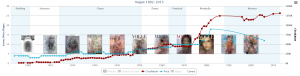
Overall, the project has done an amazing job in breaking down the various characteristics of the magazine, both in terms of visuals and content, to illustrate its trends across the century.
I love how you divided the sources, processing, and presentation in an easily digestible format. You did great adding your own analysis on the dissection of magazine covers contrasting the differences in aesthetics of each generation. Keep up the good work!
Hi Tenn Shaun! I really loved the way you broke down this project, especially that you hyperlinked the various methods of processing Robots Reading Vogue. Being a very visual person, I also really enjoyed the dissection of Vogue magazine covers and thought it was a very interesting and different way to analyze something we see every day. Awesome job! (: