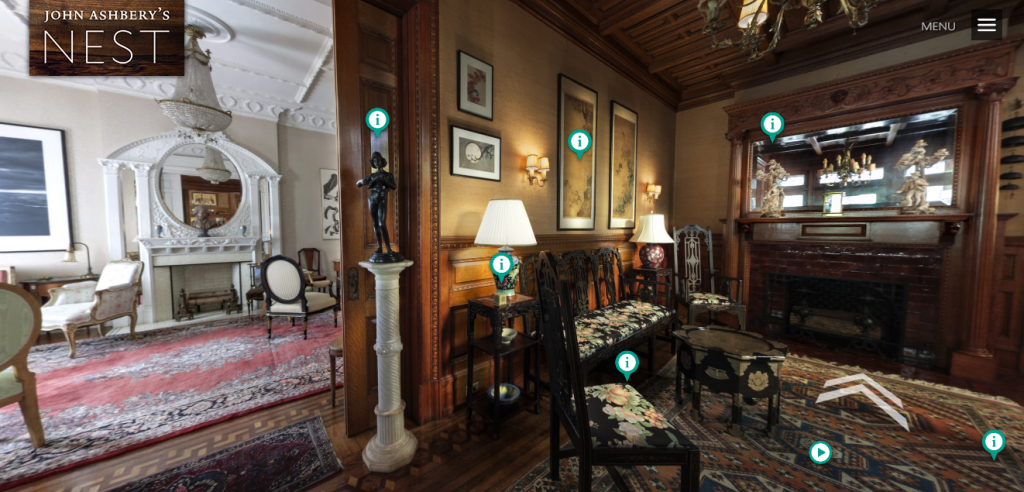
American poet John Ashbery was renowned for his writing, art, and critiques. Lesser known was his incredible collection of antiques, and carefully curated home of furniture, artwork, and other decorations. Developed by the Yale Digital Humanities Department, “John Ashbery’s Nest” is a virtual, interactive tour of Ashbery’s incredible environment conducive to artistic creations of all kinds. Throughout the tour, we are able to learn about the significance of various objects and pieces in the home narrated to viewers by Ashbery himself.
Sources: The sources of all web content come from John Ashbery and his partner David Kermani. The photos of the Hudson House were taken by The Poetry Foundation, and materials to create the virtual tour collected by Yale professor Karin Roffman; however, all interviews and information on objects within the home come straight from Ashbery and Kermani.
Processing: The material from the sources have been processed in a variety of ways. The first and probably most obvious method has been through digitization. Ashbery’s home has been photographed and made available online in a 360 virtual view. Individual objects have also been photographed, documented, and made analyzeable in addition to the rooms themselves. Each artifact contains a description of its meaning and continues into how it is connected to other aspects of Ashbery’s life. For example, this Drop-Leaf Table is found by the steps of the Center Hall. The tour connects data on the table to other historically relevant information, such as its placement in Ashbery’s childhood home and its meaning to his family as well. This is creating additional data out of initial data as well.
Each artifact contains a description of its meaning and continues into how it is connected to other aspects of Ashbery’s life. For example, this Drop-Leaf Table pictured below is found by the steps of the Center Hall. The description has been connected the table to eight slides of other historically relevant data, such as its placement in Ashbery’s childhood home and its meaning to his family as well. At the bottom of each object’s description is also either an interview or relevant poem from Ashbery that is somehow connected to the object. Through this additional information, metadata is interestingly created from initial information on the table.
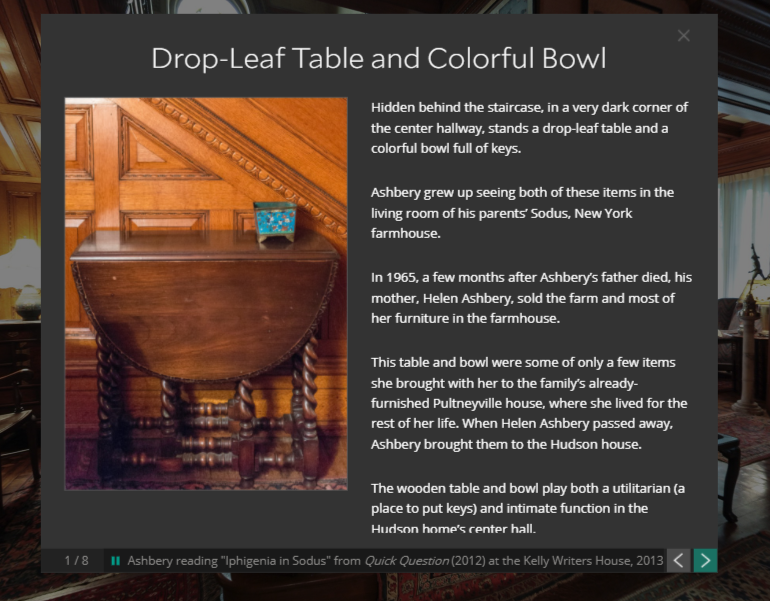
Presenting: Finally, all the data and imagery has been stitched together into a beautifully interactive, and web-accessible digital humanities project. The data collected from Ashbery and Kermani has been transformed into a fully interactive, virtual tour.
I personally had a really great time interacting with the final presentation of this information. It was very engaging for me, a visual learner, and is certainly very engaging for both auditorial and kinesthetic learners as well. Overall, I thought it was a really awesome way to learn more about an icon that I didn’t previously know much about.
I really liked how this blog post was set up, it looks very clean and the information given looked very well thought through.
Hi Stacy!
Awesome post – I like how they turned a 360 snapshot into an interactable little tour. It is indeed engaging and fun to click to around. It’s interesting to see the workspace of a creative person, and how their work environment influences them. Thanks for acknowledging different modalities of learning – it’s true that certain content appeals better to certain learning types.
Hi Stacy! Thank you for sharing and breaking down this project. It was very informative and detailed, and the meticulous work you put into dissecting the website definitely shows in your blog post. Like you, I thought the project is engaging both in an visual and auditory sense, and I definitely learned a lot from your blog and from looking at the website1