Introduction
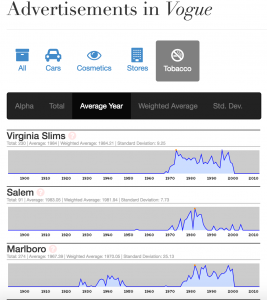
Robots Reading Vogue is an experimental project that seeks to discover the different ways we can use data mining to better understand topics such as gender studies, color usage, theme patterns, and word usage in the popular fashion magazine — Vogue. This page exhibits early student/faculty studies ranging from histograms to topic modeling to show the wide range of insights that can be found. As a joint project by the Haas Arts Library and Digital Humanities Lab, it shows the power of blending the arts and the sciences.
Sources
There are several sources cited by the authors of the page due to the complexity of the analysis. Some of the most prominent and vital sources include the Vogue material (accessed from Condé Nast) and the Vogue Archive (accessed from ProQuest LLC). King and Leonard, the authors, also used several other articles, books, and publishings to gain a more holistic understanding of the data. Through their intensive research they have had the ability to form an analysis from over 6TB of data.
Processing
The processing of 400,000 pages of Vogue magazine allowed the authors to break down several characteristics of the page. They dissected Vogue’s color patterns, visual imagery, word usage, themes, advertisements, circulation trends, and price to page correlation through the use of histograms, n-gram searches, topic modeling, word embedding models, and other statistical models. The authors have also created algorithms to mimic the editor-in-chief Diana Vreeland’s style of writing memos. In my opinion, an interesting find is the near-instantaneous drop in the popularity of the word “fox” and “mink” as movements against animal cruelty began becoming more prevalent in the latter half of the 20th century.
Presentation
I believe that Robots Reading Vogue does an amazing job of visually representing the results of multiple, distinct analyses. The authors use different forms of tables, graphs, charts, and images to depict their findings which make it easy for readers to get a grasp of the data relatively quickly. For example, they use a combination of word clouds and area charts to show the presence of certain themes like “travel” and “advice and etiquette” in Vogue magazines. Another example is the presentation of their findings from a slice histogram in the form of a simple chart with the x axis representing the brightness and the y axis representing the saturation.
All in all, the blog post does a marvelous job of breaking down and analyzing various factors of the magazine to show patterns and trends over the years.
Hi!
I think you did a great job in extensively breaking down how the sources used in “Robots Reading Vogue” were obtained. Additionally, I agree that editor-in-chief, Diana Vreeland, had a strong impact on the magazine’s publications to push for social movements, as you mentioned. I think Vreeland’s passionate personality also played a role in the success of the magazine because she pressed for content that was original during the time she was editor in chief. As a reader, I would maybe like to see images from the actual project pertaining to the examples you mentioned in your post. Otherwise, I thoroughly enjoyed reading this post!