This week I am analyzing the short story called The Martians Claim Canada written by Margaret Atwood which was found on the site Granta. The story begins by an introduction with three martians accidentally landing on Canada instead of New York and their sole purpose for this journey is to see a musical. Since the martians know how to speak the language of the mushrooms, they decide to ask the mushroom about their whereabouts and for more information about the place. The mushroom explained the history behind the land and how different groups of humans take over and claim the land though the usages of flags and countries. Essentially the mushroom explains how a society is built and describes the tragedy involved in claiming lands and transfer of power. At the end, the martians decide to just take over Canada and rewrite it so they can have and watch Canada the Musical.
Since the majority of the short story is the dialogues between the three martians and the mushroom, I decided to use Google Fusion Tables to track how many times one character spoke and see who the dialogue was directed to. Please click here for a link to the dataset and see the visualization below:
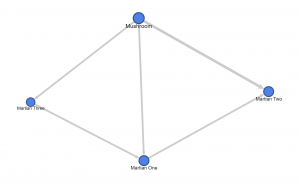
As expected, it seems as though the mushroom spoke the most (based on size of the dot) which makes sense because the mushroom was the primary one telling the history behind the land. What this data omits is the length of the conversation. For example, the martian may have just said one word but that is recorded in the data as if it spoke once so the visualization is skewed towards frequency of conversations but fails to display duration of conservation.
Using Google Fusion Tables was intimidating at first since I have never used it. But after seeing the tutorial and watching the video, I realized that it is actually very simple and I just need to create an excel sheet and upload it onto the Fusion Table and the chart would be generated.
Overall, I think this story was a very unique and interesting method to explain the horrors of colonization and mankind. The story also had a slight touch of humor which allows for some comedic breaks to this heavy topic. It was a very easy and enjoyable read and sheds light to the struggles of indigenous people after colonization. At the end, the martians decide to colonize Canada, and thus giving the colonizers a taste of their own medicine.
Hi Wanda,
I found your blog post very interesting and informative. Particularly, I found the same limitation with the use of Google Fusion Tables when analyzing the short story that I picked too, as the table failed to reflect inner monologues and the depth of the interaction between characters. Nonetheless, I believe that the table is a useful and interesting tool in identifying the frequency of interaction between characters. Keep up the good work!