The Every Animal Counts audit released by City Controller Ron Galperin which reflects that “the Los Angeles’ Department of Animal Services is making progress toward its goal of making Los Angeles a ‘No Kill’ City.” Although the results of the audit credit the city for the advancements made to prevent euthanization of animals in Los Angeles’ shelters, the description of the dataset does claim that “still, last year about one of every four lost or abandoned animals that entered the City’s shelters were euthanized.”
The dataset includes the shelter from which data was collected in the audit, the species of animal (dog, cat, rabbit, and others such as pocket pets and birds), the number of animals undergoing various shelter functions (number of animals placed in foster care, number of animals euthanized and number of animals live-released). The audit time period accounts for June 2014 and June 2015, to compare the numbers from both years.
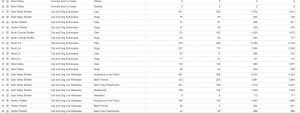
The dataset, itself, contains 485 rows and 7 columns, accounting for 7 content types, which show the shelter name, procedure, animal-type and the data of the number of animals in June 2014, June 2015, YTD Fiscal 14/15, and YTD 13/14. The number of animals are categorized by procedure, each procedure being listed one after another. For example, below is the data for the number of animals in shelters which were fostered, animals euthanized and animals released, listed after each other:
The ontology of this dataset seems to be the most applicable for a few organizations. This includes the City of Los Angeles in their efforts to become a “No Kill” City to evaluate the L.A. shelter system, the shelters involved who will be able to compare their numbers to that of other shelters so they will be able to adjust their procedures accordingly, and also for the potential adopters to become more involved and provide incentive for a campaign to increase adoptions of animals from shelters rather than buying.
The data does show that the euthanization numbers from 2014 have come down in 2015 comparing shelter to shelter; however, there is a lesser drop in euthanization rates in dogs than cats indicating that dogs in Los Angeles shelters still face the high rate of being “put down.” Also, the numbers indicate that there are several shelters in Los Angeles which have not reduced their numbers significantly in the last year from 2014 to 2015, and rather have increased the number of euthanized animals.
What can be concluded from this dataset, therefore, is that the rates of animals being adopted and fostered in Los Angeles has increased, and several shelters in L.A. do have lower rates of euthanasia in animals. Unfortunately, the fact that “last year about one of every four lost or abandoned animals that entered the City’s shelters [was] euthanized” still proves that, at least until 2015, changes needed to be made to push the city in the “No Kill” status direction. What we are missing, to have a better evaluation of the city’s current state, is current data from the time June 2016 and June 2017.
I really love how detailed this archive is. It truly allows us to understand how the rates of euthanization has changed over the years. I would love to see if this rate is going to continue as LA tries to strive towards its goal of being a kill free zone.
I like that you were professional in your critique of the dataset, but you still also expressed your opinion. It makes for a more interesting read and differentiates it from the rest of the blogs on the same dataset.
I love that this dataset was created because I think its astonishingly important to have these shelter animals be rescued and saved rather than be euthanized. Is it probable that the areas where the shelters that did not decrease their euthanization rates have more stray animals than other parts of the city? I think LA becoming a no kill city would be wonderful but can a city like Los Angeles with its sheer size and population become a no kill city?
Hi! This was a very detailed analysis on the ontology of this dataset! I did not come across this dataset myself, but I’m glad I was able to read about it through your blog post because I too believe the high rates of euthanized animals are a problem of which not many people are aware but should be.
What an interesting dataset to look at! I really liked your analysis on the ontology of this particular dataset, specifically on how the dataset leads you to the bigger picture of animal control in LA.
Wow, your blog is super detailed! I really like how you included a picture from the data set you were looking at. It makes it easily accessible without having to click onto a new link.
Hi,
Out of the blog posts that I’ve read, I think you’re one of the few that actually included a picture of the listing (something that I wish I did). Because of the image, it made it really clear on what points you were aiming towards.
This is a great post and its well delivered. Like the way you communicated the data for people to better understand what they’re looking at and what the info means.
This was really well-written! On topics such as animal rights, I find they can often lean to be a little emotional – which is fine, I’m all for emotions – but it could dissuade some readers. Like others have said, great job on delivering an informative piece that lays down the facts and data. It educates a concern, but doesn’t fear-monger
Hi,
I enjoyed reading your article a lot. I think you pointed out a crucial missing information: the current data from the time June 2016 and June 2017. Since it is unconventional for the government to stop collecting data without any public announcement, I think we should examine the reasons behind the absence of the current data.
I find the dataset sad and shocking. The data speaks for itself and shows how useful data can be in the campaign for animal welfare advocacy. This data is impactful and informative as to what further steps need to be taken.
I find this dataset particularly interesting and insightful. I agree that the number of euthanizations has not decreased very much according to the dataset. Even in one case, the number of euthanizations increased. At the East Valley Shelter, 71 cats were euthanized in 2014 and 102 were euthanized in 2015. I think although this dataset is very useful for animal lovers especially. The only problems I see with this dataset is that it is a little difficult to observe how the number of euthanizations has changed each year. Also, it would be more helpful to include data from years prior to 2014.