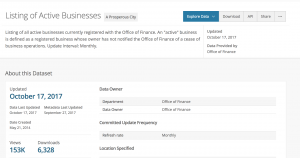
I have to admit that my title is a bit exaggerated: The listing of active businesses is indeed a comprehensive database composed of all the active business currently registered with the Office of Finance. However, different with the catalogs designed for retail customers, which categorize businesses with their services, this database is similar to a mailing list that contains mailing addresses and crucial geographic information.
Listing of Active Businesses was created on May 21, 2014, and has been updated by the Office of Finance every month since then. There are 153K views in total. There are sixteen columns in the dataset, which are Location Account #, Business Name, Doing Business As (DBA) Name, Street Address, City,Zip Code, Location Description, Mailing Address, Mailing City, Mailing Zip Code, NAICS (The self-reported North American Industry Classification System (NAICS) code), Primary NAICS Description, Council District, Location Start Date, Location End Date, Location (Latitude & Longitude). Thirteen of them are plain text, one of them is number, one of them is date & time, and one of them is location. Generally, this database is well organized and informative. The dataset claims to describe the distribution of a variety of businesses registered with the Office of Finance. Some businesses that are not in the city of LA might be included since the description of council district # states that “”0″ means the business location is out of the City. “Crucial information for retail customers such as services provided, business hours, store size, and price range are not included in the dataset. This implies that the dataset sees businesses as legal entities rather than weekend destinations.
Most of the categories are jargon for administrative purposes. For example, location account #, business name, DBA name, NAICS, and primary NAICS description are informative and useful for the office of finance to grasp a glimpse of the business activities in the area. Besides, the office of finance, as well as local city governments, can investigate the distribution of businesses in their areas through the council district column. This database is also for urban planning purposes, as urban designers can understand the occupancy of different areas through the mailing city, mailing zip codes, and the exact location. The information above would help urban designers estimate the conditions of various neighborhoods, thus evaluate the possibilities of new construction projects within specific districts. Moreover, the location start date and the location end date help real estate agents calculate the turnover rate of the commercial lands in different cities. With the turnover rate, they can be more accurate when matching up customers that have different budgets.
As I have mentioned, this dataset can potentially be the internal database used by real estate agents. In order to optimize the current dataset for them, several new columns could be added. Types of property, property size, as well as types of services provided should be included. These columns would enable agents to estimate the value of commercial lands or properties more precisely. The types of services provided would also speed up and improve the customer match process, thus assist agents to find the most suitable properties for their customers.
I also analyzed this same data set, but I love how you were able to categorize the data into types and also draw some interesting conclusions about who might use this data. I also considered that urban designers/planners would find use in the data, especially since it included some pretty specific data such as the coordinates of each business’ location on the map. I definitely think that with the addition of some of the data categories you mentioned, the data set would be of great assistance to commercial real estate agents in finding suitable properties for clients.
I will have to admit that your title drew me in as I was curious to learn more about Yelp for Real Estate Agents! I like the small image you included at the beginning of your post as it helps me visualize the dataset as I make my way through the post. The use of jargon in the categories do suggest that this dataset would be most beneficial to urban designers or city planners. With the additions you suggested, I can see how this could be a great tool for real estate agents!