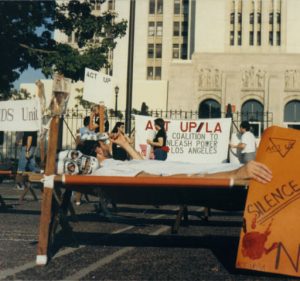
ACT UP/Los Angeles Records stands for the AIDS Coalition To Unleash Power/Los Angeles. Inspired by the ACT UP New York chapter, the organization was founded by activists in Los Angeles in 1987. The main focus of the organization is to improve AIDS healthcare services and networking with a broad coalition of progressive groups upheld the principle of non-violence. They have aimed to increase the accessibility of AIDS care to the minorities such as women and prisoners. The collection of ACT UP / Los Angeles records is available at the ONE National Gay and Lesbian Archives.
The records include buttons, clippings, correspondence, financial records, fliers, membership materials, minutes, newsletters, photographs, press releases, stickers, and topical files of ACT UP/LA from 1987-1995. The records are categorized into two parts: the Administrative Records Series and the Action and Events Series. The Administrative Record Series is composed of internal materials such as minutes, financial records, and press releases. There is also a limited amount of committee records such as proposed structural changes. The Actions and Events Series is composed of the materials documenting the activities of the ACT UP/Los Angeles Chapter. Primary materials like filers and secondary materials like photographs have recorded events such as protests, parades, and fundraisers.
Based on the materials, we might be able to tell the holistic history of ACT UP/Los Angeles through the organization’s perspective. With the rich collection of administrative documents, we would be able to construct the official history of ACT UP/Los Angeles, and more importantly to understand the rationale of each of their decisions. With the financial records, we would be able to trace its financial sources and analyze the most supportive donors during 1987-1995.
We could also present the events held by ACT UP/Los Angeles and the reaction of the society through the press release and the Actions and Events Series. As press release is a form of self-explanation, declaration, and doctrine to the public, the documents would provide us an indirect channel to learn about people’s general reaction, impression, and attitude towards the organization and its actions. We could also study the nature and format of the events organized by ACT UP/Los Angeles through the photographs.
However, the narrative would lack a humanized perspective. The official documents are the predominant source in the collection. Hence, a perspective of outsiders, composed of feelings and memories of individual participants, would complete the narrative. Even though official records are usually the most credible source, in order to tell an attractive and thorough story, narratives from unofficial sources, such as interviews with the participants, should also be included. To solve the disconnection between the official and the unofficial, we could use the membership records in the Administrative Record Series, and interview the members in the past. Through the interviews, we would be able to obtain a humanized perspective from unofficial sources.
Hello! I thought your point on the lack of humanized perspective from the collection is very interesting, and I agree! Archival collections seek to document and record human experiences in history. However, digitization of the records often eliminate or lessen the human aspects of these records.
You bring up an interesting point: “in order to tell an attractive and thorough story, narratives from unofficial sources . . . should also be included.” In what ways do you believe that technology can aid in obtaining these “unofficial sources”? I agree with you completely that bureaucratic documents can only tell so much about a moment in history, and that in order to complete the “picture” we must obtain information from a subjective point of view rather than merely from an objective point of view. I very much enjoyed reading your blog post!
To echo the thoughts of the other commenters, I also agree with your point that the official documents lack a human or more emotional perspective. In addition to holding interviews with not only organization leaders but also those who are infected or affected by HIV/AIDS, I think it would also be helpful to gather stories from blogs, diaries, opinion articles, or really anything that enables people to share more personal details and give greater insight into the history of ACT UP/Los Angeles and the HIV/AIDS crisis in general.
Hi,
I like your analysis of the database which is well-rounded and thoughtful. I agree that by examining these materials, one can understand the reasons behind each decisions made in the history and it is very important for studying the history and perspectives on ACT UP/Los Angeles. I like the idea that to ask for opinions from an outsider since the official records would be as objective as possible but not sensible in terms of people’s feelings.
Hello,
I definitely agree with your points on the lack of humanization associated with this archive. Especially acknowledging that ACT UP/LA is a very humanitarian organization it seems imperative that documentation collections reflect the realism and emotion involved. I felt this collection was very thorough in its administrative records though which was a nice positive thing.