“Robots Reading Vogue” is a publication sponsored by Yale University’s Digital Humanities department. For the first time in history, we have the capacity to mine and analyze thousands of datapoints from physical and digital publications. In this piece specifically, vogue becomes the center of attention as each published magazine is analyzed dating back from the 1900’s.

The data we are able to glean from this information is insurmountable. Because so much information is at our fingertips, the author of this post split up content into 10 core subdomains: ranging from algorithmically-generated internal memos (using speech patterns and keywords to recreate editor-specific notes) to statistics on student work, color uses, key words per year and publication, and more.
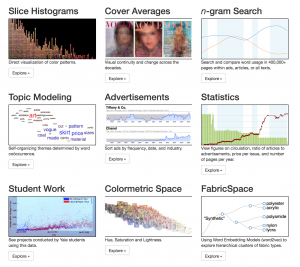
To begin, sourcing this project is extremely easy. Vogue Magazine is the only source of any data throughout the entire publication. However, it is also important to understand the depth and variety within the Vogue family when conceptually identifying sources. The sources specifically are individual magazine and digital publications from the early 1900’s to today, traversing multiple cultural advances, time periods, and managing editors. This means that although they all come from the same organization as a source, they vary greatly in terms of what influences might change the manner in which the magazine is presented accordingly.
Processing this information came between two forms: one for digital publications, and one for physical publications. For digital, it becomes much more streamlined to upload and analyze information within the confines of the magazine. For physical publications, however, the archives must be analyzed, scanned, and verified within every piece of information to ensure that all data is captured accurately. The details of this process were not immediately discussed, however, the millions of datapoints before online publications began in the 1980’s and beyond are still accounted for.
Bringing this information together from a non-academic source to draw academic conclusions is an oxymoron that fascinated me. More and more, I see the merit in studying the dynamics of cultural trends over time (especially accented by big data) to understand the way humanity continues to grow and evolve in the interaction with one another.
Good job, Adam, especially since you didn’t have a chance to discuss this in section!