The Mappa Mundi website is an interactive map which allows users to trace the various beliefs, myths, and legends held by Christian scholars during the thirteenth and fourteenth centuries.
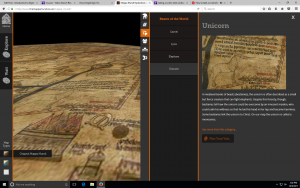
The main source for this display is the actual Mappa Mundi, which is currently housed at Hereford Cathedral. In order to process the map, scholars both digitally scanned and 3-D scanned the Mappa Mundi, and uploaded relevant information for multiple points on the map. Finally, the presentation is done in the form of a digital map. Upon entering the site, the user is given the option of seeing one of three maps: the original, the color enhanced, and the 3-D scanned.
Altogether I found that the way the data was processed and presented made it very easy for the user to explore the map. Furthermore, the option of seeing the map in three different ways also draws in the user. Additionally, the use of 3-D scanning brings out many primary details about the source which would have otherwise been lost. 3-D scanning allowed researchers to see details about the map, such as the type of animal skin used to make the map, or the repairs that were done to the map over the years. 3-D scanning also reveals more philosophical and ideological beliefs. One such example can be seen in the tiny hole placed in the center of Jerusalem, which was revealed through the 3-D scan. The hole signals the center of the circumferences of both Jerusalem and the rest of the world. The placement of the hole in Jerusalem and the reference to Jerusalem as the center of the world show how significant the city was in the Christian framework and worldview.
Personally, I found the variety of worldviews found in the Mappa Mundi to be very interesting. Biblical stories are found side by side with Greek myths and legends. For example, one of the legends featured is that of the Labyrinth in Crete which contained the Minotaur, half-man and half-bull. Researchers then go on to show how the symbol of the labyrinth was used in many medieval cathedrals, symbolizing the unique blend between Greek mythology and Christian ideology. Notable animals and people are also featured on the map, along with several historically significant cities, such as Rome and Jerusalem. Together, these stories and beliefs create a map which is based on Christian views, but heavily influenced and complemented through Greek and other ancient literary myths and legends.
I really liked how you described the Mappa Mundi website! For someone who hasn’t fully analyzed the website, your reverse engineer for Mappa Mundi was very concise and informative. I also agree with you on how interesting the site is for their myths and legends.
Hi Jonathan,
I liked your analysis on the 3D scanning processing step and how it helped to convey meanings of the artifact in a more interactive and extensive way. You also brought up an interesting point that the map helps us trace the beliefs and myths and offers various world views which I agree with you.
Hey!
I liked how you give a very informative, but concise summary of what the background is and the significance of the data. I also enjoyed how you went into how the various presentation techniques show what the authors found. Good work!