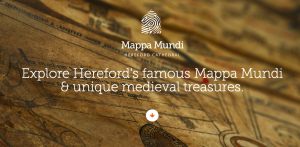
The Mappa Mundi project includes a digital exhibition of the three pieces of artifact that are contained in the Hereford Cathedral – the Mappa Mundi, the Chained Library, and the Magna Carta 1217. It brought the three pieces of artifact to life online and presented them in a smart and informing way. Not only does the project functions as a thorough introduction of the artifacts, but it also attracts tourists who want to learn more about them to actually visit the Hereford Cathedral.
The sources of the project are the three artifacts respectively.
- The Mappa Mundi is a map that is believed to be made around the year 1300. It shows thehistory, geography and destiny of humanity as it was understood in Christian Europe in the late thirteenth and early fourteenth centuries. It is measured 5’2″ by 4’4″ and is constructed on a sheet of calf skin.
- The Hereford Cathedral Chained Library is the largest surviving chained library in the world. In the early seventeenth century, chained libraries could be found in universities and cathedrals, but this is the only one still to be chained. It contains about 1,500 books, dating from around 800AD to the early nineteenth century, including 227 medieval manuscript books. The books are still read by scholars who come from all over the world to study them.
- The Great Charter of Liberties or ‘Magna Carta‘ agreed between King John and his barons at Runnymede near Windsor in 1215 is one of the most famous documents in history. It is considered the foundation of English common law and much of its worldwide importance lies in the interpretation of the clauses from which grew the right of the freedom of the individual.
The processing of these sources varied depending on which artifact is being processed. The Mappa Mundi is processed by creating 3D visualization through 3D scanning techniques. Different metadata was gathered such as the information about the canvas material and the pigmenting, in order to gain a deeper insights of the artifact. An inclusive narrative is created based on the source and the metadata. The Chained Library and the Magna Carta are processed mostly by creating narratives and present them in a chronologically organized way.
The presentations of these sources are also different from each other due to the different nature of the artifacts. The Mappa Mundi project is presented mainly through the 3D visualization created through scanning. Upon the visualization of the artifact, an interactive map layer is created so that interactive narratives can be presented in a much accessible way. The map is created in a sense of highlighting significant points of the original map, and guiding the users to understand the meaning and connections among them. For the Chained Library and the Magna Carta, 2D visualizations were created, such as pictures of the images and pages from the artifacts, in order to to build stronger ties between the narratives and the primary sources.
You bring up a great point in your introduction of the Mappa Mundi Project. Some people may find these virtual tours as projects for users to learn about places without leaving the comfort of their home. However, you bring up that this project can also be used to check out the attraction to gauge whether they want to visit the actual Hereford Cathedral. This project creates a great foundation for potential tourists to virtually see the artifacts and plan accordingly. This also makes me think that users who may stumble across this project and interact with it more may become so interested that they would want to visit it in real life. From my own experience, seeing historical artifacts in real life brings about another level of amazement; however digital humanities projects like this come very close to the same level of excitement.