The site I have chosen to reverse engineer is The Walt Whitman Archive. It is a comprehensive multimedia resource that documents a vast amount of work by Walt Whitman, a famous American writer. The site is run by two university professors, Kenneth Price and Ed Folsom.
The sources of information for this project are mainly Walt Whitman’s work, as well as what others have written about him and his work. His work encompasses fiction, poetry, writing for periodicals, as well as his correspondence with others.
To obtain such work, the creators examined extensive archives and manuscripts from repositories and private collectors. They obtained book copies from library and personal collections, such as the Special Collections Library of the University of Virginia. They also referred to newspapers Whitman wrote for. To obtain copies of his poetry and prose, they similarly went through manuscripts from repositories.
The creators also acquired writings about Whitman and his work. For instance, to obtain modern reviews, the creators used a book entitled “Walt Whitman: The Contemporary Reviews.” For their “Selected Criticism” section, they sourced more than 20 books. They also gathered more than 90 articles written about Whitman in news publications.
The website also features visual and auditory media. These include pictures of Whitman, and recorded readings of Whitman’s work by individuals like Eric Forsythe.
In processing Whitman’s work, Whitman Archive Objects were used to organise work into different units. Agreement was gotten from publishing companies or presses to digitize various books about Whitman. Transcription of documents was carried out so they could be displayed online.
To make images digitally viewable, the site’s creators did colour scans of manuscripts. Where scanning was not possible, they photographed images. These media were resized and refined for web display.
Extensible Markup Language (XML) was used to encode the text-based components of the project, while the METS schema was used to capture metadata. PHP was used to display information within the site’s database, so entries could be arranged and analysed by criteria such as author and year. While different processing standards were used for various works, such as notebooks and fiction, Whitman Encoding Guidelines were established to standardise encoding methods to a certain extent.
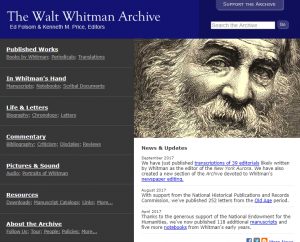
This project is presented as an interactive website. The website contains text, links, as well as pictures and audio. It is organised into different sections like “Published Works,” “Commentary” and “Pictures & Sound.” Each section also contains sub-categories, such as “Selected Criticism” and “Bibliography” in the “Commentary” section. The presentation features mentioned so far allow readers to zoom in on certain areas of interest. A brief site tour is also included to guide readers through navigating the archive.
There is also a search function at the top of every page so people can directly access information they want. Manuscripts and other information sources like notebooks are all searchable, with date ranges included so users can view works chronologically, or concentrate on works from a certain time period.
Hi Rebecca,
You did a great job in breaking down the site. It was interesting for me to read your blog because I choose the same site, but we had slightly different responses for the organization and presentation. It was helpful to learn from your point of view. However, I wish your blog post had your own voice in it. It made for a nice summary, but I wanted your thoughts on the site.