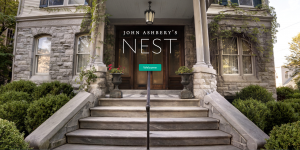
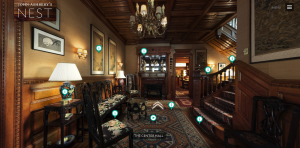
This week, I examined John Ashbery’s Nest. It is an incredible website full of interactive components. Basically, this project allows you to tour Ashbery’s home and then click through certain points in the house. For example, if you click on the paintings, it tells the user that we are looking at Hiroshige and Hokusai images, allows us to look at more similar images, and has a voice recording of John Ashbery reading an excerpt of “37 Haiku” from A Wave. I think the most impressive part of this project is how “real” the house feels even though it is a virtual tour.
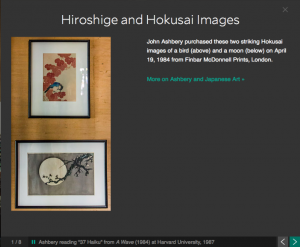
As for sources, we learned in lecture that sources are the raw materials. It’s the basic “stuff” the project is trying to tell you about. In this case, it’s John Ashbery’s actual house that is the source. I guess you can take it a step further and say that the artifacts within Ashbery’s house are also sources for example the Hiroshige and Hokusai images (see image left), the royal teplitz candelabras, the Korean chest and the Persian bowl, etc.
Second is processing. It is getting the “thing” you are studying into a computer that can then be analyzable. Essentially, it is getting something into digital form. In order to take the source, Ashbery’s house, and put it into digital form, they used 360 degree video. To get 360 video, you have to use cameras to record all 360 degrees at the same time, or you have to take separate shots and stitch them together. By using video, they are turning a live object into a digital one. In addition, they took the source of John Ashbery himself and made him digital by recording his voice explaining certain things in his house. This to me is one of the most interesting aspects of this project because he tells users the story behind the extravagant things in his house. It makes it feel like you aren’t just looking at his home, but also getting the inside scoop and learning more about him as a person.
Lastly is presentation. The presentation is the thing you actually encounter- it is the interactive, and searchable part of your project. In this case, it is presented in a form of a website from Yale’s Digital Humanities Library. Because it is a website, it is easily accessible to all who have internet. Overall, I really appreciated this digital humanities project and it made me rethink what sources can actually be made digitized and presented.
You mention a lot of details that resonate with me in your breakdown of John Ashbery’s Nest. I love how you bring up how “real” the house feels because this is the beauty of digital humanities projects: the ability to make the reader feel as if they are getting the most engaging experience even if it is through a virtual screen. The factor that breaks away from the “realness” of a tour is the interactive icons that the reader can click on to learn more about the item. Of course we do not have these learning devices in real life, but in this virtual tour they are able to enhance your engagement and understanding of the project. You also mention how the artifacts indeed are also primary sources for this project. These artifacts that are a part of the final presentation visually are also sources that researchers used to analyze and create this final project.
This blog post was very easy to read and understand and I liked how you linked to the website you referred to so I could easily navigate to what you were talking about.