The project I looked at for this week’s assignment was the “Mappa Mundi”. To visit the project’s website, you can either click on the link (https://www.themappamundi.co.uk/index.php) or the photo below.
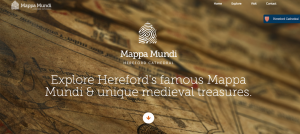
The Mappa Mundi project is based on the Hereford Mappa Mundi, housed in the Hereford Cathedral. This map is considered to be a very important historical artifact, as it provides insight into the historical and geographical perspective of the world as viewed from European Christians in 1300. As someone who took a class on the history of Jerusalem, this project was very interesting to me because of the location of Jerusalem in the centre of the map, reflecting the sanctity of Jerusalem to medieval Christians.
I reverse engineered the Mappa Mundi into its sources, processing, and presentation, in order to break down and analyse this project.
Firstly, I started looking on the website for the raw materials used. For this project, the primary source used was the Mappa Mundi artifact, a 1.59 by 1.34 metres sheet of vellum. Another source used for the website was the Magna Carta 1217, a document which is considered an important foundation of English Law. Throughout the website, several pictures of the Hereford Cathedral, the Mappa Mundi and the Hereford Cathedral Chained Library were also used.
There were several forms of processing that were conducted on the Mappa Mundi. First of all there was a digital scan and colour enhancement reproduction of the map done by the Folio Society. Additionally, there was a 3D scan done by Factum Arte, which used a laser scanner and 2 video camera to convert the visual information into 3D data.This allows researchers and the general audience to not only view the visual information displayed on the map, but also to look at the indentations to analyse how people interacted with this document in the past.
For the presentation aspect of this project, the Mappa Mundi is presented on its website as a digital, interactive map, where viewers are able to click on different parts of the map to explore it further. The information also links to other relevant locations/ symbols within the same category. The virtual Mappa Mundi has the ability to be viewed on the website in its original form, a colour enhanced form, and a 3D scan form.
After breaking down this project, I was really amazed how the Mappa Mundi was able to be transformed into a much more easily accessible format. Initially, I found the map to be quite overwhelming to look at due to the abundance of visual information that was displayed on it, and I think this virtual map can help us take a closer look into some of the smaller details of the map, which may not have been noticed if we simply looked at the original raw version of the map.
This is a really well put together blog post! I liked how much detail you went into and Mappa Mundi seems like it was easily accessible and contained a lot of information. Some of your opinions based on the visual informational part i would have to agree with. But overall i really enjoyed reading your blog!
Good job!
Hi!
It’s interesting that you chose to examine this project despite how you found it quite overwhelming because of the visual information on it. I shared the same sentiments, which is why I chose to look at a different project! Although the website was easy to navigate, I was intimidated by all the information and options made available to users. That being said, I found your explanation of the project straightforward and understandable. I also liked how you connected your explanation for choosing this project to your experiences in another class!