In his essay, “’So the Colors Cover the Wires:’ Interface, Aesthetics, and Usability” Matthew Kirschenbaum argues that today many users think of computer-aided interactivity in binary terms through the separation of application and appearance. According to Brena Laurel, the interface is what humans “talk” with, it is the thing that mediates humans and the inner workings of the machine. Although Laurel was arguing against this prevailing viewpoint, Kirschenbaum reminds readers that interfaces are both conceptually and computationally distinct from the applications they allow users to navigate.
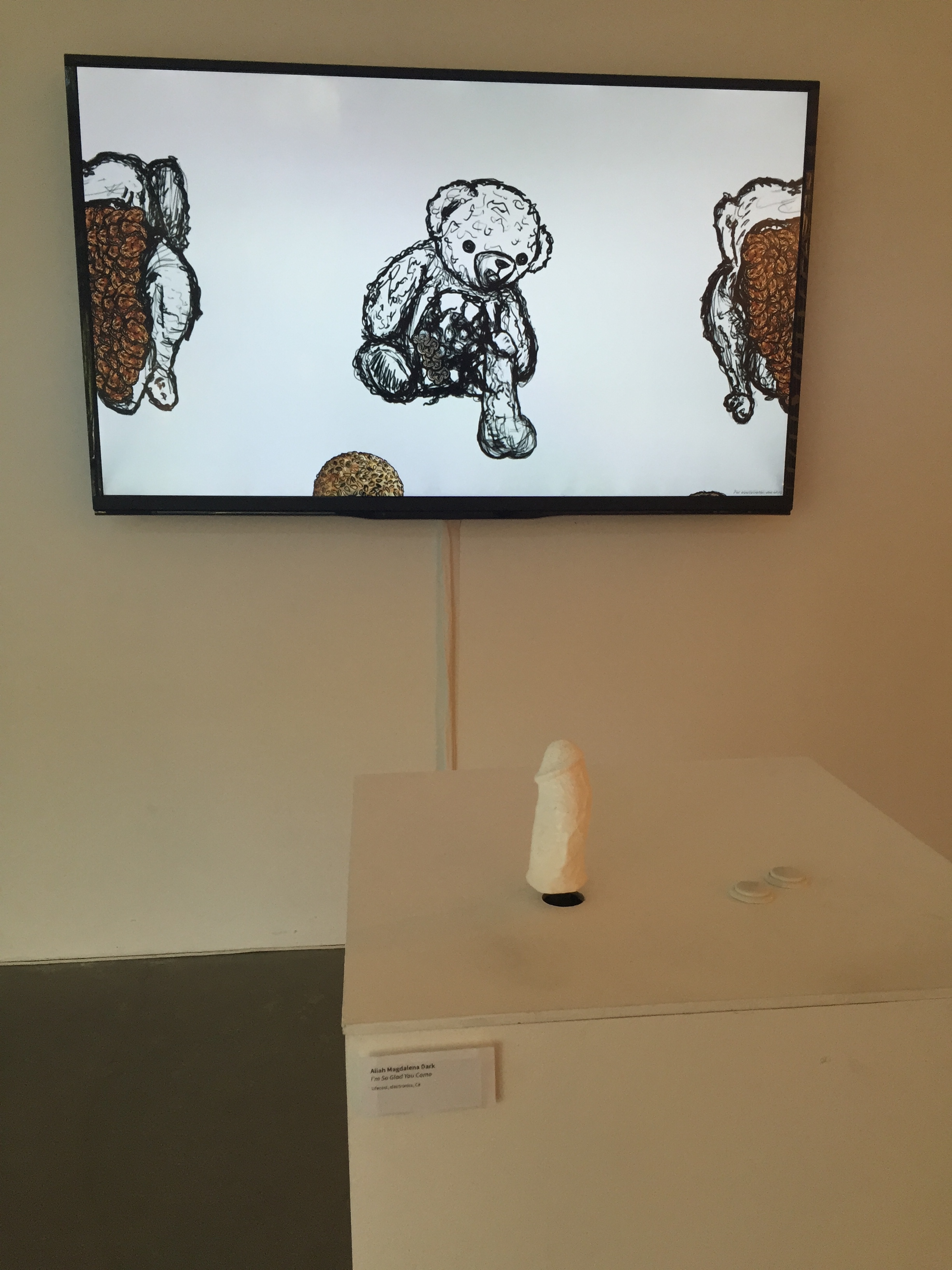 Aliah Magdalena Dark’s “I’m So Glad You Came,” at the 2014 MFA exhibition.
In line with this view, I was reminded of a work of art I saw at this year’s DMA MFA exhibition, “.CALM.” If user interfaces are traditionally thought of as the medium through which an observer or user navigates a physical or digital environment, what happens when that medium becomes a piece of the application itself? The piece by Aliah Magdalena Dark, entitled “I’m So Glad You Came” invites observers to control the digital space on the screen by touching what appears to be a ceramic penis and pushing two white circular buttons to the right of the object. As the user becomes more comfortable with the idea of using this phallic object to navigate the space in front of them, it becomes clear that the ceramic penis in the interface is actually translated on to the monitor, and the buttons produce sperm, which “fill up” a variety of different objects on the screen. Regardless of the artist’s intended message, the piece brings up an interesting question of using interfaces design directly as an artistic component with the application or artwork itself. I think part of the reason which makes Dark’s piece so fascinating is the fact that application and appearance are blurred.
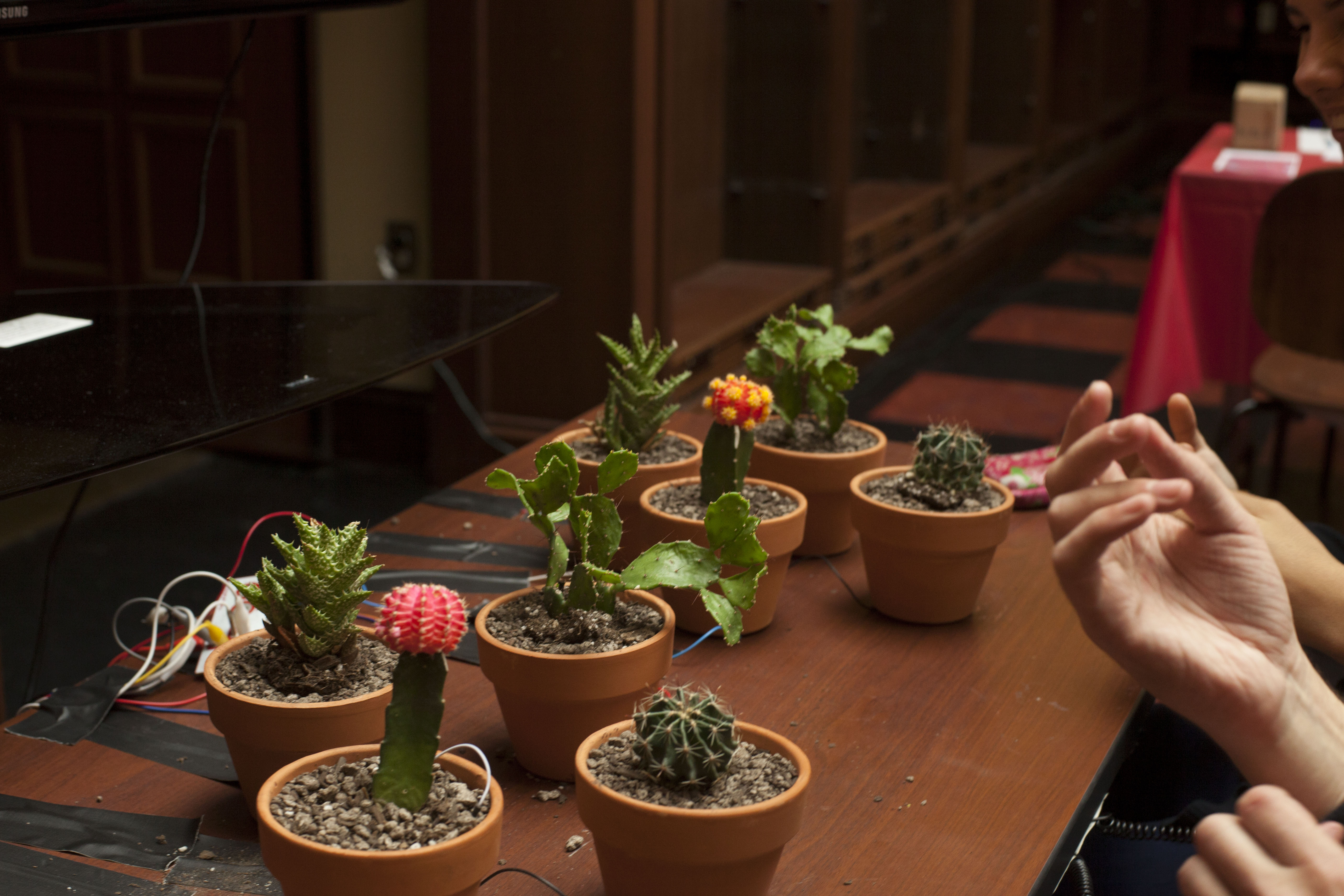 “Sneaky Cactus, Cactical Espionage,”at the 2014 International Games Day in Powell Library.
Another similar piece of interactive artwork reminded me of the possibility of artistic overlap between the interface and the application at the 2014 International Games Day at Powell Library entitled “Sneaky Cactus, Cactical Espionage.” This game requires that the player use actual cacti to navigate the virtual environment. As I was taking photos I watched numerous participants touch their fingers, seemingly worried about getting needles stuck in their palms. I think this game raises wonderful questions about the very nature of tactility in interfaces.
Dark’s piece and the Sneaky Cactus game take Kirschenbaum’s view that “computers compute, of course, but computers today, from most users’ points of view, are not so much engines of computation as venues for representation,” a step further by expanding the “venue of representation” to include the user interface.