Near the end of summer vacation, before I arrived back at UCLA for the start of the fall quarter, I was spending some time at home with my parents. It was probably about three or four in the afternoon, when my dad stepped outside on our patio to start grilling his dinner. Suddenly a very familiar smell flooded our living room—it smelled like a fire.
For those of you who have never experienced a summer wildfire first hand, its smell is very distinct. It’s different from a campfire or a fireplace in the winter. I stepped outside and saw bits of ash reigning down as Cal Fire planes started to fly by overhead and breathed in the heavy, hot air.
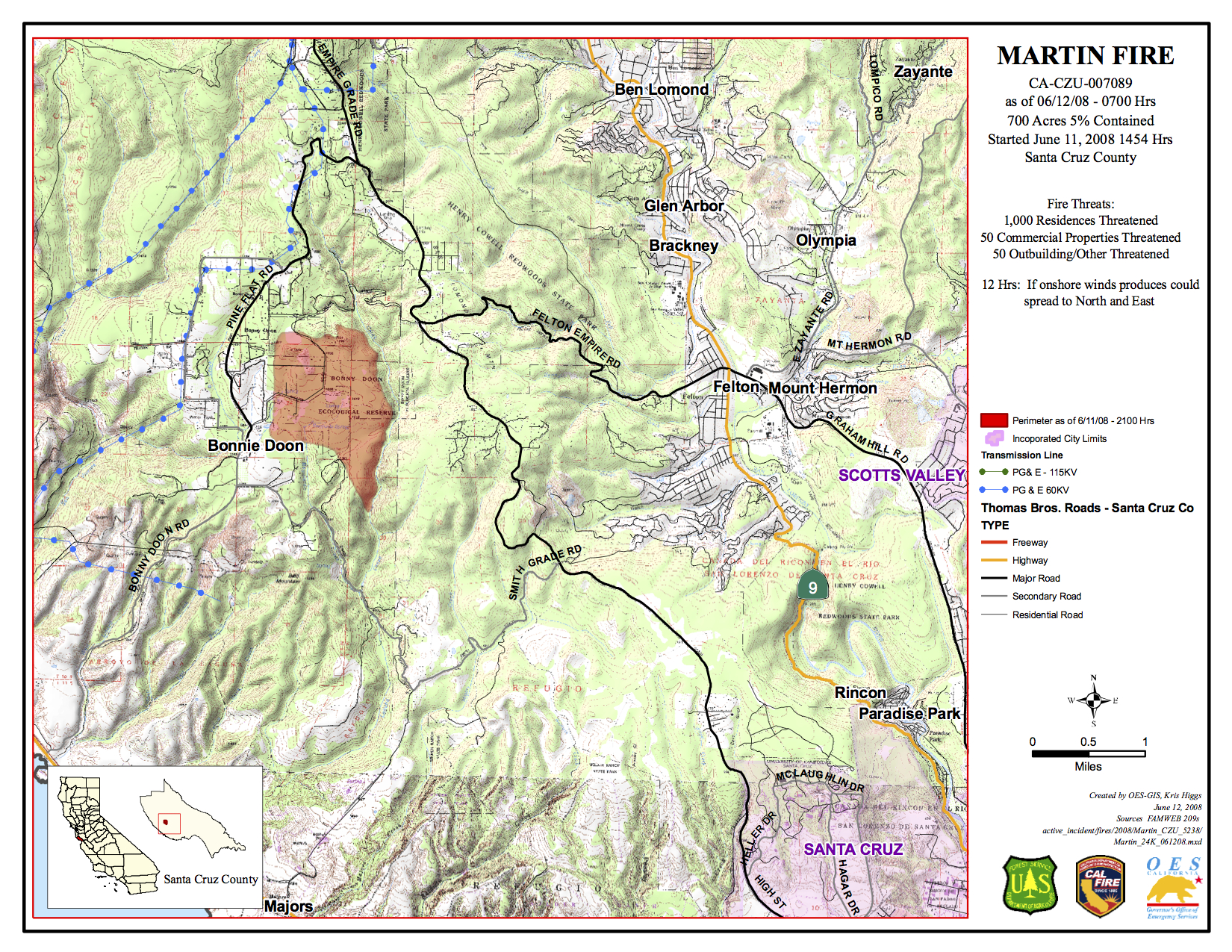
This scene was all-to-familiar to me, because in 2008 my house actually did burn down because of the Martin Fire (named after the road I live on). My house is situated up in the mountains, about a 20-minute drive from UCSC in Santa Cruz, California.
The reason I’m bringing all this up in this week’s posting is because the very first thing I did after I realized what might be going on was jump on Cal Fire’s Incident Information page in order to view their California Statewide Fire Map. In his article regarding the history and basics of web mapping, Jim Detwiler explains how dynamically-created web maps “are generated on the fly when the user loads the associated web page.” Cal Fire’s incident map should be considered a dynamic map because of the “real-time” updates it provides its viewers about fires currently burning in the state of California.
However, back in September when I was hurriedly searching their page to find information about a fire that was clearly happening only a few miles away from me at most, I found nothing about it. This is an interesting example about how in many ways, the data presented on dynamic maps or other online information repositories should perhaps be approached from more often a more “digitally humanistic” vantage point of awareness and interpretation. Just because a visualization is put up online and supported by a government website does not give it total authority or accuracy.
Because we couldn’t find any news at the time online, my parents decided to drive down the street and see if they could find any information about what was happening. About half an hour later they returned and told me that there was an electrical shortage about 3 miles down the road, which sparked the fire. Luckily, Cal Fire crews responded within 20 or 30 minutes of the outbreak and the fire was so small it didn’t spread more than a few acres. I tried searching again for the incident while writing this post, and I still couldn’t find anything about this fire online.
I think this is a great example of how we as digital humanists need to remain critical of all data that claims to be concrete or total in any way. Regardless of any certainty that is claimed, I think interpretation is crucial, because the majority of the time there’s probably some piece of information that’s missing.