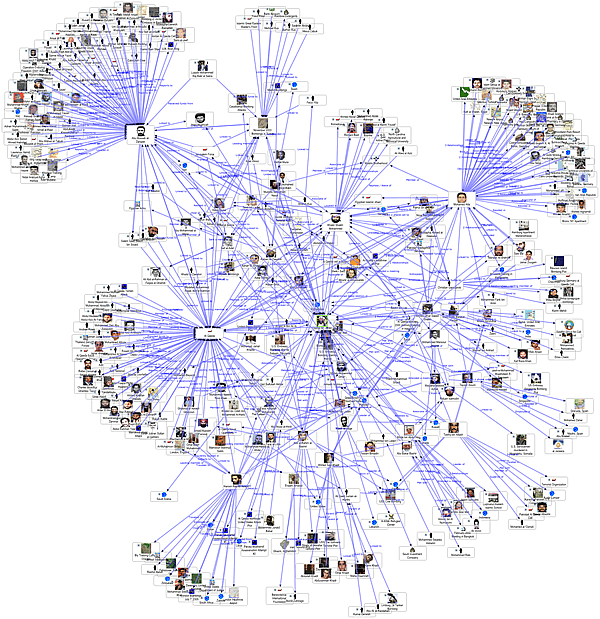
This week’s readings got me interested in the science behind social network analysis. Network theory involves nodes, which represent individuals within the network, along with ties, which show the various ways these individuals come together. This could be through a number of factors, including friendships, organizations, hobbies, and other topics of that nature. A social network diagram shows nodes represented by points, and ties as lines. Social network analysis has been able to provide a mathematical way of analyzing human relationships. For example, management consultants have implemented it with their business clients for what they call Organizational Network Analysis. Scott Weingart’s blog post “Demystifying Networks” looks at how networks are being created so frequently that it’s difficult to keep up with the network’s true meaning. His definition of network as “a net-like arrangement of threads and wire” gives an easy visualization to what is actually a complicated subject. His use of authors and books set a simple stage for me before diving into wide array of social network analysis topics.

While typing in “social network analysis of…” on Google, the first auto fill options were “…terrorist organizations in India, …Alice and Wonderland, …a criminal hacker community.” I didn’t know where to start; all the options seemed equally obscure but attention grabbing. After looking through a few of these various, unorthodox topics that could be studied through social network analysis, I stumbled across, “The Application of Social Network Analysis to Team Sports,” by Dean Lusher. The study allowed for the simultaneous examination of social relations with the individual-level qualities from members of the team. By incorporating a range of attitudes, behaviors, along with other individual-level attributions, an examination was reached on how these may affect and be affected by team structures. Players were asked whom they considered friends on their team along with whom they saw as the most influential. After, they were asked who they viewed as the ‘best’ player on the team, and anyone who received more than five notes was denoted with a black node. The image above shows how the ‘best’ players on a team formed their own group that was connected, but still separate from the other white nodes. This illustration shows two social networks (friendship and influence) coupled with an individual-level attribute (playing ability). It was interesting to see a digital angle applied to this very human subject.