The City Budget Expenditures data consisted of financial data shown by the budget fiscal year since 2012. It includes the Los Angeles City Budget, Adjustments and Expenditures as the LA City Controller has documented. Its data types are the Budget Fiscal Year, Department Name, Fund Name, Account Name, Adopted Budget, Total Expenditure, Budget Change Amount, Budget Transfer In Amount (increase in appropriation to account by transfer in of funds), Budget Transfer Out Amount (decrease in appropriation to account by transfer out of funds), Total Budget (appropriation account amount net of changes and transfers to/from the original budgeted amount), Encumbrance Amount (obligation or commitment to pay for a good or service), Pre-Encumbrance Amount (Anticipated obligation or commitment to pay for a good or service), Budget Uncommitted Amount (Total unused appropriation after expenditures and encumbrances), Account Group Name, Fund, Account and Department Number. Then, for all the budget information, there is a total section that includes the total money spent for each of the budget categories. A record in this dataset is each expenditure a department makes and the changes that they make to their budgets. This is important in seeing how they allocate and spend the funds provided by the city of Los Angeles and taxpayers’ money.
Wallack and Srinivasan’s definition of ontology clearly indicates that it is “systems of categories and their interrelations” (Wallack and Srinivasan, pg.1) that people use to deal with information and understand the world around them. This dataset’s ontology creates an understanding of the money that is used by the city of Los Angeles based on budgets that are set. It means more transparency of government funds which allows for trust and hopefully ethical and honest expenditures. The taxpayers and residents of Los Angeles would find this data most useful and illuminating. However, I also believe that this data would be helpful for each department’s accounting team and the LA Controller to prepare and keep track of the budgets for that year and the following years.
The dataset can tell us a lot about where our money goes and how it is generally used. Most of the funds go towards resources for the elderly, neighborhood empowerment/ neighborhood councils, administration, salaries, among other things. It also shows that amending budgets based on certain expenditures and re-allocating money is proper procedure as long as each transaction is noted and correct. The way in which the information is provided and the options available, allow for the viewer to interact with the data. There are different tools and ways of looking at the data (visuals), you are able to filter through the data to find something in particular, you can export the information and you can also make comments to discuss with others viewers.
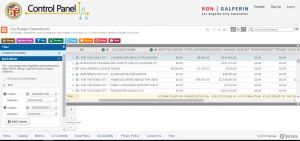
As far as I can tell, the amounts and expenditures that they list are grouped expending greater amounts ranging between hundreds to thousands of dollars. This means the data that is left out are probably small expenditures that either get grouped into a record or noted in some other way.
If I were to start over with data-collection with a completely different ontology, I would start by using different data types. I would take into account the justifications for certain expenses and be more specific on certain charges, especially for generic expenditures like: travel, transportation, etc. I would also include a section for the aspect that it would pertain to most: health, education, well-being, administration, etc. I think people would appreciate knowing and sorting through these more broad categories for how money is spent It can also give a more general idea of the expenditure areas.